Slavic Pantheon
Svarozhich
Zuarasici (Latinized by Thietmar)(Svarožičŭ)
Also known as Radogost, Redigast
- fire
- war
- divination
The chief god of the West Slavic Redarii, worshipped at a temple in Riedegost and consulted before war through the movements of a sacred horse and lots, known from a German bishop's firsthand account.
About Svarozhich
Attestation
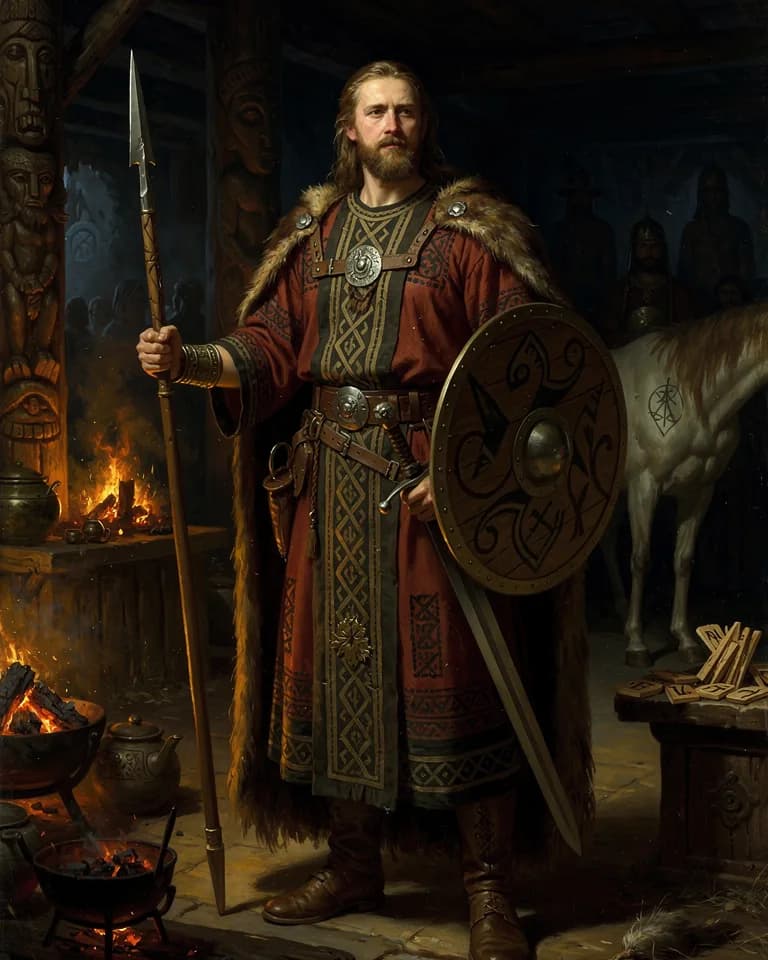
Thietmar of Merseburg, a German bishop writing his Chronicon in the years before his death in 1018, gives the fullest surviving account of a Slavic pagan temple: a shrine at Riedegost (in the land of the Redarii, part of the Lutici confederation) housing several carved gods, chief among them one he calls Zuarasici, understood by most scholars as a Latinization of Svarozhich, "son of Svarog." Thietmar describes the Redarii consulting this shrine before going to war, using a horse led over crossed spears and reading its steps as an omen. Writing half a century later, Adam of Bremen names the principal god of what appears to be the same or a closely related site "Redigast" (Radogost), leaving it debated among historians whether Svarozhich/Zuarasici and Radogost/Redigast were the same figure under two names, two distinct gods at related sites, or a case of one chronicler confusing a god's name with the name of the town or temple itself.
Fire and the patronymic problem
The name's "son of Svarog" form has led some scholars to treat Svarozhich as functionally close to Dazhbog (also called "son of Svarog" in the East Slavic tradition), especially given a shared fire association; others read Svarozhich as an independent West Slavic war-and-fire god whose patronymic name need not imply the same theology as the unrelated East Slavic Hypatian gloss. This site treats the connection to Svarog as likely but not proven.
Worship and cult
Temples, festivals, and practices recorded for Svarozhich
Consulted before military campaigns: Thietmar describes a sacred horse led over crossed spears at the shrine, its steps read as a favorable or unfavorable sign, alongside the casting of lots.
Sacred sites
- The shrine at Riedegost, described by Thietmar as a wooden building carved with images of gods and hung with the horns and weapons of victims and offerings.
Family
Family tree
Svarozhich's parents, consorts, children and rivals, as recorded in the atlas.
Sources and further reading
Source notes
These references are recorded in the catalog. Their passage wording and translation have not been checked, so quotations are not displayed here.
- Thietmar of Merseburg, Chronicon, Book VI (paraphrase)
Cite this page
No publication date is recorded for this page, so each citation uses n.d. and today's date as the access date.
About this entry
By Elizabeth Stein for Mythos Atlas. About the author. Editorial notes are grounded in the site's cited sources and can be challenged through the contact page.
Parallels are editorial comparisons across traditions: a shared role does not, by itself, establish a shared origin.
Family relationships come from the atlas's kinship records. Ancient sources often disagree on divine genealogy.
Keep exploring
One myth a week, with its sources in a short email. The sign-up form is at the foot of the page.