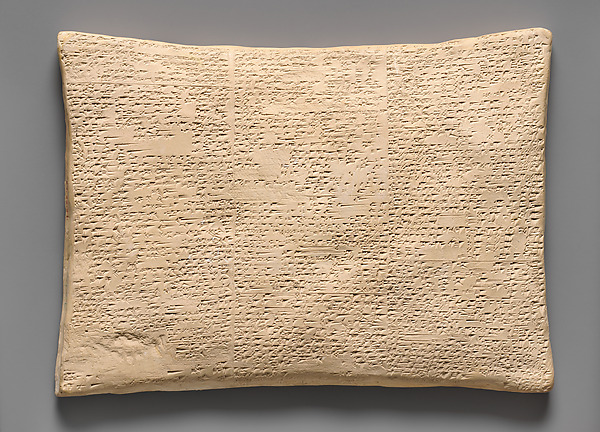
Cast reconstruction of Babylonian Flood Tablet, The Metropolitan Museum of Art
Mesopotamian pantheon
Utnapishtim
𒌓𒍣(Uta-napishti)
Also known as: Uta-napishti, Ziusudra (Sumerian version), Atrahasis (in the Atrahasis epic)
the Great Flood
the sole grant of immortality among mortals
A mortal king of Shuruppak, not a god, who survived the great Mesopotamian flood by building a boat on the god Ea's secret warning. Utnapishtim and his wife were granted immortality as a singular, unrepeatable exception, and Gilgamesh's failed quest to learn this secret from him forms the climax of the Epic of Gilgamesh.
Utnapishtim is explicitly a human being in Mesopotamian tradition, a king of the city of Shuruppak, not a deity. His singular status as the one mortal ever granted eternal life makes him the central figure Gilgamesh seeks out at the end of his own quest to escape death, recorded in Tablet XI of the Standard Babylonian Epic of Gilgamesh, sometimes called "the Flood Tablet."
Warned of the Flood
The great gods, angered by the noise and unruliness of humanity, resolved through the god Enlil to destroy it with a flood. Ea (called Enki in the Sumerian tradition), who had sworn not to reveal the gods' plan directly, spoke instead to the reed wall of Utnapishtim's house, allowing Utnapishtim to overhear the warning. Following Ea's instructions, Utnapishtim built a great cubic boat, sealed it with pitch, and loaded it with his family, craftsmen, and the seed of every living creature.
The Flood and Its Aftermath
The flood raged for six days and seven nights before subsiding, and Utnapishtim's boat came to rest on the mountain of Nimush (also transliterated Nisir). He released a dove, then a swallow, both of which returned, and finally a raven, which did not return, confirming that land had reappeared — a sequence often compared by scholars to the later biblical account of Noah, though the two should be treated as related but independent literary traditions rather than identical. Utnapishtim then offered sacrifice, around which the hungry gods, deprived of offerings during the flood, gathered "like flies." Enlil, furious that a mortal had survived his flood, was persuaded by Ea that his punishment had been excessive, and in recompense granted Utnapishtim and his wife eternal life, settling them at "the mouth of the rivers, faraway," beyond the reach of ordinary humanity.
Gilgamesh's Failed Quest
When Gilgamesh reaches Utnapishtim seeking the secret of immortality, Utnapishtim first tests him with a challenge to stay awake for six days and seven nights, which Gilgamesh fails almost immediately, falling asleep. Taking pity, Utnapishtim's wife urges her husband to tell Gilgamesh of a rejuvenating plant growing at the bottom of the sea. Gilgamesh retrieves it, only to lose it to a serpent while bathing on the journey home, a final, decisive loss that leaves Gilgamesh to accept his mortality and return to Uruk empty-handed but wiser.
Origin Story
Utnapishtim was a mortal king of Shuruppak, warned by the god Ea of the gods' plan to destroy humanity with a great flood. Building a boat and preserving his family and the seed of every living creature, he survived the flood, and the god Enlil, though initially furious a mortal had escaped his design, granted Utnapishtim and his wife immortality as a singular, unrepeatable exception.
Source Notes
These records lack edition and translator details. Their wording has not been verified as a direct quotation.
Tear down the house, build a boat! Abandon riches and seek survival! Spurn property, save life! Take on board the boat all living things' seed!
The gods crowded like flies about the sacrificer.
Ancient Texts
Epic of Gilgamesh by Sin-leqi-unninni (standard version)
c. 2100 BCE (earliest versions)·Akkadian/Sumerian
Tablet XI is the primary source for Utnapishtim's flood story and his encounter with Gilgamesh
Recommended translations:N.K. Sandars (1960), Andrew George (1999)
Places the flood narrative within the wider context of Mesopotamian literature
References & further reading
Editorial notes for deeper study (not a full bibliography).
George, Andrew (trans.). *The Epic of Gilgamesh* (Penguin Classics, 1999) — standard modern scholarly translation.
Sandars, N. K. (trans.). *The Epic of Gilgamesh* (Penguin Classics, 1960, rev. 1972) — earlier widely read translation.
Browse representative texts and policies on the Sources page.
Worship & Cult
How Utnapishtim was venerated in ancient times
Sacred Temples
•No attested cult site; Utnapishtim was not worshipped as a god
Worship Practices
Utnapishtim received no cult and was not an object of worship; his significance is entirely literary, as the sole mortal granted the immortality that Gilgamesh, and by extension every human reader, ultimately cannot obtain.
Domains
the Great Flood
the sole grant of immortality among mortals
Symbols
the great boat (the Ark)
the plant of rejuvenation
In the museums
Utnapishtim in art
Real objects in public collections, released into the public domain by the museums that hold them. Dates refer to when each object was made. Objects made within the tradition come first, later depictions after.
Mesopotamian · 19th century, after 7th century BCE original · Plaster
A nineteenth-century plaster cast reproducing the Babylonian Flood Tablet, the Gilgamesh Epic tablet in which Utnapishtim recounts surviving the great flood. The cast documents how the deciphered tablet circulated among museums after its 1872 translation, not an ancient depiction of Utnapishtim himself.