Persian (Iranian) TraditionHero
Rostam
Also known as Rustam, Rostam-e Dastan, Tahamtan
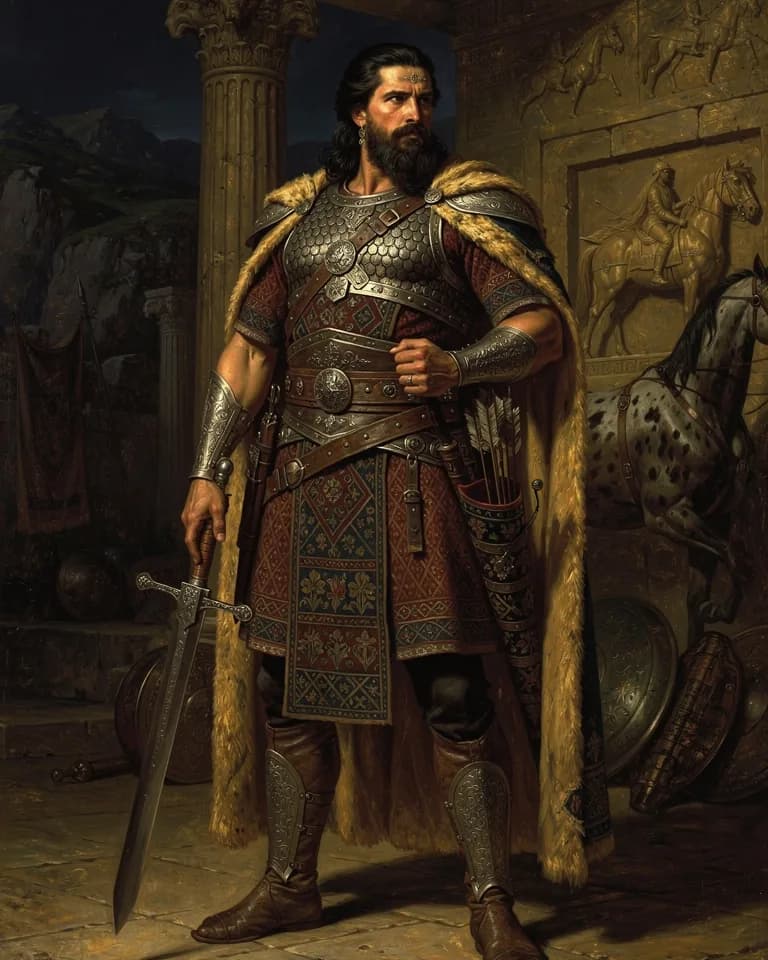
The greatest champion of Ferdowsi's Shahnameh, lord of Zabulistan and defender of Iran's kings for centuries, rider of the horse Rakhsh, who in the epic's most famous tragedy kills his own son Sohrab without knowing him.
About Rostam
Born with the Simurgh's help
Rostam is the son of Zal, the white-haired hero raised by the Simurgh, and of Rudabeh, princess of Kabul. His birth is so difficult that Zal burns one of the Simurgh's feathers; the bird appears and instructs that the child be cut from his mother's side while she is drugged with wine, and that the wound be healed with herbs and a stroke of her feather. As a boy he kills a raging white elephant, and he chooses the colt Rakhsh, who will carry him through the epic.
Champion of Iran
Rostam serves the kings of Iran against Turan and against demons. To rescue King Kay Kavus from captivity in Mazandaran, he passes through seven trials (the Haft Khan), among them a lion, a dragon, a sorceress, and at last the White Div, whose blood restores the sight of the blinded king and his army. He fights the Turanian king Afrasiyab through many reigns and rescues the hero Bizhan from a pit.
Tragedies
Two tragedies define him. Unrecognized, he kills his son Sohrab in single combat, learning the truth only from the armband he had left with the boy's mother. And late in life he is forced into combat with the prince Esfandiyar, who is invulnerable except in his eyes; with the Simurgh's help Rostam kills him with an arrow of tamarisk, knowing that whoever kills Esfandiyar is doomed.
Before Ferdowsi
Rostam has no clear place in the Avesta. His legends are associated with Sistan in eastern Iran and appear in Sogdian and Middle Persian fragments before Ferdowsi, who drew on older prose chronicles for the epic.
On parentage: Wholly mortal parentage in the Shahnameh; his birth is attended by the Simurgh, whose feather Zal burns to summon her.
Key deeds
- Born by a surgical birth guided by the Simurgh
- Chose and tamed the horse Rakhsh
- Passed the Seven Trials (Haft Khan) and killed the White Div to free Kay Kavus
- Killed his son Sohrab in single combat without knowing him
- Rescued Bizhan from Afrasiyab's pit
- Killed the invulnerable prince Esfandiyar with a tamarisk arrow, on the Simurgh's advice
Fate
His half-brother Shaghad and the king of Kabul lure him into a hunting ground lined with hidden pits of spears and swords; Rakhsh falls in with him. Dying, Rostam asks for his bow and kills Shaghad with an arrow that pierces the tree he hides behind.
Across traditions
Parallel figures
Heroes and gods who play a part like Rostam's in other traditions.
 Celtic PantheonCú Chulainn
Both heroes kill their own sons in single combat without recognizing them until too late: Rostam and Sohrab in the Shahnameh, Cú Chulainn and Connla in the Irish tale 'The Death of Aífe's Only Son'. The father-son combat is a widely noted comparative motif.
Sources and further reading
Source notes
These references are recorded in the catalog. Their passage wording and translation have not been checked, so quotations are not displayed here.
- Ferdowsi, Shahnameh, 'Rostam and Sohrab', reign of Kay Kavus (paraphrase)
- Ferdowsi, Shahnameh, the Seven Trials of Rostam (paraphrase)
Appears in
Ancient and classical works featuring this figure.
Iran's greatest champion (from the reign of Manuchehr to that of Goshtasp)
About this entry
By Elizabeth Stein for Mythos Atlas. About the author. Editorial notes are grounded in the site's cited sources and can be challenged through the contact page.
Hero legends were retold for centuries, and the sources often disagree on parentage, deeds and death. This entry follows the best-known versions and notes the main alternatives.