Source recordAncient text
Nihon Shoki (Chronicles of Japan)
Prince Toneri and O no Yasumaro · 720 CE · Classical Chinese
Ancient text
Nihon Shoki (Chronicles of Japan)
Prince Toneri and O no Yasumaro
The second-oldest book of classical Japanese history, providing alternative versions of myths found in the Kojiki and additional material.
About this work
The second-oldest book of classical Japanese history, providing alternative versions of myths found in the Kojiki and additional material.
Where to start
Read the opening cosmogony of Book I alongside Book II's account of the Tenson Korin (Divine Descent), the core mythological narrative of Japanese history.
Figures in the text
Heroes and divinities who feature prominently, with where they appear.
Deities and immortals
 AmaterasuAge of the Gods, Books I-IISupreme solar ruler whose divine decree commands her grandson Ninigi to govern the terrestrial realm
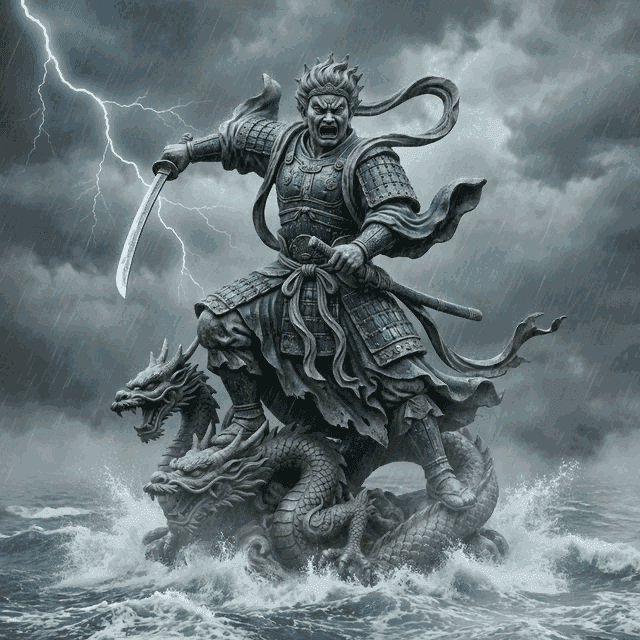 SusanooAge of the Gods, Book IStorm brother whose pact with Amaterasu produces divine offspring and whose trials shape ritual kingship
 IzanagiAge of the Gods, Book IPrimordial male deity whose ritual dialogues established ancient customs of marriage and purification
 IzanamiAge of the Gods, Book IPrimordial female deity whose binding covenant created mortal life cycles
Key scenes
Turning points of the work, in reading order.
The Primordial Separation of Heaven and Earth
The chronicle begins in stately classical prose: 'Of old, Heaven and Earth were not yet separated... forming a chaotic mass like an egg, wherein the clear and pure formed Heaven while the heavy and gross settled as Earth.'
The Descent of the Heavenly Grandson (Tenson Korin)
Amaterasu entrusts Ninigi-no-Mikoto with the Three Sacred Treasures (Mirror, Jewel, Sword), saying: 'The Reed-Plain-1500-Autumn-Fair-Rice-Ear Land is the realm which my descendants shall govern.'
Stories drawn from it
Retellings in the atlas that quote or cite this work.
 Izanagi's Descent to YomimythAfter his wife Izanami dies giving birth to the fire god, Izanagi descends to the underworld to bring her back. But when he breaks the taboo against looking at her, he sees her rotting corpse and must flee, sealing the boundary between life and death forever.
 Hoori and Toyotama-himeepicAfter losing his brother's magical fishhook, the hunter Hoori journeys to the palace of the sea god, where he wins the heart of the dragon princess Toyotama-hime. Their love produces an heir, but forbidden knowledge destroys their union.
 The Banishment of SusanoorivalryStorm god Susanoo rages through Amaterasu’s heavenly fields, wrecking her loom and sacred halls until the sun goddess seals herself in a cave, and Susanoo is cast from heaven.
About this record
By Elizabeth Stein for Mythos Atlas. About the author. Editorial notes are grounded in the site's cited sources and can be challenged through the contact page.
Dates and authorship follow standard scholarly references; for many ancient works both are approximate or disputed.