Source recordAncient text
Rigveda
Various Vedic sages · c. 1500-1200 BCE · Vedic Sanskrit
Ancient text
Rigveda
Various Vedic sages
The oldest of the four Vedas, containing 1,028 hymns to the Vedic deities including Indra, Agni, and Varuna. Foundation of Hindu religious tradition.
About this work
The oldest of the four Vedas, containing 1,028 hymns to the Vedic deities including Indra, Agni, and Varuna. Foundation of Hindu religious tradition.
Where to start
Start with Rigveda 1.32 (Indra slaying Vritra) for foundational mythic conflict, then read 10.129 (Nasadiya Sukta) for sublime cosmic philosophy, followed by 1.1 (the invocation of Agni).
Figures in the text
Heroes and divinities who feature prominently, with where they appear.
Deities and immortals
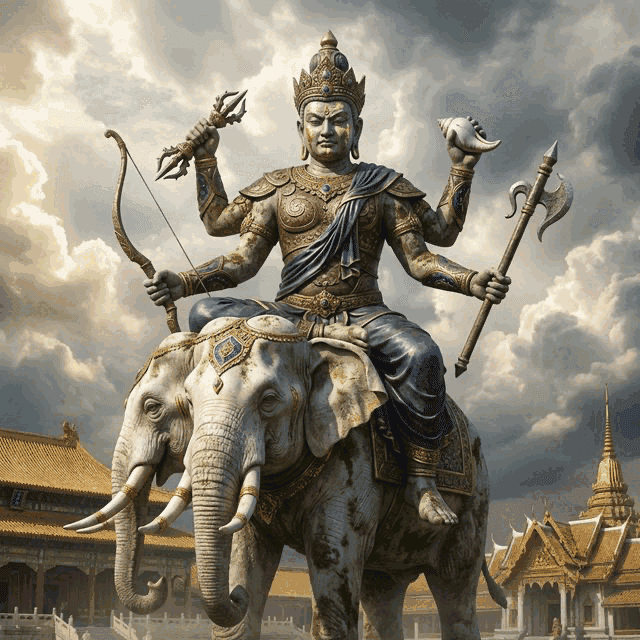 IndraHymns 1.32, 2.12, 4.18Thunder-wielding hero-king of the Devas who drinks soma, hurls the vajra, and releases the captive waters
 AgniHymns 1.1, 10.51Sacred fire, divine priest, and mediator carrying offerings from mortals to the gods
 ShivaHymn 2.33Prefigured in the fierce storm archer Rudra, lord of the wilderness, diseases, and healing balms
 VishnuHymn 1.154The wide-striding cosmic preserver whose three strides measure out earth, air, and the highest abode of light
 BrahmaHymn 10.121Anticipated in the Golden Womb (Hiranyagarbha) and Prajapati, the singular Lord of all created things
Key scenes
Turning points of the work, in reading order.
Indra's Conquest of Vritra
Intoxicated with triple soma, Indra grips his lightning bolt (vajra) and smashes the shoulders of Vritra the dragon-coiler, releasing the rivers that flow like bellowing cows to the sea.
The Hymn of Creation (Nasadiya Sukta)
An awe-inspiring metaphysical inquiry: 'Then was neither non-existence nor existence... Who knows for certain? Who shall declare it? Whence was it born, and whence came this creation?'
The Sacrifice of the Cosmic Giant (Purusha Sukta)
The thousand-headed giant Purusha is offered up by the gods; from his mind the moon was born, from his eye the sun, from his breath the wind, and from his feet the earth.
Passages
Direct quotations are distinguished from editorial paraphrases and records awaiting verification.
“Yama first found for us a place to dwell in”
Rigveda · 10.14.2, opening clause
Translation: Ralph T. H. Griffith
Ralph T. H. Griffith translation, Internet Sacred Text Archive. English opening clause checked against the cited transcription on 2026-09-23; no Sanskrit text is supplied.
Read sourceAbout this record
By Elizabeth Stein for Mythos Atlas. About the author. Editorial notes are grounded in the site's cited sources and can be challenged through the contact page.
Dates and authorship follow standard scholarly references; for many ancient works both are approximate or disputed.