Japanese Pantheonheroabout 2 min
The Trials of Okuninushi
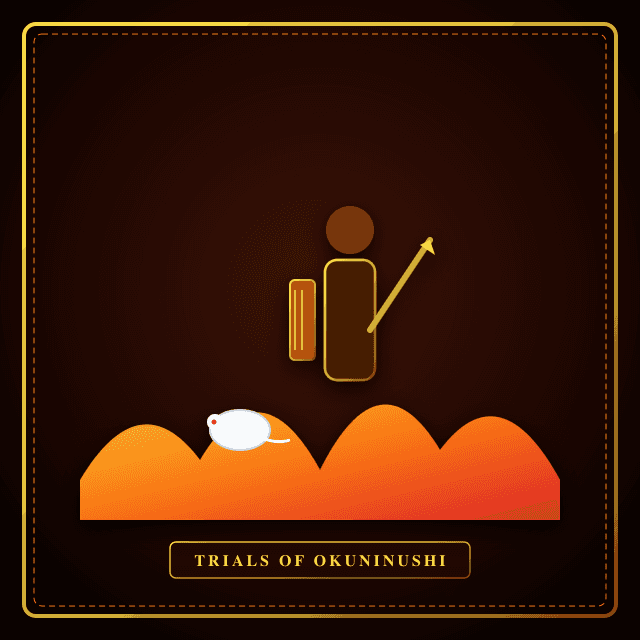
Okuninushi endures murder by jealous brothers, underworld tests from Susanoo, and the love of Suseri-hime before becoming the great earthly kami who “makes the land.”
An editorial retelling
The story
The White Hare
Okuninushi, a descendant of Susanoo, had eighty brothers, the Yasogami, and all of them sought the hand of Princess Yakami of Inaba. They made Okuninushi carry their bags like a servant. On the road they found a skinned hare and mocked it; Okuninushi healed the creature with advice that revealed his kindness. The hare prophesied that he, not his brothers, would win the princess.
Murder and Return
Enraged when the princess chose him, the brothers told Okuninushi to catch a red boar they would drive down a mountain, then rolled down a great rock heated red-hot, and he was burned to death. His mother, Sashikuni-waka-hime, appealed to the creator deity Kamimusubi, who sent two shellfish goddesses, Kisagai-hime and Umugi-hime, to restore him with a salve of powdered shell and clam juice. The brothers killed him again, crushing him in a split tree; again his mother revived him, and sent him to Susanoo's land for safety.
In Susanoo’s Realm
Fleeing to the underworld, Okuninushi met Suseri-hime, daughter of Susanoo. The storm god set lethal trials: snakes, centipedes, and a howling field of fire. With Suseri-hime’s counsel and a life-giving scarf, Okuninushi survived, bound Susanoo’s hair as he slept, and escaped with divine treasures.
Lord of the Land
Armed with Susanoo’s sword, bow, and koto, he subdued his brothers and became Okuninushi, Great Land Master, architect of the earthly realm later “ceded” to Amaterasu’s line.
Making the Land
The Kojiki goes on to tell how a tiny god, Sukunabikona, came to him over the waves in a boat made from a seed pod, dressed in the skin of a moth, and how the two together built and consolidated the land, until Sukunabikona departed across the sea to the Eternal Land.
Ceding the Land
Later, envoys of Amaterasu came to demand the land for her descendants. After a contest of strength between Takemikazuchi and Okuninushi's son Takeminakata, Okuninushi agreed to yield the visible world, asking in return for a great shrine whose pillars reached down to the bedrock and whose crossbeams rose to heaven. Tradition identifies that shrine with Izumo Taisha, where he is still worshipped as Ōkuninushi-no-Ōkami.
The cycle praises perseverance, alliance, and the hard apprenticeship of sovereignty.
Listen or change reading mode
Highlights
Okuninushi endures murder by jealous brothers, underworld tests from Susanoo, and the love of Suseri-hime before becoming the great earthly kami who “makes the land.”
Why it matters
A cornerstone Izumo cycle explaining how the earthly kami established Japan’s land before the heavenly lineage of the imperial line.
Quick answers
- What is the story of The Trials of Okuninushi about?
- Okuninushi endures murder by jealous brothers, underworld tests from Susanoo, and the love of Suseri-hime before becoming the great earthly kami who “makes the land.”
- What themes does The Trials of Okuninushi explore?
- The atlas lists these themes for The Trials of Okuninushi: perseverance, love, sovereignty, and ordeal.
Sources and further reading
By Elizabeth Stein for Mythos Atlas. About the author. Editorial notes are grounded in the site's cited sources and can be challenged through the contact page.
Works cited
Cite this page
No publication date is recorded for this page, so each citation uses n.d. and today's date as the access date.
Keep exploring
One myth a week, with its sources in a short email. The sign-up form is just below.