Source recordAncient text
Kojiki (Records of Ancient Matters)
O no Yasumaro · 712 CE · Old Japanese
Ancient text
Kojiki (Records of Ancient Matters)
O no Yasumaro
The oldest surviving chronicle of Japan, containing myths of creation, the divine couple Izanagi and Izanami, and the sun goddess Amaterasu.
About this work
The oldest surviving chronicle of Japan, containing myths of creation, the divine couple Izanagi and Izanami, and the sun goddess Amaterasu.
Where to start
Begin with Chapter 17 (the Heavenly Rock Cave) and Chapter 19 (the slaying of Yamata-no-Orochi), then read Chapters 3-10 for the island creation and Izanagi's eerie descent into Yomi.
Figures in the text
Heroes and divinities who feature prominently, with where they appear.
Deities and immortals
 AmaterasuChapters 11-17Great August Sun Goddess born from Izanagi's left eye, sovereign ruler of Takamagahara (High Plain of Heaven)
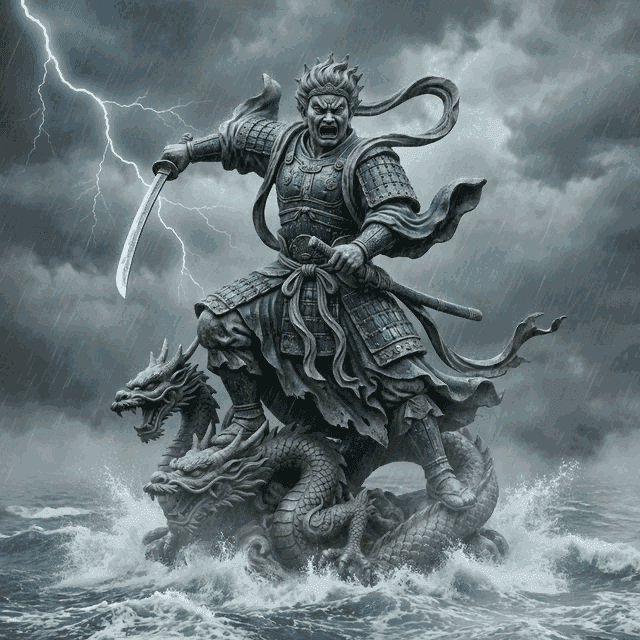 SusanooChapters 11-19Fierce storm god born from Izanagi's nose, exiled for rebelliousness, who slays the eight-headed dragon Yamata-no-Orochi
 IzanagiChapters 3-10The Male-Who-Invites, creator who churned the islands of Japan and journeyed to the underworld of Yomi
 IzanamiChapters 3-9The Female-Who-Invites, creator who died giving birth to the fire god Kagutsuchi and became ruler of Yomi
 TsukuyomiChapter 11Radiant moon god born from Izanagi's right eye during his purifying bath, assigned dominion over the night
 Ame-no-UzumeChapter 17Goddess of ecstatic dance who coaxes Amaterasu out of the Heavenly Rock Cave with laughter and performance
 OkuninushiChapters 20-27Benevolent earth ruler of Izumo who survives eighty jealous brothers and heals the White Hare of Inaba
Key scenes
Turning points of the work, in reading order.
Churning of the Primordial Island
Standing upon the Floating Bridge of Heaven, Izanagi and Izanami stir the brine with the Jeweled Spear; drops falling from its tip congeal to form Onogoro Island.
The Descent into Yomi and the Great Cleansing
Izanagi seeks Izanami in the land of the dead, breaks his promise not to gaze upon her rotting corpse, flees from thunder demons, and cleanses himself in the river, birthing Amaterasu, Tsukuyomi, and Susanoo.
The Retreat into the Heavenly Rock Cave (Ama-no-Iwato)
Grieved by Susanoo's violent rampages, Amaterasu conceals herself in the cave, plunging the world into darkness until Ame-no-Uzume's joyful dance brings laughter and coaxes her into the mirror's light.
Slaying the Yamata-no-Orochi
Susanoo intoxicates the eight-headed serpent of Koshi with refined sake, hacks it to pieces with his sword, and discovers the legendary blade Ame-no-Murakumo (Kusanagi) in its tail.
Passages
Direct quotations are distinguished from editorial paraphrases and records awaiting verification.
“So thereupon the Heaven-Shining-Great-August-Deity, terrified at the sight, closed [behind her] the door of the Heavenly Rock-Dwelling, made it fast, and retired.”
Kojiki · Part I, §XVI (p. 63)
Translation: Basil Hall Chamberlain
The Kojiki, trans. Basil Hall Chamberlain (1882), Sacred Texts 1919 web transcription; English-only replacement of prior unverified wording. Exact punctuation, bracketed interpolation, and wording checked against the cited English transcription. Japanese text was not retained or certified. English transcription checked 2026-09-23.
Read source“Then the Plain of High Heaven shook, and the eight hundred myriad Deities laughed together.”
Kojiki · Part I, §XVI (pp. 64–65)
Translation: Basil Hall Chamberlain
The Kojiki, trans. Basil Hall Chamberlain (1882), Sacred Texts 1919 web transcription; English-only replacement of prior unverified wording. Exact wording checked against the cited English transcription. Japanese text was not retained or certified. English transcription checked 2026-09-23.
Read source“So when the Heaven-Shining-Great-August-Deity had come forth, both the Plain of High Heaven and the Central-Land-of-Reed-Plains of course again became light.”
Kojiki, Part I, Section XVI · Closing sentence before footnote 35
Translation: Basil Hall Chamberlain
1882 translation, 1919 edition transcription at Sacred Texts. English transcription checked 2026-09-23. Replaces prior unverified wording; no original-language text is supplied or certified.
Read sourceStories drawn from it
Retellings in the atlas that quote or cite this work.
 The Creation of JapancreationThe primordial gods Izanagi and Izanami create the Japanese islands and countless kami, establishing the divine origins of Japan and its imperial line.
 Amaterasu and the Heavenly CavemythWhen Susanoo's violence drives Amaterasu into hiding in a cave, the world falls into darkness. The gods devise a plan to lure her out, restoring light to the world. Explains the importance of ritual.
 Susanoo and Yamata no OrochimythExiled storm god Susanoo encounters an eight-headed, eight-tailed dragon terrorizing a family. He slays the beast and discovers the sacred sword Kusanagi in its tail.
 Izanagi's Descent to YomimythAfter his wife Izanami dies giving birth to the fire god, Izanagi descends to the underworld to bring her back. But when he breaks the taboo against looking at her, he sees her rotting corpse and must flee, sealing the boundary between life and death forever.
 Hoori and Toyotama-himeepicAfter losing his brother's magical fishhook, the hunter Hoori journeys to the palace of the sea god, where he wins the heart of the dragon princess Toyotama-hime. Their love produces an heir, but forbidden knowledge destroys their union.
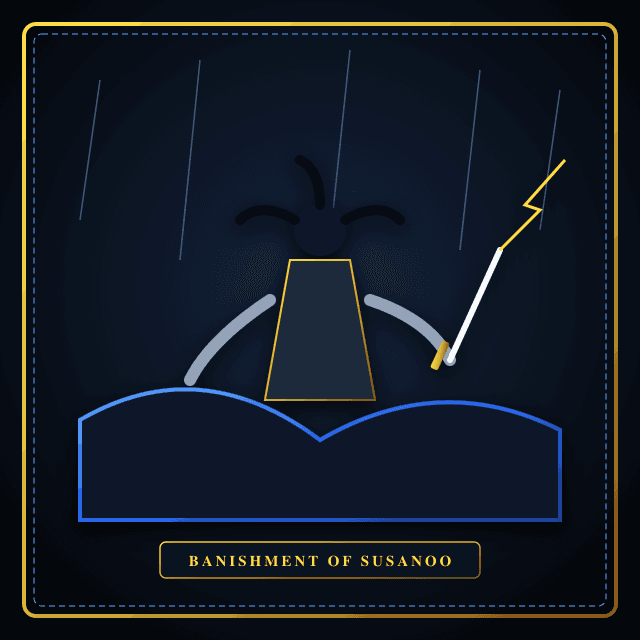 The Banishment of SusanoorivalryStorm god Susanoo rages through Amaterasu’s heavenly fields, wrecking her loom and sacred halls until the sun goddess seals herself in a cave, and Susanoo is cast from heaven.
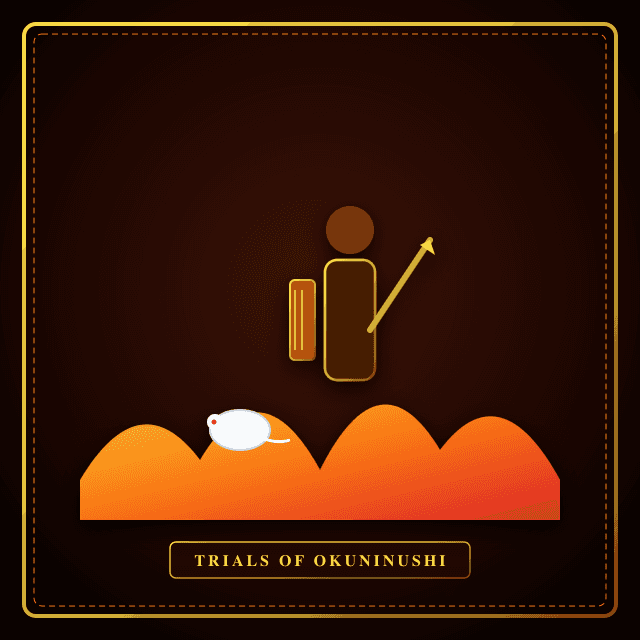 The Trials of OkuninushiheroOkuninushi endures murder by jealous brothers, underworld tests from Susanoo, and the love of Suseri-hime before becoming the great earthly kami who “makes the land.”
About this record
By Elizabeth Stein for Mythos Atlas. About the author. Editorial notes are grounded in the site's cited sources and can be challenged through the contact page.
Dates and authorship follow standard scholarly references; for many ancient works both are approximate or disputed.