Polynesian Pantheoncreation
The Separation of Rangi and Papa
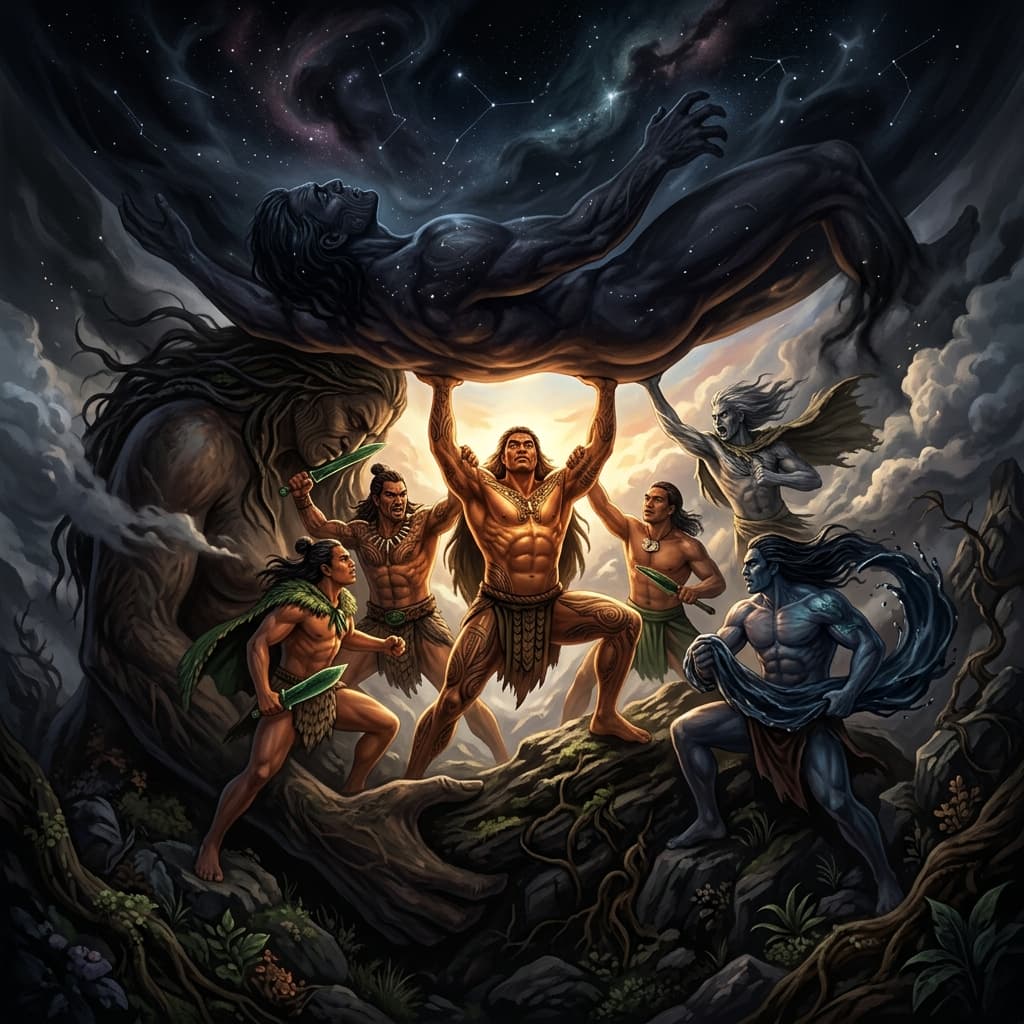
The Maori creation myth telling how the children of the Sky Father and Earth Mother, trapped in darkness between their parents' embrace, debated and finally succeeded in pushing them apart, bringing light into the world.
An editorial retelling
The story
In the Beginning
Before the world as we know it, there was only darkness. Rangi, the Sky Father, and Papa, the Earth Mother, lay locked in an eternal embrace, their bodies pressed so tightly together that no light could enter the space between them.
In this cramped darkness, their children were born and grew: Tane (forests and birds), Tangaroa (the sea), Tu (war), Rongo (cultivated plants), Haumia (wild plants), and Tawhirimatea (storms). For ages beyond counting, the children lived in this suffocating darkness, never seeing light, never knowing the beauty of the world.
The Debate
At last, the children gathered to discuss their plight. They could not continue living in darkness. Something had to change.
Tu, fierce and warlike, spoke first: "Let us kill our parents. That will end our suffering."
But Tane, gentler and wiser, disagreed: "No, let us not kill them. Instead, let us push them apart. Rangi can go above to become the sky, and Papa can remain below as the earth. Then there will be space and light between them."
Most of the brothers agreed with Tane. But Tawhirimatea loved his parents too much to see them separated. "I will not support this. If you do this terrible thing, I will fight against you forever."
The others ignored his warning and decided to proceed.
The Attempts
One by one, the brothers tried to push their parents apart:
Rongo tried first, but he was too gentle. He pushed and strained, but Rangi and Papa did not move.
Tangaroa tried next, heaving with all the strength of the sea, but he could not separate them.
Haumia tried, then Tu, but none could break the primordial embrace.
Tane's Success
Finally, Tane stepped forward. He did not push with his hands like the others. Instead, he lay on his back, with his shoulders against Papa (the earth) and his feet against Rangi (the sky). Then he began to push upward with his legs.
Slowly, painfully, the sky began to lift. Rangi clung to Papa, crying out in grief. Papa reached up toward Rangi, her arms stretching but unable to hold him. Light began to flood into the world for the first time.
Tane pushed and pushed. The sky rose higher and higher. At last, Rangi was far above, and Papa lay below, and between them was the space where life could flourish.
The World Transformed
Light flooded the world. The children of Rangi and Papa saw each other clearly for the first time. They saw the beauty of existence that had been hidden in darkness.
Tane adorned his father with the sun, moon, and stars as ornaments. He covered his mother with trees, plants, and all growing things. The world became beautiful.
But Rangi and Papa wept for their separation. Rangi's tears fell as rain upon Papa. Papa's sighs rose as mist toward Rangi. Even today, the mist at dawn and the rain at evening are signs of their eternal longing for each other.
Tawhirimatea's Revenge
Tawhirimatea kept his promise. Enraged at what his brothers had done, he ascended to the sky with his father and launched a terrible attack on his siblings.
He sent his children - the winds, storms, hurricanes, and clouds - against his brothers. Tangaroa's fish fled to the depths of the sea or onto the land, dividing into fish and reptiles. Tane's trees were torn and battered. Rongo and Haumia hid in the body of their mother Papa.
Only Tu stood firm against the assault. When the storm finally passed, Tu was furious at his brothers for their cowardice. He turned on them in revenge, trapping their children - fish, birds, and plants - to become food for humanity.
This is why humans eat the children of Tangaroa (fish), Tane (birds), Rongo (cultivated plants), and Haumia (wild plants) - because Tu conquered them when they fled from Tawhirimatea's storm.
The Eternal Grief
The separation was necessary for life to exist, but it came at a cost. Rangi and Papa still love each other and grieve their separation. They will never be reunited in this world.
Yet their love persists. Every sunrise and sunset, when sky and earth seem to touch at the horizon, is a moment when Rangi and Papa almost embrace again. The beauty of these moments reminds us of the love that still connects heaven and earth.
Listen or change reading mode
Highlights
Tane lay on his back and pushed the sky from the earth with his feet, bringing light into the world. The sky father and earth mother still weep for each other - rain is Rangi's tears, mist is Papa's sighs.
Why it matters
This is the foundational creation myth of Maori tradition, explaining the origin of the world, the separation of heaven and earth, and the relationships between the major gods. It also establishes the basis for why humans eat fish, birds, and plants. The emotional depth of the primordial parents' grief gives Maori cosmology a distinctive poignancy.
Quick answers
- What is the story of The Separation of Rangi and Papa about?
- The Maori creation myth telling how the children of the Sky Father and Earth Mother, trapped in darkness between their parents' embrace, debated and finally succeeded in pushing them apart, bringing light into the world.
- What themes does The Separation of Rangi and Papa explore?
- The atlas lists these themes for The Separation of Rangi and Papa: creation requires sacrifice, light comes from darkness, love persists through separation, and actions have consequences.
Sources and further reading
By Elizabeth Stein for Mythos Atlas. About the author. Editorial notes are grounded in the site's cited sources and can be challenged through the contact page.
Works cited
Maori Oral Tradition
Myths and Legends of the Polynesians
Johannes Andersen
Keep exploring
One myth a week, with its sources in a short email. The sign-up form is just below.