Greek Pantheonarmor
Aegis
- Invulnerability
- Fear Inducement
- Divine Protection
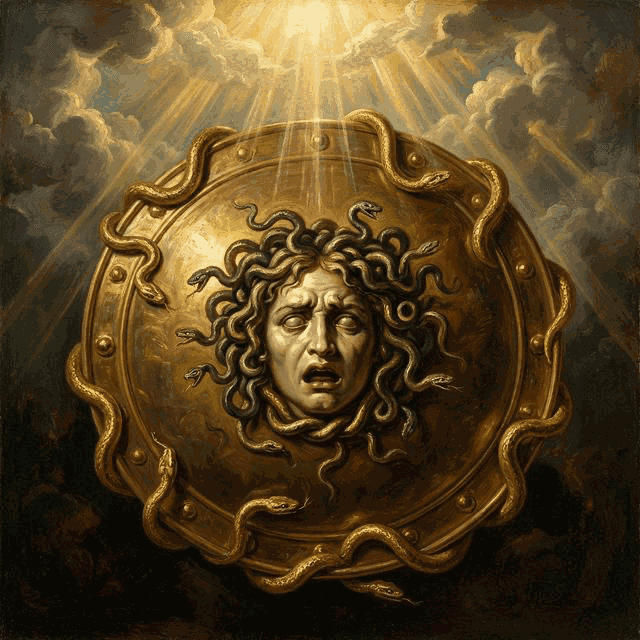
The legendary shield of Zeus and Athena, adorned with the fearsome head of the Gorgon Medusa. This divine aegis strikes terror into the hearts of enemies and provides impenetrable protection to its bearer.
About Aegis
Goatskin, storm, Gorgon
In the Iliad the aegis belongs to Zeus and is worn in battle by Athena: tasselled, flashing, fitted with the Gorgon's head that turns the enemy's knees. Homer gives no workshop scene. Apollodorus and the Perseus cycle have Athena fix Medusa's head on the shield after the hero's gift. Vase-painters and the Shield of Heracles often show a goatskin or a breast-aegis, not a round hoplon. The word may mean storm-cloud as much as goat. It is an attribute of the storm-king and his daughter, not a relic stored in a known treasury.
Origin
Forged by Hephaestus at Zeus's command, the shield was later given to Athena who mounted Medusa's severed head upon it after Perseus's legendary quest.
Sources and further reading
Source notes
These references are recorded in the catalog. Their passage wording and translation have not been checked, so quotations are not displayed here.
- Homer, Iliad 5
- Apollodorus, Library 2.4
About this entry
By Elizabeth Stein for Mythos Atlas. About the author. Editorial notes are grounded in the site's cited sources and can be challenged through the contact page.
Keep exploring
One myth a week, with its sources in a short email. The sign-up form is just below.