Greek PantheonCreature
Medusa
- Petrifying Gaze
- Serpent Hair
- Immortal Blood
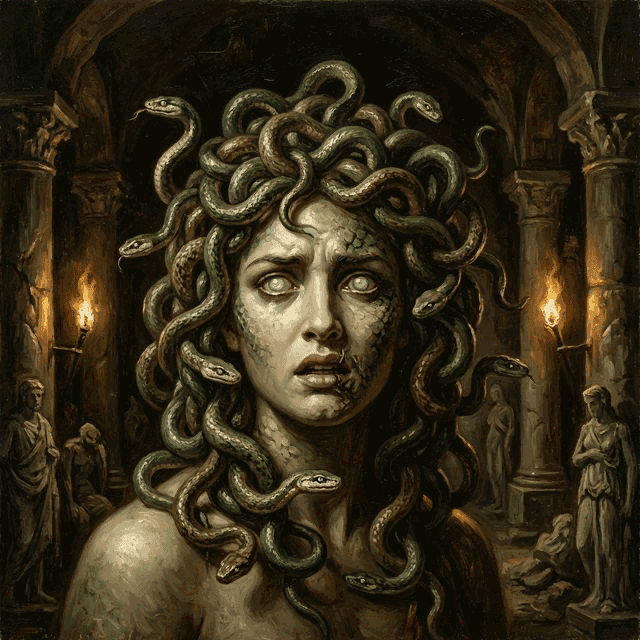
The mortal Gorgon sister with living serpents for hair. Once beautiful, she was cursed by Athena and could turn anyone who looked upon her face to stone. Beheaded by the hero Perseus.
About Medusa
The Mortal Gorgon
Of the three Gorgons only Medusa is mortal. Perseus beheads her with Athena's aid; Pegasus and Chrysaor spring from the neck. Ovid adds the later tale that Athena punished Medusa's beauty after Poseidon's assault in the temple — a Roman overlay on an older beheading myth.
The head remains a weapon: the aegis, the apotropaic face on shields.
After the beheading
Perseus carries the head in a kibisis (wallet), turns the sea-monster and Polydectes' court to stone with it, and gives it to Athena, who sets it on her aegis. Ovid (Metamorphoses 4) adds that drops of blood falling over Libya became its snakes and that the head, laid on seaweed, turned the plants to coral. The Gorgoneion, the staring face with tongue and tusks, was painted on shields, pediments, and pottery as a protective sign long before Ovid's tragic backstory.
Quick answers about Medusa
- What is Medusa?
- The mortal Gorgon sister with living serpents for hair. Once beautiful, she was cursed by Athena and could turn anyone who looked upon her face to stone. Beheaded by the hero Perseus.
- Where does Medusa live?
- The atlas lists Medusa's habitat as Western Libya.
- What abilities does Medusa have?
- The atlas lists these abilities for Medusa: Petrifying Gaze, Serpent Hair, and Immortal Blood.
In the museums
Medusa in art
Real objects in public collections, released into the public domain by the museums that hold them. Dates refer to when each object was made. Objects made within the tradition come first, later depictions after.
(opens the museum record)
Later European depiction
Perseus with the Head of Medusa (opens the museum record)
Canova's sculpture presents Perseus holding Medusa's head. Made in the early nineteenth century, it shows the myth's later artistic reception rather than an ancient depiction.
Sources and further reading
Source notes
These references are recorded in the catalog. Their passage wording and translation have not been checked, so quotations are not displayed here.
- Hesiod, Theogony
About this entry
By Elizabeth Stein for Mythos Atlas. About the author. Editorial notes are grounded in the site's cited sources and can be challenged through the contact page.
The danger rating is an editorial shorthand for how the myths portray the creature, not a claim made by the sources.
Keep exploring
One myth a week, with its sources in a short email. The sign-up form is just below.