Greek PantheonCreature
Cerberus
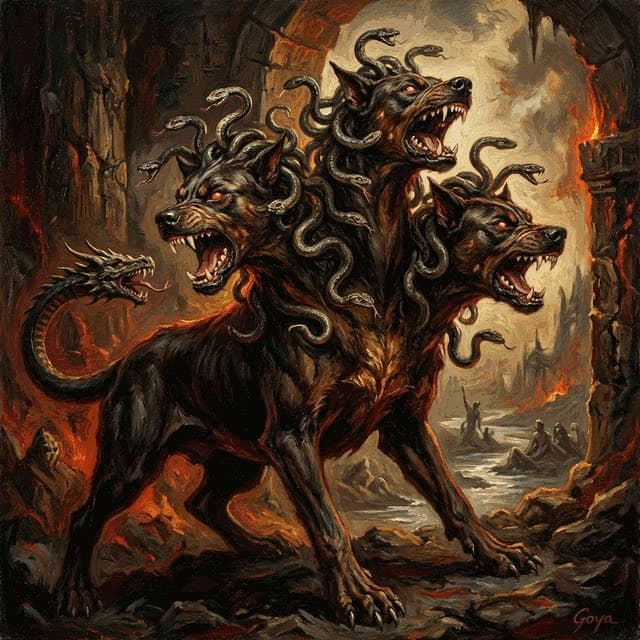
- Multi-headed Awareness
- Immortality
- Serpent Mane
The three-headed hound of Hades who guards the gates of the Underworld to prevent the dead from leaving. His mane consists of writhing serpents.
About Cerberus
Hound of the Gate
Kerberos is the many-headed dog of Hades, set to keep the dead inside. Hesiod gives him fifty heads; later vase-painters and poets settle on three, with a serpent tail and a mane of snakes. Heracles' last labor is to haul him to the sunlit world and return him unharmed.
Virgil's Aeneas drugs the beast with honeyed cake. The job is architectural, not decorative: the underworld needs a lock, and the lock has teeth.
Honey-cake and the leash
The dog's lineage in the Theogony makes him a sibling of the Hydra and the Chimera, children of Typhon and Echidna. Apollodorus (2.5.12) sets the terms of Heracles' twelfth labour: Hades allows him to take the hound if he masters it without weapons, and he does so bare-handed, wrapped in the Nemean lion's skin. The Sibyl's honeyed, drugged cake in Aeneid 6 became the proverbial 'sop to Cerberus', a small bribe paid to get past a gatekeeper.
Quick answers about Cerberus
- What is Cerberus?
- The three-headed hound of Hades who guards the gates of the Underworld to prevent the dead from leaving. His mane consists of writhing serpents.
- Where does Cerberus live?
- The atlas lists Cerberus's habitat as The Underworld (Gates).
- What abilities does Cerberus have?
- The atlas lists these abilities for Cerberus: Multi-headed Awareness, Immortality, and Serpent Mane.
In the museums
Cerberus in art
Real objects in public collections, released into the public domain by the museums that hold them. Dates refer to when each object was made. Objects made within the tradition come first, later depictions after.
 (opens the museum record)
Ancient object
Sardonyx cameo fragment with Hercules tying up Cerberus (opens the museum record)
A sardonyx cameo fragment the museum titles Hercules Tying Up Cerberus, showing the hero's final labor of capturing the three-headed hound of the underworld.
Sources and further reading
Source notes
These references are recorded in the catalog. Their passage wording and translation have not been checked, so quotations are not displayed here.
- Hesiod, Theogony
About this entry
By Elizabeth Stein for Mythos Atlas. About the author. Editorial notes are grounded in the site's cited sources and can be challenged through the contact page.
The danger rating is an editorial shorthand for how the myths portray the creature, not a claim made by the sources.
Keep exploring
One myth a week, with its sources in a short email. The sign-up form is just below.