Greek PantheonCreature
Hydra
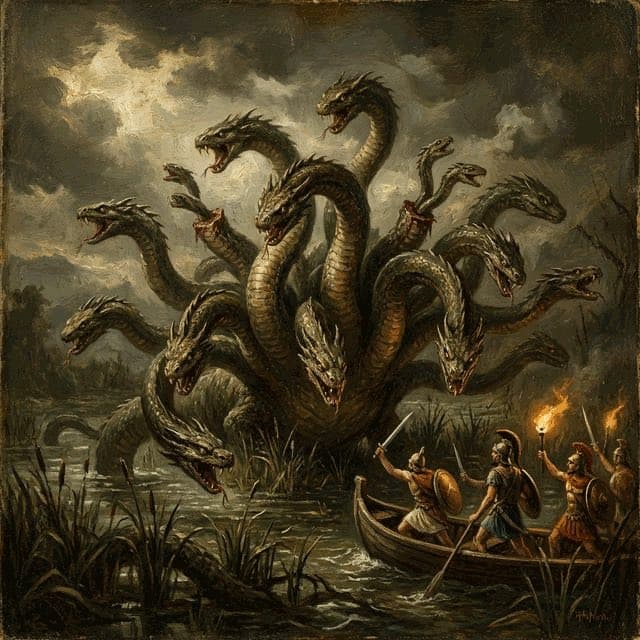
- Regeneration
- Venomous Breath
- Immortal Central Head
A gigantic water serpent with multiple heads that regenerate when severed. Slain by Heracles as his second labor, who discovered that two heads grow back for each one cut off.
About Hydra
The Lernaean Water-Snake
Hesiod places the Hydra among Typhon and Echidna's brood. The second labor of Heracles is to kill the many-headed water-snake of Lerna; for each head cut, two grow, until Iolaus cauterizes the necks. The central head is called immortal and is buried under a rock.
The spring at Amymone is the local hook: a swamp monster tied to Argive hydrology, later moralized as a labor.
The poisoned arrows
Apollodorus adds that Hera sent a giant crab to bite Heracles' foot during the fight, and Eurystheus refused to count the labour because Iolaus had helped. Heracles dipped his arrows in the Hydra's venomous gall, and the poison runs through the rest of his story: it kills the centaur Nessus, and Nessus's blood, soaked into a robe, eventually kills Heracles himself.
Quick answers about Hydra
- What is Hydra?
- A gigantic water serpent with multiple heads that regenerate when severed. Slain by Heracles as his second labor, who discovered that two heads grow back for each one cut off.
- Where does Hydra live?
- The atlas lists Hydra's habitat as Lake Lerna.
- What abilities does Hydra have?
- The atlas lists these abilities for Hydra: Regeneration, Venomous Breath, and Immortal Central Head.
Sources and further reading
Source notes
These references are recorded in the catalog. Their passage wording and translation have not been checked, so quotations are not displayed here.
- Hesiod, Theogony
About this entry
By Elizabeth Stein for Mythos Atlas. About the author. Editorial notes are grounded in the site's cited sources and can be challenged through the contact page.
The danger rating is an editorial shorthand for how the myths portray the creature, not a claim made by the sources.
Keep exploring
One myth a week, with its sources in a short email. The sign-up form is just below.