Greek PantheonCreature
Sphinx
- Flight
- Supernatural Intelligence
- Prophetic Riddles
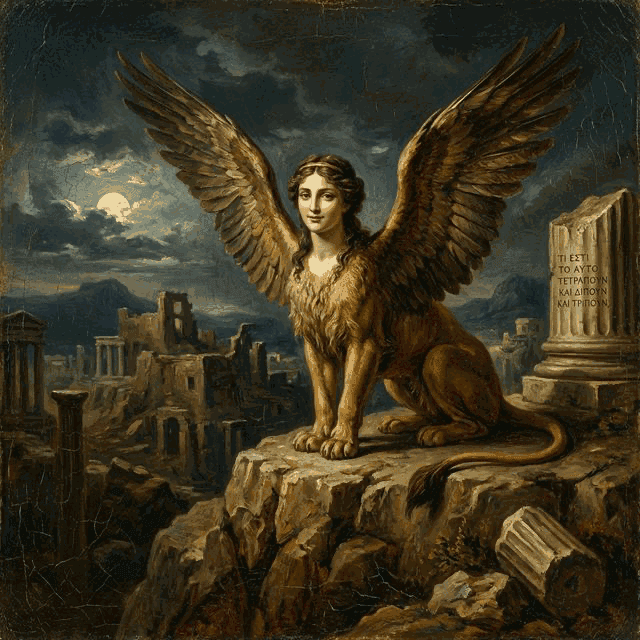
A creature with the body of a lion, wings of an eagle, and head of a woman. She terrorized Thebes, devouring travelers who failed to answer her riddles until Oedipus solved her puzzle.
About Sphinx
The Theban Riddler
The Greek Sphinx is a winged lion-woman sent against Thebes. She asks the riddle of the creature that walks on four, two, then three feet; Oedipus answers 'man,' and she throws herself from the rock. Apollodorus and tragedy fix the episode as the city's entry-exam.
She is not the Giza guardian. Thebes's Sphinx eats the unlettered; Egypt's recumbent king watches the horizon.
Sent against Thebes
Hesiod's Theogony calls her the Phix, a child of Echidna and Orthus, bane of the Cadmeans. Hera or Dionysus is named as the god who sent her, depending on the source. The riddle itself is not in Hesiod; it appears in later tradition and the scholia, and in Sophocles' Oedipus Tyrannus it is the answer to the riddle that makes Oedipus king of Thebes and so sets up his catastrophe.
Quick answers about Sphinx
- What is Sphinx?
- A creature with the body of a lion, wings of an eagle, and head of a woman. She terrorized Thebes, devouring travelers who failed to answer her riddles until Oedipus solved her puzzle.
- Where does Sphinx live?
- The atlas lists Sphinx's habitat as Mount Phicium near Thebes.
- What abilities does Sphinx have?
- The atlas lists these abilities for Sphinx: Flight, Supernatural Intelligence, and Prophetic Riddles.
In the museums
Sphinx in art
Real objects in public collections, released into the public domain by the museums that hold them. Dates refer to when each object was made. Objects made within the tradition come first, later depictions after.
 (opens the museum record)
Ancient object
Marble stele (grave marker) with a youth and little girl, and a capital and finial in the form of a sphinx (opens the museum record)
An Archaic Attic grave stele topped by a small sphinx finial, tagged by the museum with the creature's name. Sphinxes were common protective figures on Greek funerary monuments.
Sources and further reading
Source notes
These references are recorded in the catalog. Their passage wording and translation have not been checked, so quotations are not displayed here.
- Apollodorus, Library 3.5.8
About this entry
By Elizabeth Stein for Mythos Atlas. About the author. Editorial notes are grounded in the site's cited sources and can be challenged through the contact page.
The danger rating is an editorial shorthand for how the myths portray the creature, not a claim made by the sources.
Keep exploring
One myth a week, with its sources in a short email. The sign-up form is just below.