Japanese Pantheonweapon
Kusanagi-no-Tsurugi
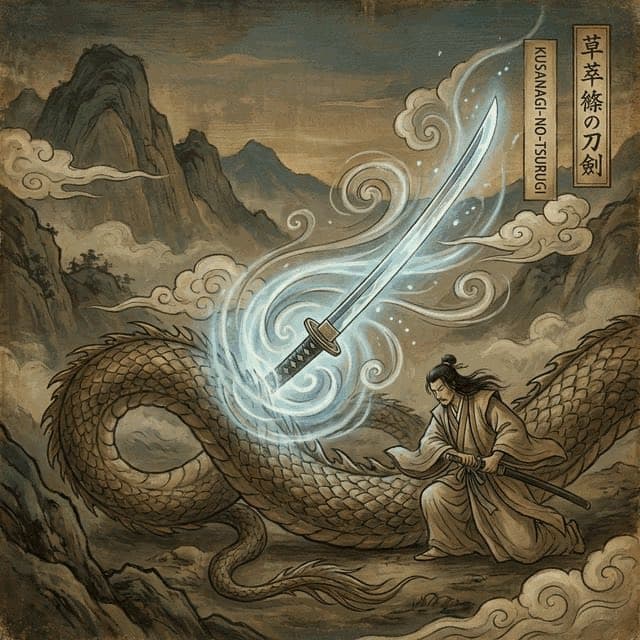
- Wind Control
- Grass Cutting
- Imperial Authority
- Serpent-Slaying
The Grass-Cutting Sword, one of the three Imperial Regalia of Japan. It represents the virtue of valor and was discovered within the body of the eight-headed serpent Yamata no Orochi.
About Kusanagi-no-Tsurugi
Sword from Orochi's tail
The Kojiki and Nihon Shoki tell how Susanoo slays the eight-headed serpent Yamata no Orochi in Izumo and draws Ama-no-Murakumo-no-Tsurugi from the tail, then presents it to Amaterasu. The Nihon Shoki later names it Kusanagi, "grass-cutter," after Yamato Takeru slashes the grass to escape a burning field. It is one of the three imperial regalia. Atsuta Shrine holds the tradition of housing it; the blade is not put on view. Court chronicle of the eighth century, not a folk sword-in-the-stone, and not a public museum piece.
Origin
Found by Susanoo within the tail of Yamata no Orochi after he slew the monster. Originally named Ama-no-Murakumo-no-Tsurugi (Sword of the Gathering Clouds of Heaven).
Sources and further reading
Source notes
These references are recorded in the catalog. Their passage wording and translation have not been checked, so quotations are not displayed here.
- Kojiki (Susanoo and Yamata no Orochi)
About this entry
By Elizabeth Stein for Mythos Atlas. About the author. Editorial notes are grounded in the site's cited sources and can be challenged through the contact page.
Keep exploring
One myth a week, with its sources in a short email. The sign-up form is just below.