Japanese PantheonCreature
Yamata no Orochi
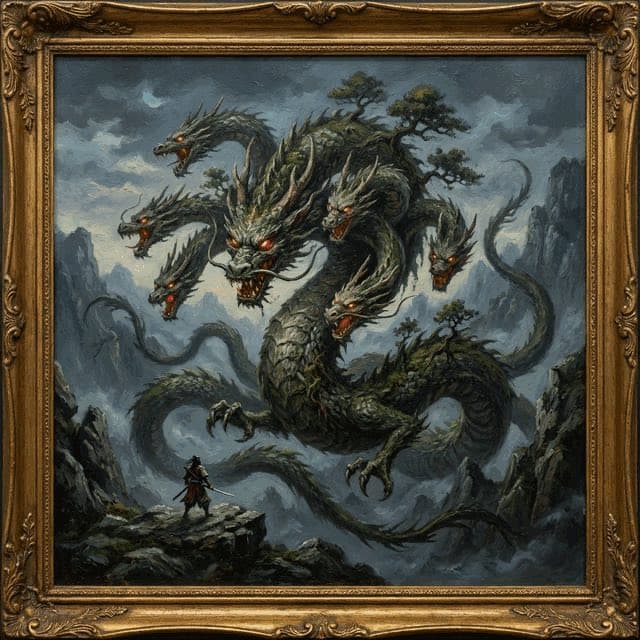
- Eight Heads
- Size Manipulation
- Regeneration
A legendary eight-headed and eight-tailed Japanese dragon serpent. Slain by the storm god Susanoo, who discovered the legendary sword Kusanagi within its body.
About Yamata no Orochi
Eight Heads in the River
The Kojiki and Nihon Shoki tell how Susanoo found a family in Izumo whose daughters were being eaten, year by year, by an eight-headed, eight-tailed serpent that filled eight valleys. He stupefied it with eight vats of sake, cut it apart, and drew the sword Kusanagi from the tail.
The monster is local and hydrological — a Koshi-province terror — before it becomes an imperial relic in the grass-cutting sword.
The sword and the bride
The girl Susanoo saves, Kushinadahime, becomes his wife; in the Kojiki he turns her into a comb and wears it in his hair during the fight. He presents the sword to his sister Amaterasu, and it passes down to become one of the three imperial regalia. The story is one of the founding narratives of Izumo, and the serpent's red eyes and moss-grown back fit a reading of it as a flooding river.
Quick answers about Yamata no Orochi
- What is Yamata no Orochi?
- A legendary eight-headed and eight-tailed Japanese dragon serpent. Slain by the storm god Susanoo, who discovered the legendary sword Kusanagi within its body.
- Where does Yamata no Orochi live?
- The atlas lists Yamata no Orochi's habitat as Koshi Province.
- What abilities does Yamata no Orochi have?
- The atlas lists these abilities for Yamata no Orochi: Eight Heads, Size Manipulation, and Regeneration.
Sources and further reading
Source notes
These references are recorded in the catalog. Their passage wording and translation have not been checked, so quotations are not displayed here.
- Kojiki (trans. Chamberlain)
About this entry
By Elizabeth Stein for Mythos Atlas. About the author. Editorial notes are grounded in the site's cited sources and can be challenged through the contact page.
The danger rating is an editorial shorthand for how the myths portray the creature, not a claim made by the sources.
Keep exploring
One myth a week, with its sources in a short email. The sign-up form is just below.