Japanese PantheonCreature
Kitsune
- Shapeshifting
- Illusion Magic
- Possession
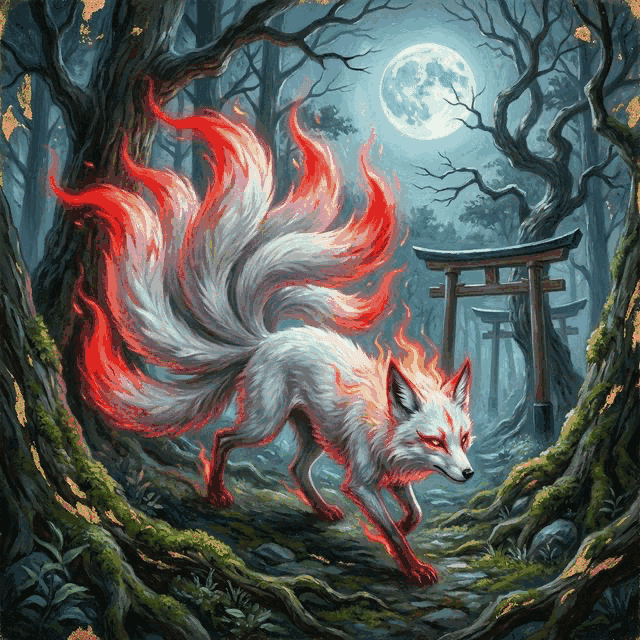
Intelligent fox spirits who grow additional tails as they age, up to nine. They can be benevolent guardians or mischievous tricksters, and possess powerful shapeshifting abilities.
About Kitsune
Foxes Who Keep Accounts
Kitsune in medieval setsuwa (Konjaku, Uji shui) seduce, possess, and repay kindness. Inari's foxes are messengers at shrines; wild kitsune are another file. The nine-tailed elder is a Chinese import (Daji / Tamamo-no-Mae) grafted onto Japanese fox lore.
There is no single canonical fox. The honest page is a class of spirit with shrine and street variants.
Inari's messengers
Fox statues guard the thousands of Inari shrines across Japan, often holding a key or a jewel in their mouths, and offerings of fried tofu (aburaage) are left for them; the dish kitsune udon takes its name from the fox's supposed favourite food. The literary fox-wife goes back to the 9th-century Nihon ryōiki, whose story of a man who married a fox woman gives a folk etymology for kitsune as 'come and sleep'.
Quick answers about Kitsune
- What is Kitsune?
- Intelligent fox spirits who grow additional tails as they age, up to nine. They can be benevolent guardians or mischievous tricksters, and possess powerful shapeshifting abilities.
- Where does Kitsune live?
- The atlas lists Kitsune's habitat as Forests and Inari Shrines.
- What abilities does Kitsune have?
- The atlas lists these abilities for Kitsune: Shapeshifting, Illusion Magic, and Possession.
In the museums
Kitsune in art
Real objects in public collections, released into the public domain by the museums that hold them. Dates refer to when each object was made. Objects made within the tradition come first, later depictions after.
 (opens the museum record)
Later depiction
Mirror With the Design of a Nine-Tailed Fox (opens the museum record)
An Edo-period Japanese print the museum titles Mirror With the Design of a Nine-Tailed Fox, depicting the shapeshifting kitsune associated in folklore with trickery and transformation.
 (opens the museum record)
Later depiction
Tale of the Fox (Kitsune no sōshi) (opens the museum record)
An illustrated Edo-period handscroll titled Tale of the Fox (Kitsune no soshi), a narrative built around a shapeshifting kitsune. The handscroll documents the fox's role as a recurring figure in Japanese storytelling.
Sources and further reading
Source notes
These references are recorded in the catalog. Their passage wording and translation have not been checked, so quotations are not displayed here.
- Konjaku Monogatarishu (fox tales)
About this entry
By Elizabeth Stein for Mythos Atlas. About the author. Editorial notes are grounded in the site's cited sources and can be challenged through the contact page.
The danger rating is an editorial shorthand for how the myths portray the creature, not a claim made by the sources.
Keep exploring
One myth a week, with its sources in a short email. The sign-up form is just below.