
Side by sideParent and child

Demeter vs Persephone

Demeter
DemeterGreek
Persephone
PersephoneGreek

Demeter and Persephone are recorded as parent and child in the Greek Pantheon.

At a glance

Demeter and Persephone compared
DemeterPersephone
TraditionGreek PantheonGreek Pantheon
Domainsagriculture, harvest, fertility, sacred lawunderworld, spring, vegetation, death
Symbolswheat, torch, cornucopia, poppiespomegranate, torch, seeds, flowers, deer
Also calledCeresProserpina, Kore, The Maiden, Queen of the Underworld

Where they meet

They share a symbol: torch.

  • torch

Where they part

Only Demeter

Associated with agriculture, harvest, fertility, and sacred law.

Only Persephone

Associated with underworld, spring, vegetation, and death.

How each was worshipped

Demeter

Cult sites
Telesterion at Eleusis; Thesmophorion sanctuaries in many cities
Festivals
Eleusinian Mysteries; Thesmophoria; Haloa

Grain and the mother's grief. Eleusis promised a better lot after death to initiates who could keep silence. The Thesmophoria was a women's festival of piglets and decayed offerings. Sicily claimed her as strongly as Attica.

Persephone

Cult sites
Eleusis, with Demeter; Locri in Italy, where she is a sovereign queen; Sites in Sicily claimed for her descent
Festivals
Eleusinian Mysteries; Thesmophoria; Koreia

Kore is the girl taken; Persephone is the queen who receives. Eleusis keeps both names in one rite. Locri gave her a queen's cult that does not wait for Demeter's permission. Pomegranate and the dead belong to her even when the hymn pretends she is only a daughter.

The two figures

Greek Pantheon

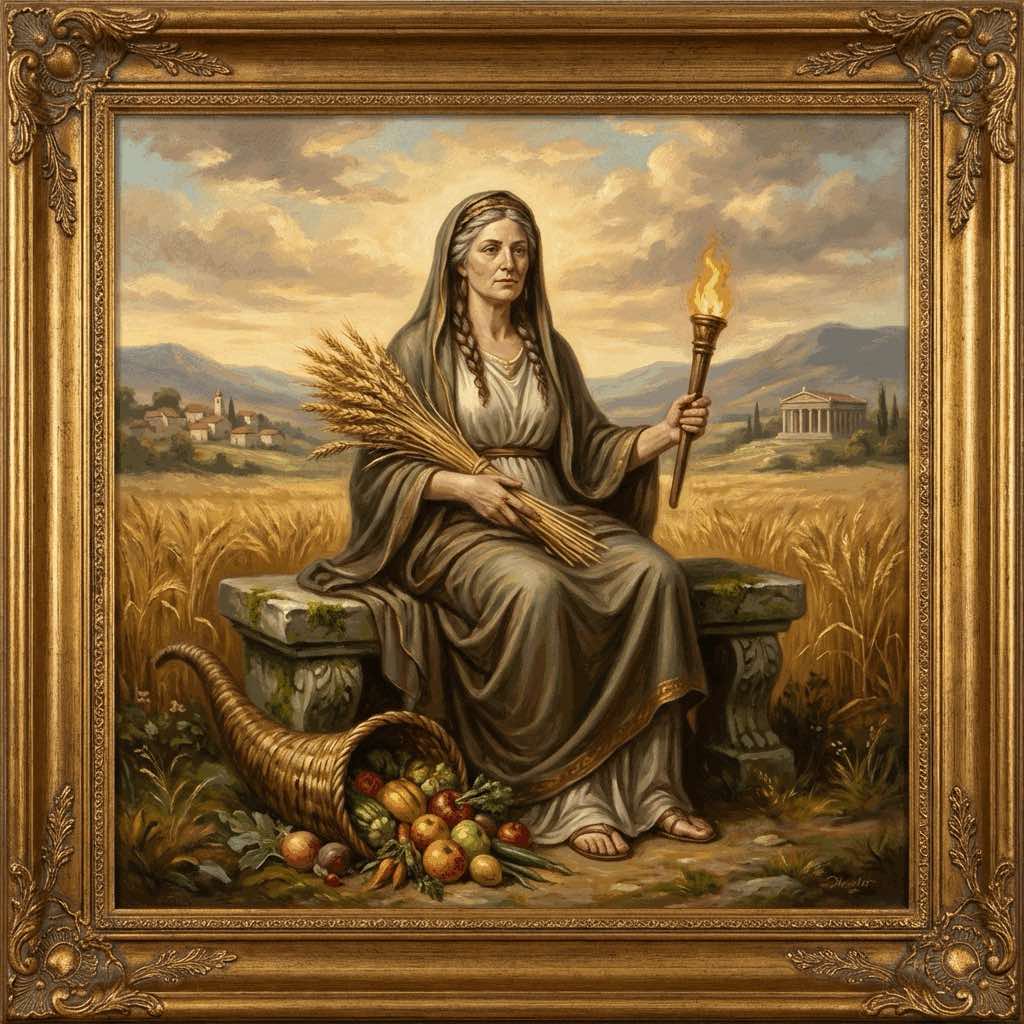
Demeter

Goddess of agriculture, harvest, and fertility. Mother of Persephone, whose abduction by Hades explains the seasons.

Demeter acts as the provider of food and the protector of marriage. She presides over the cycle of life and death through the harvest.

Read the full Demeter entry

Greek Pantheon

Persephone

Queen of the Underworld and goddess of spring growth. Daughter of Zeus and Demeter, wife of Hades. Her annual return from the underworld brings spring; her descent brings winter.

**Persephone** was gathering flowers in a meadow when the earth opened and **Hades** abducted her to be his queen. Her mother **Demeter** searched the earth in grief, causing famine. Zeus intervened, but because Persephone had eaten pomegranate seeds in the underworld, she was bound to return there for part of each year.

**Persephone** embodies a fundamental duality: she is both the **Kore** ("maiden"), innocent goddess of spring flowers, and the dread **Queen of the Dead**, ruling beside Hades over the shades of the departed. Her myth, preserved most fully in the *Homeric Hymn to Demeter*, explains the cycle of seasons and was central to the **Eleusinian Mysteries**.

Read the full Persephone entry
About this comparison

Comparisons pair figures that play a similar role across traditions, or that the myths connect within one. A shared role does not, by itself, establish a shared origin.