Side by sideParallel across traditions

Durga vs The Morrígan

Durga
DurgaHindu
The Morrígan
The MorríganCeltic

Both are goddesses of war and battlefield sovereignty who determine victory.

At a glance

Durga and The Morrígan compared
DurgaThe Morrígan
TraditionHindu PantheonCeltic Pantheon
Domainswar, protection, strength, victorywar, fate, death, sovereignty
Symbolslion, tiger, weapons, tridentcrow, raven, cattle
Also calledDevi, Shakti, MahishasuramardiniMorrígu, Phantom Queen

Where they meet

Both are associated with war.

Where they part

Only Durga

Associated with protection, strength, and victory.

Only The Morrígan

Associated with fate, death, and sovereignty.

Why they are compared

Both are warrior goddesses who determine victory in battle and embody righteous, sovereign violence.

How each was worshipped

Durga

Cult sites
Dakshineswar and Kalighat in Bengal; Vaishno Devi; Pandals raised only for the festival week
Festivals
Durga Puja; Navaratri; Vijayadashami

Nine nights, then the image goes into the river. Kolkata's puja is civic theatre: rented clay, drums, and a goodbye. The rest of the year she is a fierce form of the Goddess, not a quiet parish saint.

The Morrígan

Cult sites
No temple; battlefields, rivers, and sovereignty sites in the tales
Festivals
Samhain meetings in the Ulster Cycle

Phantom queen, crow, and the washer at the ford. You do not find a neat priesthood. Offerings, if any, sit in the same world as war-spells and land-goddess sovereignty, which the manuscripts remember as story.

The two figures

Hindu Pantheon

Durga

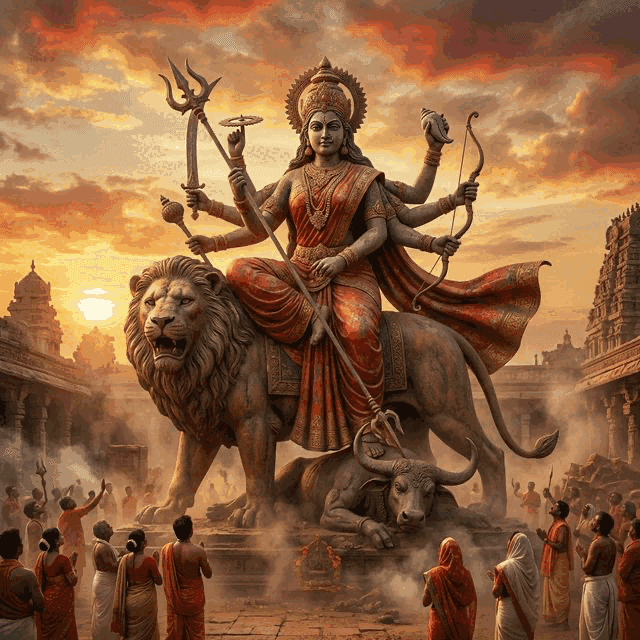
Fierce warrior goddess and protector of dharma. Form of Parvati who slayed the buffalo demon Mahishasura. Depicted riding a lion or tiger with multiple arms wielding divine weapons.

When the buffalo demon Mahishasura threatened the gods, they combined their powers to create Durga. Each god gave her a weapon - Shiva's trident, Vishnu's discus, Indra's thunderbolt. She fought Mahishasura for nine days before defeating him.

Durga is the fierce warrior goddess and protector of **dharma** (cosmic order). Her name means "the invincible" or "she who is difficult to approach." She is a powerful manifestation of **Shakti**, the divine feminine energy, created to defeat evil that the gods alone could not overcome.

Read the full Durga entry

Celtic Pantheon

The Morrígan

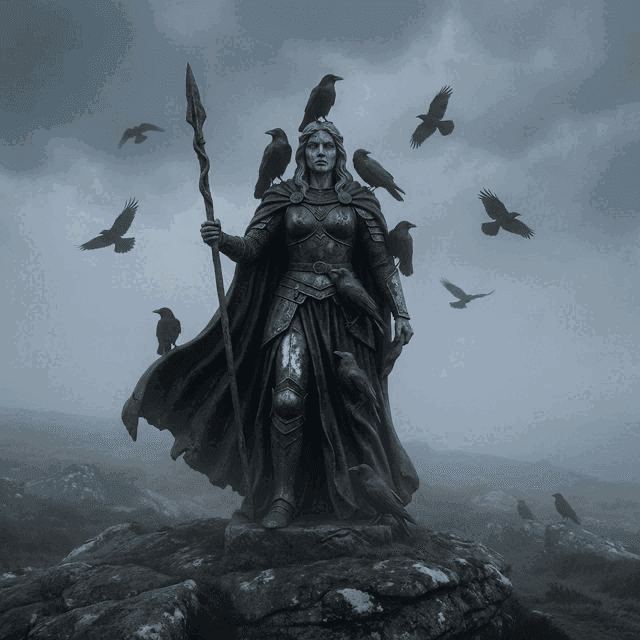
A shapeshifting goddess of war and fate, often appearing as a crow to foretell doom or victory. She represents the terrifying power of sovereignty.

The Morrígan is a powerful member of the **Tuatha Dé Danann**, though her parentage is obscure in the sources. Some texts identify her as a daughter of Ernmas, making her a sister to other sovereignty goddesses like Ériu, Banba, and Fódla. She is intimately connected to the land of Ireland itself. Her union with the Dagda before the Second Battle of Mag Tuired establishes her as a goddess of both war and fertility, and her prophecies after the battle speak to the fate of the world itself.

The Morrígan, whose name means **"Phantom Queen"** or **"Great Queen,"** is one of the most fearsome deities of Irish mythology. She embodies the terrifying aspects of war: not glory or honor, but the chaos, carnage, and inevitability of death on the battlefield. She is strongly associated with sovereignty, fate, and the land itself.

Read the full The Morrígan entry
About this comparison

Comparisons pair figures that play a similar role across traditions, or that the myths connect within one. A shared role does not, by itself, establish a shared origin.