Side by sideParallel across traditions

Ometeotl vs Pangu

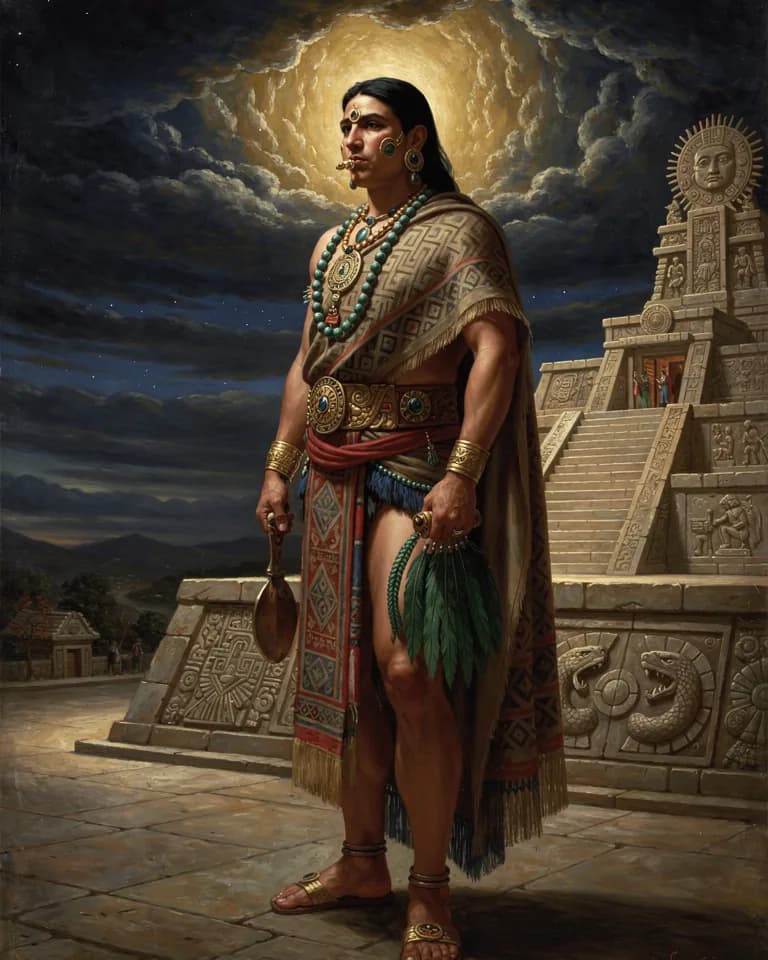
Ometeotl
OmeteotlAztec
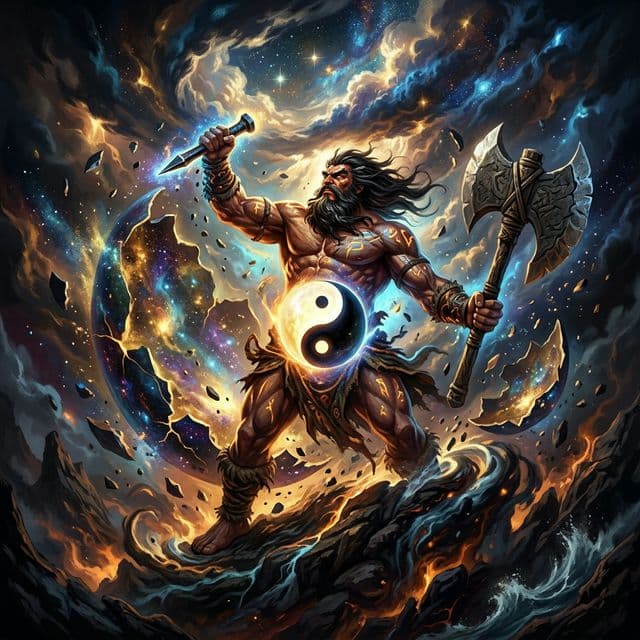
Pangu
PanguChinese

Both are primordial figures whose act of generation stands at the very root of the pantheon's cosmogony, though Ometeotl's dual nature has no close parallel in Pangu's solitary emergence.

At a glance

Ometeotl and Pangu compared
OmeteotlPangu
TraditionAztec PantheonChinese Pantheon
Domainsduality, primordial creation, the origin of the godscreation, separation of heaven and earth, primordial being
SymbolsOmeyocan, the highest heaven, the paired male-female creative principlecosmic egg, axe, chisel, yin-yang
Also calledOmetecuhtli (male aspect), Omecihuatl (female aspect), Tonacatecuhtli/Tonacacihuatl (associated forms)Pan Gu, Primordial Giant

Where they meet

The atlas records no domain or symbol that Ometeotl and Pangu share.

They are compared for the part each plays in their own tradition rather than for any attribute in common.

Where they part

Only Ometeotl

Associated with duality, primordial creation, and the origin of the gods.

Only Pangu

Associated with creation, separation of heaven and earth, and primordial being.

How each was worshipped

Ometeotl

Cult sites
No securely attested dedicated temple; the associated forms Tonacatecuhtli/Tonacacihuatl were venerated as remote, abstract creators rather than through an active, image-based state cult

Unlike the major gods of the Aztec state cult (Huitzilopochtli, Tezcatlipoca, Tlaloc), the dual creator described in sources like the Historia de los Mexicanos por sus pinturas appears as a remote, largely abstract originating principle rather than a deity with an active, image-centered public cult of temples and festivals.

Pangu

Cult sites
Scattered Pangu temples in South China; not a universal parish cult

Cosmogonic giant more than a parish god. Some villages keep a temple and a birthday. Most Chinese never visit one. The egg, the axe, and the body-become-world are story first.

The two figures

Aztec Pantheon

Ometeotl

A primordial dual-gendered creative principle described in some colonial-era Nahua sources as residing in Omeyocan, the highest level of the heavens, and identified with the paired deities Ometecuhtli and Omecihuatl. Whether Ometeotl represents a single, named pre-Columbian deity or is chiefly a later scholarly synthesis of the paired creator gods is a genuinely unresolved debate among specialists.

According to the Historia de los Mexicanos por sus pinturas, the dual creator, dwelling in the highest heaven of Omeyocan and known also as Tonacatecuhtli and Tonacacihuatl, engendered the four Tezcatlipoca brothers, who then undertook the work of shaping the world and its successive ages. Scholars remain divided over whether 'Ometeotl' should be understood as a single named deity in pre-Columbian thought or as a modern synthesis of the paired creator gods.

Ometeotl, meaning "Two God" or "Dual God," names a primordial, dual-gendered creative force described in a cluster of colonial-era Nahua sources, most notably the anonymous 16th-century Spanish compilation *Historia de los Mexicanos por sus pinturas*, as dwelling in Omeyocan, the thirteenth and highest level of the Aztec heavens. In this account, the dual god, also called Tonacatecuhtli and Tonacacihuatl ("Lord and Lady of Our Sustenance"), engendered the four Tezcatlipocas (Xipe Totec (the Red Tezcatlipoca), Huitzilopochtli (associated with the Blue Tezcatlipoca in this telling), Quetzalcoatl (the White Tezcatlipoca), and Tezcatlipoca proper (the Black Tezcatlipoca)) who in turn undertook the work of creating the world and the successive Suns (world-ages).

Read the full Ometeotl entry

Chinese Pantheon

Pangu

The primordial giant who created the world by separating yin and yang, Heaven and Earth. After holding them apart for 18,000 years, his body became the features of the universe.

Before the world existed, there was only a cosmic egg of chaos. Within it, Pangu grew for 18,000 years until he awoke and split the egg with his axe, creating Heaven above and Earth below. He held them apart until they were stable, then his body became the features of the world.

Pangu is the creator deity of Chinese mythology, a primordial giant whose birth, life, and death created the universe as we know it. His story is one of the most profound creation myths, combining themes of sacrifice, transformation, and the origin of cosmic order.

Read the full Pangu entry
About this comparison

Comparisons pair figures that play a similar role across traditions, or that the myths connect within one. A shared role does not, by itself, establish a shared origin.