Celtic PantheonCreature
Cu Sith
- Death Howl
- Soul Collection
- Supernatural Tracking
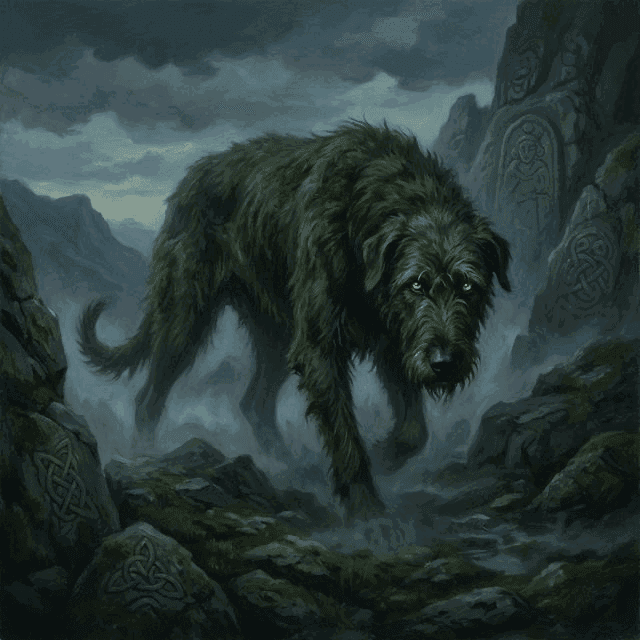
A massive fairy hound the size of a bull, with shaggy dark green fur and braided tail. Its three barks summon death, and it roams the Scottish Highlands collecting souls of the dying.
About Cu Sith
The Green Hound of the Sithein
Scottish Gaelic tradition knows a large green fairy dog, the cù-sìth, whose barks (often three) are a death omen. Collectors (J. G. Campbell, later folklore archives) place it on the moors between this world and the sìth mounds. It is not Cú Chulainn's hound.
The record is oral and early-modern; there is no medieval tract devoted to the beast.
Three barks
In the Highland lore gathered by John Gregorson Campbell in Superstitions of the Highlands and Islands of Scotland (1900), the fairy dog moves silently and leaves footprints as large as a man's hand. It barks three times, with long pauses between, and anyone who has not reached safety by the third bark is overtaken by terror or death. Women were sometimes said to be taken by it to nurse fairy children in the mounds.
Quick answers about Cu Sith
- What is Cu Sith?
- A massive fairy hound the size of a bull, with shaggy dark green fur and braided tail. Its three barks summon death, and it roams the Scottish Highlands collecting souls of the dying.
- Where does Cu Sith live?
- The atlas lists Cu Sith's habitat as Scottish Highlands.
- What abilities does Cu Sith have?
- The atlas lists these abilities for Cu Sith: Death Howl, Soul Collection, and Supernatural Tracking.
Sources and further reading
Source notes
These references are recorded in the catalog. Their passage wording and translation have not been checked, so quotations are not displayed here.
- Scottish Gaelic oral tradition (collected 19th c.)
About this entry
By Elizabeth Stein for Mythos Atlas. About the author. Editorial notes are grounded in the site's cited sources and can be challenged through the contact page.
The danger rating is an editorial shorthand for how the myths portray the creature, not a claim made by the sources.
Keep exploring
One myth a week, with its sources in a short email. The sign-up form is just below.