Korean TraditionFounding King
Bak Hyeokgeose
朴赫居世 (박혁거세)(Bak Hyeokgeose)
Also known as Hyeokgeose Geoseogan, Bulgunae (Brightness)
- the founding of Silla
- brightness
- kingship
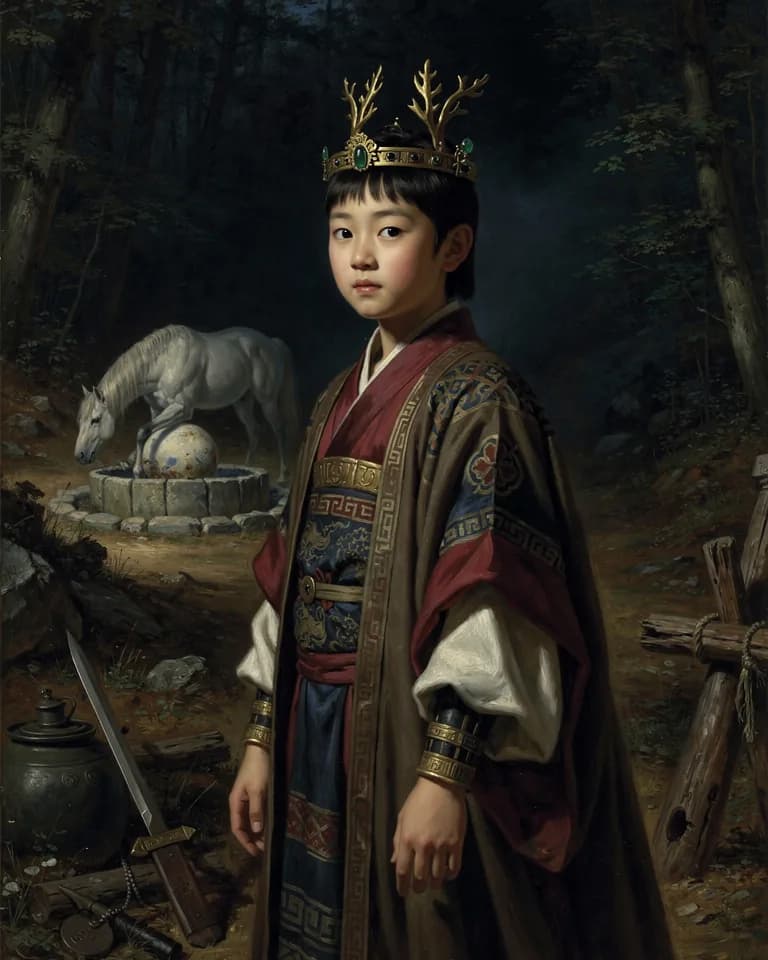
The egg-born founder of Silla, found by the six village chiefs beside the Najeong well where a white horse knelt and then rose into heaven; crowned at thirteen with his queen Aryeong, born from a dragon at another well.
About Bak Hyeokgeose
The egg at Najeong
In Iryeon's Samguk Yusa, the chiefs of six villages of the Gyeongju plain gather on the bank of the Al River and agree that they need a ruler. Looking south, they see a strange light like lightning at the Najeong well at the foot of Mount Yang, and a white horse kneeling there as if bowing. They find a purple egg; the horse, seeing them, neighs and rises into the sky. From the egg comes a boy of great beauty. When they bathe him in the Eastern Spring, his body gives off light, birds and beasts dance, heaven and earth shake, and the sun and moon shine clear. They name him Hyeokgeose, 'brightening the world', and give him the surname Bak because the egg was like a gourd (bak).
Aryeong
On the same day a chicken-dragon appears at the Aryeong well and a girl is born from its side, with lips like a chicken's beak until she is bathed in the northern stream. The two are raised together, and when Hyeokgeose is thirteen (traditionally 57 BCE), he becomes king with Aryeong as queen, and the state is called Seorabeol.
Death
After sixty-one years of rule, the Samguk Yusa says, he ascended to heaven, and seven days later his body fell to the earth in five parts. When the people tried to bury them together, a great serpent prevented them, so they buried the five parts in five tombs, the Oreung ('Five Tombs'), also called the Serpent Tombs. The traditional dates are not historical; Silla emerged as a state in the following centuries.
Origin story
Born from a purple egg found beside the Najeong well where a white horse knelt and then rose to heaven (Samguk Yusa, Book 1; Samguk Sagi).
Worship and cult
Temples, festivals, and practices recorded for Bak Hyeokgeose
Silla kings sacrificed at the founder's shrine; the Bak clan continues ancestral rites at Sungdeokjeon.
Sacred sites
- The Najeong site in Gyeongju, where excavations uncovered the foundations of an octagonal building interpreted as a shrine to the founder.
- Sungdeokjeon, the shrine to Bak Hyeokgeose beside the Oreung (Five Tombs) in Gyeongju.
In the atlas
Where Bak Hyeokgeose appears
Sources and further reading
Source notes
These references are recorded in the catalog. Their passage wording and translation have not been checked, so quotations are not displayed here.
- Iryeon, Samguk Yusa, Book 1, 'Silla's Founder King Hyeokgeose' (paraphrase)
- Kim Busik, Samguk Sagi, Annals of Silla, Hyeokgeose (paraphrase)
Appears in
Ancient and classical works featuring this figure.
Samguk Yusa (Memorabilia of the Three Kingdoms)
egg-born founder of Silla (Book 1, Silla's founder King Hyeokgeose)
About this entry
By Elizabeth Stein for Mythos Atlas. About the author. Editorial notes are grounded in the site's cited sources and can be challenged through the contact page.
Parallels are editorial comparisons across traditions: a shared role does not, by itself, establish a shared origin.