Korean Traditionlegend
Bak Hyeokgeose and the Egg at Najeong
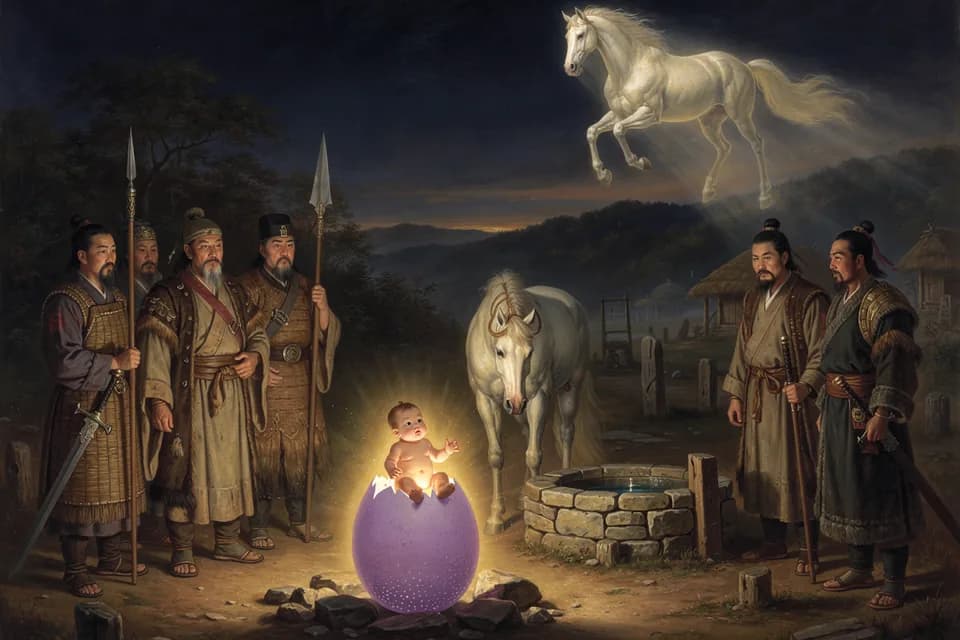
The six village chiefs of the Gyeongju plain, seeking a king, see a white horse kneeling at the Najeong well beside a purple egg; the horse rises into heaven, and from the egg comes the radiant boy who will found Silla, crowned at thirteen with a queen born from a dragon.
An editorial retelling
The story
Six villages without a king
Iryeon's Samguk Yusa tells that in the year the Chinese reckoned as the first year of the Dijie era of the Former Han (69 BCE), on the first day of the third month, the chiefs of the six villages of Jinhan gathered with their sons on the bank of the Al River. They said: we have no ruler over the people, and they do as they please; let us find a man of virtue, make him king, and found a state.
The white horse
They climbed to a high place and looked south. At the Najeong well below Mount Yang they saw a strange light like lightning touching the ground, and a white horse kneeling there as if bowing. Going down to look, they found a purple egg (some say a large blue egg). When the horse saw them, it neighed long and rose up into the sky.
The radiant boy
They broke open the egg and found a boy of beautiful form. They were astonished, and bathed him in the Eastern Spring. His body gave off light; birds and beasts danced together; heaven and earth shook; and the sun and moon shone clear. So they named him Hyeokgeose, 'one who brightens the world'. Because the egg was like a gourd, called bak, they gave him the surname Bak.
The queen from the dragon
People congratulated each other, saying that the Son of Heaven had come down and now a virtuous queen must be found for him. That same day, at the Aryeong well in Saryang village, a chicken-dragon appeared, and from its left side a girl was born. Her face was lovely, but her lips were like a chicken's beak. When she was bathed in the northern stream of Wolseong, the beak fell away. She was named after the well, Aryeong.
King and queen
The two children were raised in a palace built at the foot of Mount Namsan. When they were thirteen, the boy was made king and the girl queen, and the state was called Seorabeol. After sixty-one years of rule, the king ascended to heaven; seven days later his body fell back to the earth in five parts, and the queen too died. When the people tried to bury them together, a great serpent drove them off, so they buried the five parts in five tombs, called the Five Tombs or the Serpent Tombs.
Another version
Kim Busik's Samguk Sagi tells a shorter version: the chief of Goheo village, Sobeolgong, saw a horse kneeling and neighing in the forest by the Najeong well; when he went there, the horse vanished and there was only a large egg, from which the child came. The two accounts agree on the well, the horse, and the egg, the three emblems of Silla's heavenly origin.
Listen or change reading mode
Highlights
The six village chiefs see a light and a kneeling white horse at the Najeong well; the horse rises to heaven, leaving a purple egg from which the radiant Hyeokgeose is born; the chicken-dragon of Aryeong well gives birth to his queen; after his death his body falls from heaven in five parts.
Why it matters
The foundation myth of Silla, the kingdom that later unified most of the Korean peninsula; the Najeong well and the Five Tombs in Gyeongju remain places of memory and ancestral rites.
Sources and further reading
By Elizabeth Stein for Mythos Atlas. About the author. Editorial notes are grounded in the site's cited sources and can be challenged through the contact page.
Works cited
Samguk Yusa, Book 1, 'Silla's Founder King Hyeokgeose'
Iryeon; trans. Ha Tae-hung and Grafton K. Mintz
Samguk Sagi, Annals of Silla, Hyeokgeose
Kim Busik; trans. Edward J. Shultz and Hugh H. W. Kang