Korean Traditionorigin
Jumong, Son of Heaven and the River
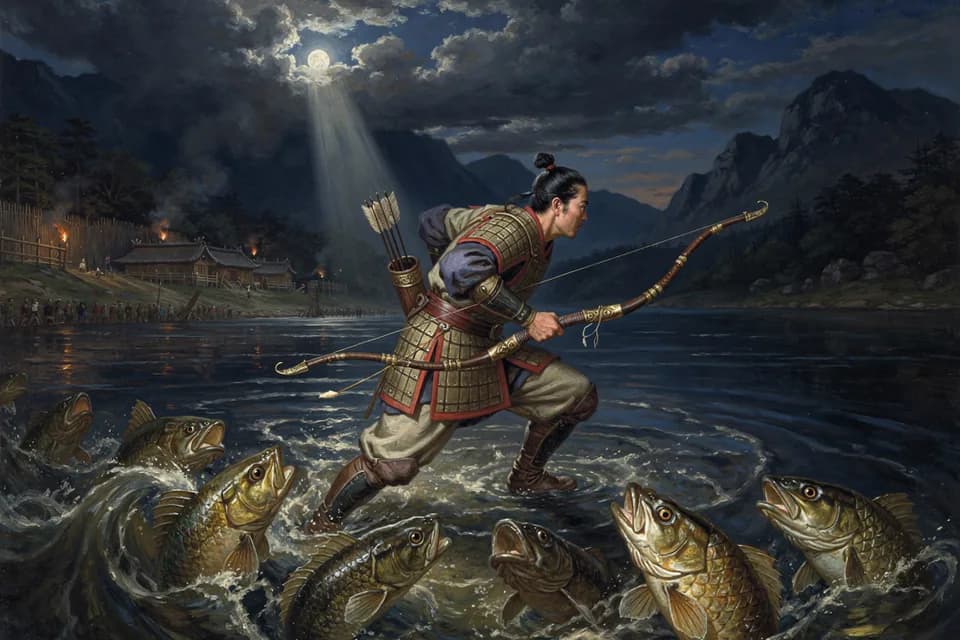
Born from an egg laid by the River Earl's daughter, Jumong grows into a matchless archer at the court of East Buyeo; fleeing the jealous princes, he is saved when fish and turtles rise to bridge a river, and he founds the kingdom of Goguryeo.
An editorial retelling
The story
The river's daughter
The history of Goguryeo in Kim Busik's Samguk Sagi (1145) begins with King Geumwa of East Buyeo, who found a young woman south of Mount Taebaek. She told him she was Yuhwa, daughter of Habaek, the River Earl. While she was out with her sisters, a man who called himself Haemosu, son of Heaven, had lured her to a house by the Amnok River beneath Mount Ungsim and lain with her, and then gone away and never come back. Her parents, ashamed, had banished her.
The egg
Geumwa, finding this strange, shut her in a room. The sunlight shone on her there, and when she moved away from it, it followed her. She conceived, and laid an egg as large as five measures of grain. The king was disgusted and had it thrown to the dogs and pigs, but they would not eat it. He had it left on the road, but the horses and cattle stepped around it. He had it left in the fields, and the birds covered it with their wings. He tried to break it himself and could not, and gave it back to its mother. She wrapped it and kept it warm, and a boy broke out of the shell, of extraordinary looks.
The archer
At seven he made his own bow and arrows, and shot a hundred times without missing. In the speech of Buyeo a good archer was called jumong, and that became his name. Geumwa's seven sons, led by the eldest, Daeso, resented him and wanted him killed. Set to tend the king's horses, Jumong recognized the finest one and starved it until it was thin, while he fattened the poor horses; the king took the fat ones for himself and gave the thin one to Jumong.
The bridge of fish and turtles
When his mother warned him that the princes meant to kill him, Jumong fled with three companions, Oi, Mai, and Hyeopbo. At the Eomsa River there was no bridge, and the pursuing riders were close behind. Jumong cried out to the water: I am the son of Heaven and the grandson of Habaek; today I flee, and my pursuers are upon me; what shall I do? Fish and turtles rose to the surface and formed a bridge, and he crossed. Then they sank, and the riders could not follow.
Goguryeo
Jumong came to Jolbon, where the land was rich and the mountains strong, and founded his capital there, naming the state Goguryeo and taking Go as his family name. The Samguk Sagi dates this to 37 BCE, when he was twenty-two.
The oldest version
Nine centuries before Kim Busik, the Gwanggaeto Stele of 414 CE had already told the story in brief: King Chumo, son of the Heavenly Emperor and the daughter of Habaek, broke from an egg; at a great river, reeds joined and turtles surfaced so he could cross; he built his capital on the mountain west of Holbon; and when he no longer delighted in the world, heaven sent a yellow dragon, and he rose to heaven standing on its head.
Listen or change reading mode
Highlights
Yuhwa, banished for her union with Haemosu, conceives from sunlight and lays an egg that animals protect; the boy Jumong becomes a peerless archer, tricks the king into giving him the best horse, and flees across a bridge of fish and turtles to found Goguryeo at Jolbon.
Why it matters
The foundation myth of Goguryeo, attested on the Gwanggaeto Stele of 414 CE as the oldest written Korean myth, and the basis of popular modern retellings such as the television drama 'Jumong' (2006-2007).
Other versions
2 alternate accounts in the catalog.
Gwanggaeto Stele
The founder is called Chumo, son of the Heavenly Emperor (Haemosu is not named); reeds and turtles, not fish and turtles, make his crossing; and he ends his life by ascending to heaven on a yellow dragon.
Note: The oldest written version, erected by his descendants.
Yi Gyu-bo, Dongmyeongwang-pyeon
Adds Haemosu's descent in a five-dragon chariot, his transformation contest with Habaek, and Yuhwa's doves carrying grain seeds after her fleeing son.
Note: Quotes the lost 'Old History of the Three Kingdoms'.
Sources and further reading
By Elizabeth Stein for Mythos Atlas. About the author. Editorial notes are grounded in the site's cited sources and can be challenged through the contact page.
Works cited
Samguk Sagi, Annals of Goguryeo, King Dongmyeong
Kim Busik; trans. Edward J. Shultz and Hugh H. W. Kang
Gwanggaeto Stele, opening lines
Goguryeo court
Dongmyeongwang-pyeon
Yi Gyu-bo