Korean Tradition
Haemosu
解慕漱 (해모수)(Haemosu)
Also known as Son of Heaven (Cheonja)
- heaven
- the sun
- kingship
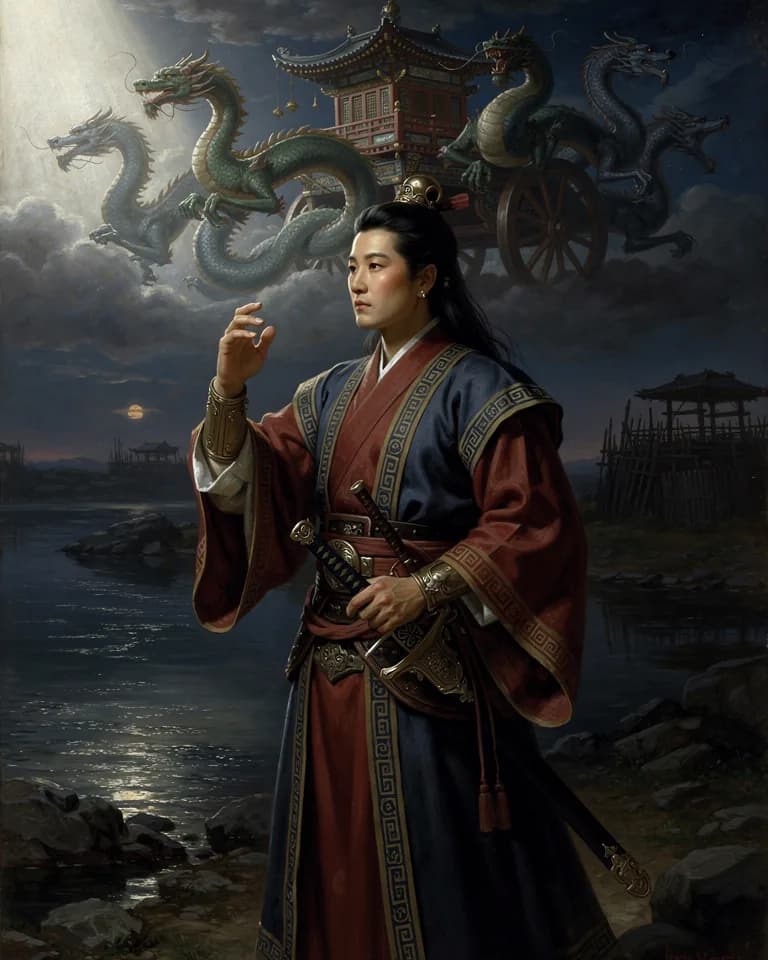
The Son of Heaven who descends in a five-dragon chariot, seduces Yuhwa, daughter of the River Earl, by the Amnok (Yalu) River, and becomes the father of Jumong, founder of Goguryeo.
About Haemosu
The Son of Heaven
In Kim Busik's Samguk Sagi (1145), Yuhwa tells King Geumwa of East Buyeo that a man calling himself Haemosu, son of Heaven, lured her to a house by the Amnok (Yalu) River beneath Mount Ungsim, lay with her, and never returned; her parents, ashamed, banished her. Yi Gyu-bo's Lay of King Dongmyeong (1193), quoting a lost older history, describes Haemosu's descent more grandly: he comes down in a chariot drawn by five dragons, with a hundred followers riding swans, wearing a crown of crow feathers and a sword of dragon-light, going up to heaven at evening and descending in the morning.
The contest with the River Earl
In Yi Gyu-bo's version, Haemosu meets the River Earl's daughters bathing, captures Yuhwa, and then asks her father, Habaek, for her hand. Habaek tests his divine claim with a contest of transformations: Habaek becomes a carp and Haemosu an otter; Habaek a deer and Haemosu a wolf; Habaek a pheasant and Haemosu a hawk. Convinced, Habaek holds a wedding feast, but Haemosu leaves Yuhwa and returns to heaven alone.
Other sources
The Samguk Yusa also names Haemosu as a Son of Heaven who founded North Buyeo. The Gwanggaeto Stele (414 CE) simply calls Jumong the son of the Heavenly Emperor, without naming Haemosu.
Origin story
Son of Heaven (the Heavenly Emperor), in Samguk Sagi and Yi Gyu-bo's poem.
Worship and cult
Temples, festivals, and practices recorded for Haemosu
Honored as the heavenly father of the Goguryeo royal line; Goguryeo's festival of heaven, the Dongmaeng in the tenth month, is recorded in Chinese histories but not tied to Haemosu by name.
Family
In the atlas
Where Haemosu appears
Sources and further reading
Source notes
These references are recorded in the catalog. Their passage wording and translation have not been checked, so quotations are not displayed here.
- Kim Busik, Samguk Sagi, Annals of Goguryeo, King Dongmyeong (paraphrase)
- Yi Gyu-bo, Dongmyeongwang-pyeon, prose note quoting the Old History of the Three Kingdoms (paraphrase)
About this entry
By Elizabeth Stein for Mythos Atlas. About the author. Editorial notes are grounded in the site's cited sources and can be challenged through the contact page.
Parallels are editorial comparisons across traditions: a shared role does not, by itself, establish a shared origin.
Family relationships come from the atlas's kinship records. Ancient sources often disagree on divine genealogy.
Genealogy
Family tree
Haemosu's parents, consorts, children and rivals, as recorded in the atlas.