Korean Tradition
Hwanung
桓雄 (환웅)(Hwanung)
Also known as Hwanung Cheonwang (Heavenly King Hwanung)
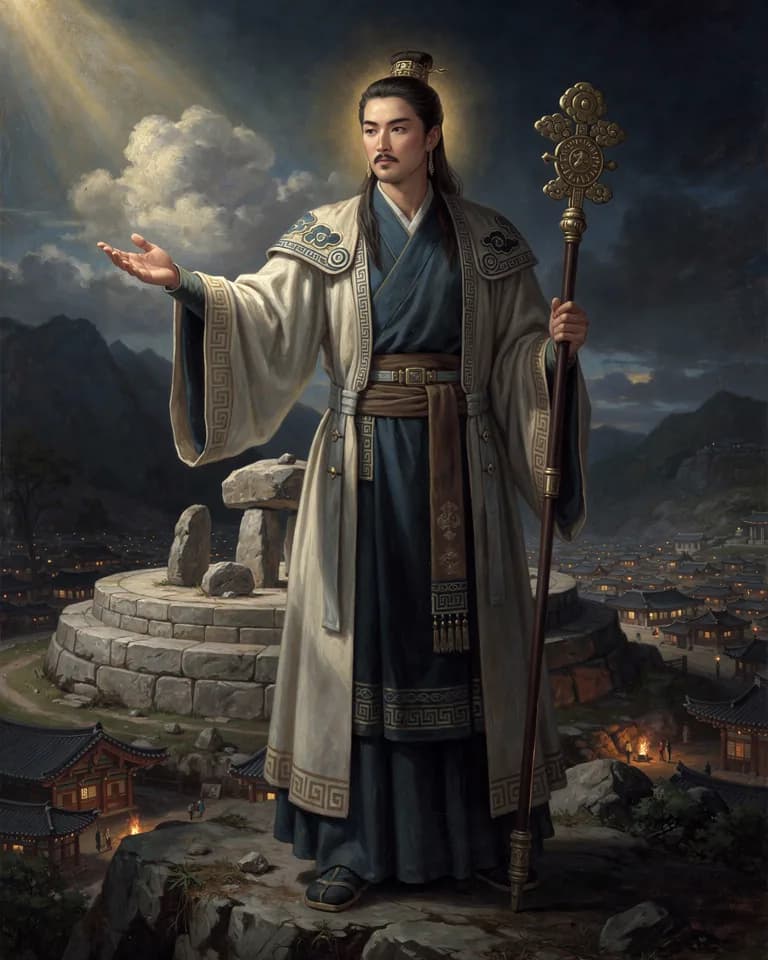
- heaven's rule on earth
- agriculture
- life and law
The son of the Lord of Heaven who descends to Mount Taebaek with three thousand followers and the ministers of wind, rain, and clouds, founds the 'City of God' beneath the sacred altar tree, and fathers Dangun with the bear-woman Ungnyeo.
About Hwanung
Descent to Taebaek
In the Samguk Yusa Dangun myth, Hwanung, son of the Lord of Heaven, receives three heavenly seals from his father and descends with three thousand followers to the summit of Mount Taebaek, beneath the sacred altar tree (Sindansu). He calls the place Sinsi, the 'City of God', and is called Heavenly King Hwanung. With the Wind Earl, the Rain Master, and the Cloud Master, he takes charge of grain, life, sickness, punishment, and good and evil, some three hundred and sixty human affairs in all, and rules and civilizes the world.
The bear and the tiger
A bear and a tiger living in one cave pray to him constantly to become human. He gives them a bundle of sacred mugwort and twenty cloves of garlic, telling them to eat these and avoid the sunlight for a hundred days. The bear keeps the taboo and after twenty-one days becomes a woman; the tiger does not. When the bear-woman prays beneath the altar tree for a child, Hwanung takes human form for a time and marries her, and she bears Dangun.
Reading the myth
The ministers of wind, rain, and clouds make Hwanung a bringer of agriculture and order, and many scholars read the bear and tiger as the totems of peoples who joined or resisted a sky-worshipping group. Such interpretations are modern hypotheses; the text itself tells a sacred story of the origin of the first Korean kingdom.
Origin story
Son of Hwanin, the Lord of Heaven, by a secondary wife (Samguk Yusa, Book 1).
Worship and cult
Temples, festivals, and practices recorded for Hwanung
Venerated in modern Dangun-centered religious movements; the sacred tree and mountain of his descent echo village guardian trees and mountain altars in Korean folk religion.
Sacred sites
- Honored with Hwanin and Dangun at shrines of Daejonggyo and in modern Dangun rites.
Festivals
- National Foundation Day (Gaecheonjeol, 3 October), which commemorates the 'opening of heaven' by his descent.
Family
Hwanung's family at a glance
- Who are Hwanung's parents?
- The atlas's kinship records name one parent of Hwanung: Hwanin. Ancient accounts do not always agree on divine parentage.
- Who are Hwanung's children?
- Children of Hwanung recorded in the atlas: Dangun.
- Who were Hwanung's spouses and consorts?
- Spouses and consorts of Hwanung recorded in the atlas: Ungnyeo.
In the atlas
Where Hwanung appears
Sources and further reading
Source notes
These references are recorded in the catalog. Their passage wording and translation have not been checked, so quotations are not displayed here.
- Iryeon, Samguk Yusa, Book 1, 'Gojoseon (Wanggeom Joseon)' (paraphrase)
Appears in
Ancient and classical works featuring this figure.
Samguk Yusa (Memorabilia of the Three Kingdoms)
son of the Lord of Heaven, who descends to Mount Taebaek (Book 1, Gojoseon)
About this entry
By Elizabeth Stein for Mythos Atlas. About the author. Editorial notes are grounded in the site's cited sources and can be challenged through the contact page.
Parallels are editorial comparisons across traditions: a shared role does not, by itself, establish a shared origin.
Family relationships come from the atlas's kinship records. Ancient sources often disagree on divine genealogy.
Genealogy
Family tree
Hwanung's parents, consorts, children and rivals, as recorded in the atlas.