Korean TraditionFounding Ancestor
Dangun
檀君王儉 (단군왕검)(Dangun Wanggeom)
Also known as Dangun Wanggeom, Tangun
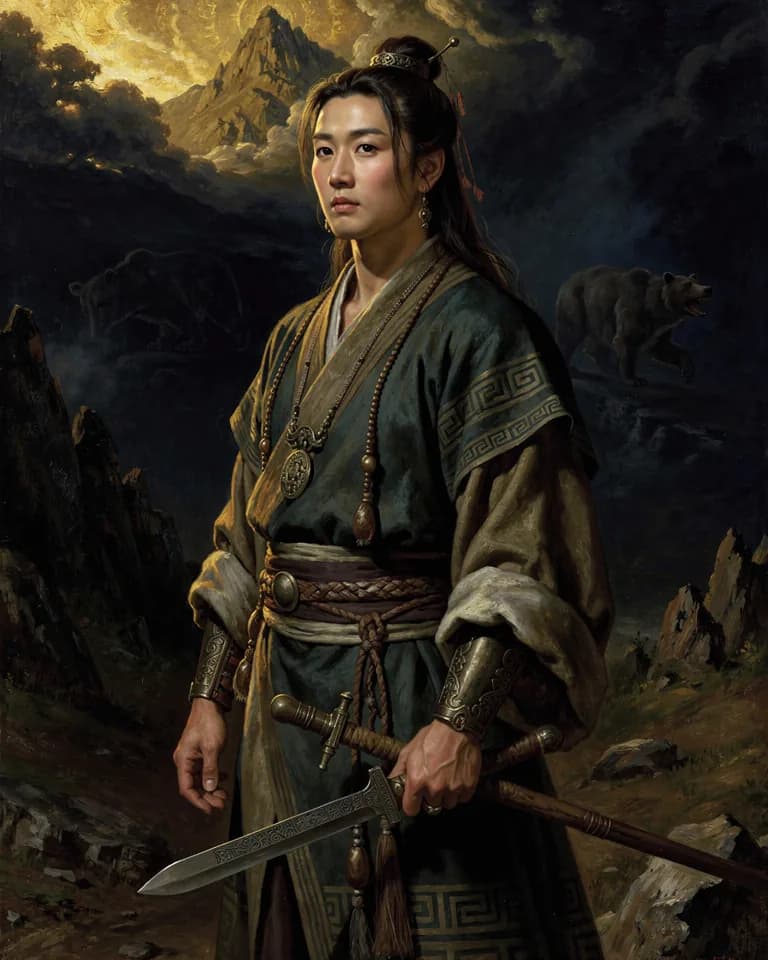
- the founding of Joseon
- the Korean people
- the mountains (as mountain god)
The son of the heavenly Hwanung and the bear-woman Ungnyeo, who in the Samguk Yusa founds the kingdom of Joseon (Gojoseon), rules for fifteen hundred years, and at last becomes a mountain god; honored as the founding ancestor of the Korean people.
About Dangun
In the Samguk Yusa
Iryeon's Samguk Yusa gives two accounts. From a Chinese 'Book of Wei' it quotes that two thousand years earlier Dangun Wanggeom set his capital at Asadal and founded a state called Joseon, in the time of the sage-emperor Yao. From the Korean 'Old Record' it tells the full myth: born of Hwanung and Ungnyeo, Dangun made his capital at Pyongyang in the fiftieth year of Yao, called his state Joseon, later moved to Asadal on Mount Baegak, and ruled for fifteen hundred years. When the Zhou king enfeoffed Gija in Joseon, Dangun moved away, returned to Asadal, and became a mountain god, having lived 1,908 years. Iryeon himself notes that the traditional year does not match Yao's reign.
The date and the nation
The date 2333 BCE for Dangun's founding, used for South Korea's National Foundation Day, is a later calculation by Joseon-dynasty historians, not the Samguk Yusa's own statement, and the historical state of Gojoseon is known from Chinese sources from about the fourth century BCE until its conquest by the Han in 108 BCE. Dangun became a powerful symbol of national identity, especially under Japanese colonial rule (1910-1945), when the religion Daejonggyo (founded 1909) and independence activists honored him as the common ancestor of all Koreans.
Two Koreas
South Korea celebrates Gaecheonjeol on 3 October. North Korea announced in 1993 that it had found Dangun's bones near Pyongyang and built a large mausoleum in 1994; most historians outside North Korea regard the claim as political rather than archaeological.
Origin story
Son of Hwanung, the son of the Lord of Heaven, and Ungnyeo, the bear who became a woman (Samguk Yusa, Book 1).
Worship and cult
Temples, festivals, and practices recorded for Dangun
Rites to Dangun as national ancestor were held by Joseon kings and revived by Daejonggyo in the twentieth century; the torch of the Korean National Sports Festival is lit at Chamseongdan.
Sacred sites
- Chamseongdan, the stone altar on Mount Mani, Ganghwa Island, traditionally said to have been built by Dangun for sacrifices to heaven.
- Samseongsa shrine at Guwol-san and other historic Dangun shrines; the modern Mausoleum of Dangun near Pyongyang (North Korea, 1994).
Festivals
- National Foundation Day (Gaecheonjeol, 3 October) in South Korea, with a heaven rite at Chamseongdan.
Family
In the atlas
Where Dangun appears
Sources and further reading
Source notes
These references are recorded in the catalog. Their passage wording and translation have not been checked, so quotations are not displayed here.
- Iryeon, Samguk Yusa, Book 1, 'Gojoseon (Wanggeom Joseon)' (paraphrase)
Appears in
Ancient and classical works featuring this figure.
Samguk Yusa (Memorabilia of the Three Kingdoms)
founder of Gojoseon (Book 1, Gojoseon)
About this entry
By Elizabeth Stein for Mythos Atlas. About the author. Editorial notes are grounded in the site's cited sources and can be challenged through the contact page.
Parallels are editorial comparisons across traditions: a shared role does not, by itself, establish a shared origin.
Family relationships come from the atlas's kinship records. Ancient sources often disagree on divine genealogy.
Genealogy
Family tree
Dangun's parents, consorts, children and rivals, as recorded in the atlas.