Korean TraditionLord of Heaven
Hwanin
桓因 (환인)(Hwanin)
Also known as Jeseok (in Iryeon's gloss)
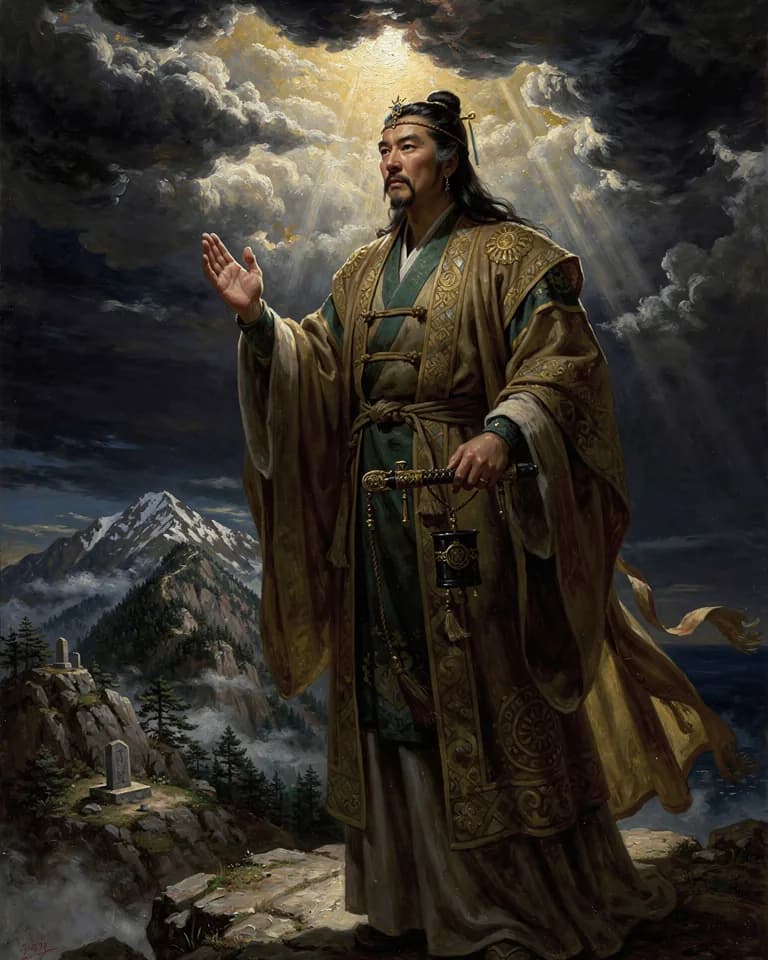
- heaven
- sovereignty over the world
The Lord of Heaven in the Dangun myth, who sees that his son Hwanung longs for the human world, looks down on Mount Taebaek as a place where he could 'widely benefit humanity', and sends him down with three heavenly seals.
About Hwanin
In the Samguk Yusa
The Dangun myth in Iryeon's Samguk Yusa (c. 1281-1289), quoting an older 'Old Record' (Gogi), opens with Hwanin. His son by a secondary wife, Hwanung, often longed for the world below and desired human society. Knowing his son's wish, Hwanin looked down on Mount Taebaek among three high peaks, judged that it was a place where one could 'widely benefit humanity' (hongik ingan), and gave Hwanung three heavenly seals (cheonbuin) and sent him down to rule.
Iryeon's gloss
At Hwanin's name Iryeon adds a brief note: 'that is, Jeseok', the Korean form of Śakra, the Buddhist name of the Vedic god Indra, king of the gods of the Trayastrimsha heaven. The note shows a Buddhist monk reading the native Lord of Heaven through a Buddhist lens; whether the older tradition already had this association is unknown. Later Korean religious movements, such as Daejonggyo (founded 1909), revere Hwanin, Hwanung, and Dangun together as a trinity.
Hongik ingan
The phrase 'widely benefit humanity', attached in the myth to Hwanin's choice of Taebaek, became a founding ideal of modern South Korean education, written into the Education Act of 1949.
Origin story
No origin is told; he is the ruler of heaven when the myth begins.
Across traditions
Parallel figures
Figures who play a role like Hwanin's in other traditions.
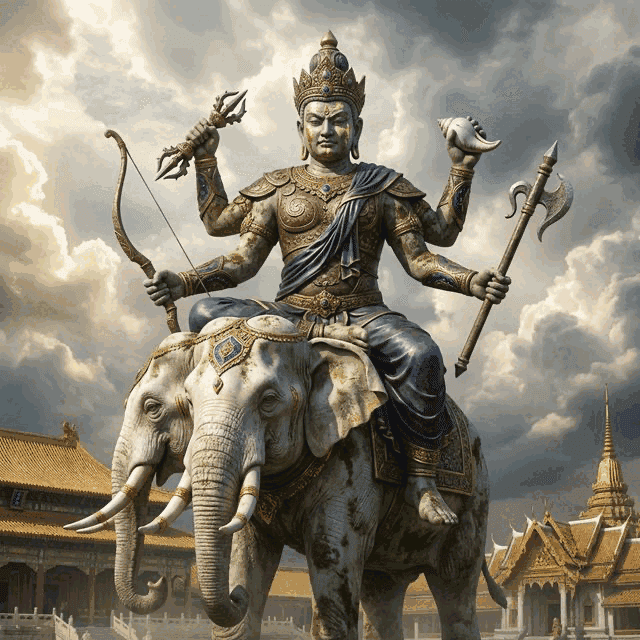 HinduIndra
Iryeon's thirteenth-century note identifies Hwanin with Jeseok (Śakra), the Buddhist name of Indra, king of the gods. The identification is a Buddhist monk's gloss, not evidence that the Korean sky-lord derives from Indra.
Compare Hwanin and Indra side by side
Worship and cult
Temples, festivals, and practices recorded for Hwanin
Honored chiefly as the heavenly origin of the Dangun lineage; the ideal of hongik ingan associated with his choice of Taebaek is cited in South Korean education law.
Sacred sites
- Samseonggung and other shrines of Daejonggyo and related modern movements venerate Hwanin, Hwanung, and Dangun together.
Festivals
- National Foundation Day (Gaecheonjeol, 3 October), celebrating the 'opening of heaven' when Hwanung descended and Dangun founded Joseon.
Family
In the atlas
Where Hwanin appears
Sources and further reading
Source notes
These references are recorded in the catalog. Their passage wording and translation have not been checked, so quotations are not displayed here.
- Iryeon, Samguk Yusa, Book 1, 'Gojoseon (Wanggeom Joseon)', quoting the Old Record (paraphrase)
About this entry
By Elizabeth Stein for Mythos Atlas. About the author. Editorial notes are grounded in the site's cited sources and can be challenged through the contact page.
Parallels are editorial comparisons across traditions: a shared role does not, by itself, establish a shared origin.
Family relationships come from the atlas's kinship records. Ancient sources often disagree on divine genealogy.
Genealogy
Family tree
Hwanin's parents, consorts, children and rivals, as recorded in the atlas.