Korean TraditionAncestral Mother
Ungnyeo
熊女 (웅녀)(Ungnyeo)
Also known as The Bear Woman
- endurance
- motherhood
- transformation
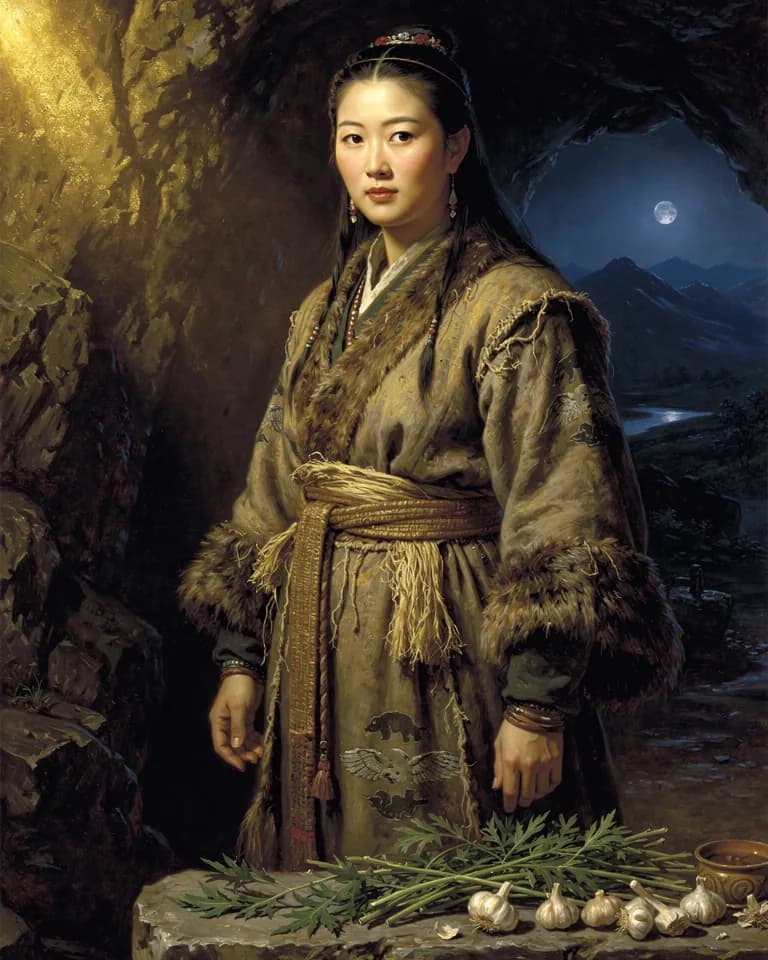
The bear who, with a tiger, begs Hwanung to become human, endures twenty-one days in darkness eating only mugwort and garlic, becomes a woman, and by Hwanung bears Dangun, founder of the first Korean kingdom.
About Ungnyeo
From bear to woman
In the Dangun myth of the Samguk Yusa, a bear and a tiger living together in a cave pray constantly to Hwanung to become human. He gives them a bundle of sacred mugwort and twenty cloves of garlic and tells them to avoid the sunlight for a hundred days. Both eat and withdraw; the bear keeps the taboo, and after three times seven days (twenty-one days) she obtains a woman's body. The tiger cannot keep it and remains a tiger.
Mother of Dangun
The bear-woman has no one to marry, and prays beneath the sacred altar tree for a child. Hwanung takes human form for a time and marries her, and she bears a son, Dangun Wanggeom, who founds Joseon. The text names her only as Ungnyeo, 'bear woman'.
Meaning and afterlife
The twenty-one days (samchil-il) of her seclusion echo a Korean custom of observing twenty-one days of taboo after childbirth, and her story is often read as a story of patience and transformation. Mugwort and garlic remain everyday foods and medicines in Korea. Scholars have long debated whether the bear reflects a bear-honoring people or a wider northern Eurasian bear cult; the myth itself gives no such explanation.
Origin story
A bear living in a cave with a tiger, transformed into a woman through Hwanung's instructions (Samguk Yusa, Book 1).
Worship and cult
Temples, festivals, and practices recorded for Ungnyeo
Honored as the ancestral mother of the Korean people in modern Dangun-centered traditions; no separate historical cult of Ungnyeo is documented.
Family
In the atlas
Where Ungnyeo appears
Sources and further reading
Source notes
These references are recorded in the catalog. Their passage wording and translation have not been checked, so quotations are not displayed here.
- Iryeon, Samguk Yusa, Book 1, 'Gojoseon (Wanggeom Joseon)' (paraphrase)
Appears in
Ancient and classical works featuring this figure.
Samguk Yusa (Memorabilia of the Three Kingdoms)
the bear who becomes a woman (Book 1, Gojoseon)
About this entry
By Elizabeth Stein for Mythos Atlas. About the author. Editorial notes are grounded in the site's cited sources and can be challenged through the contact page.
Parallels are editorial comparisons across traditions: a shared role does not, by itself, establish a shared origin.
Family relationships come from the atlas's kinship records. Ancient sources often disagree on divine genealogy.
Genealogy
Family tree
Ungnyeo's parents, consorts, children and rivals, as recorded in the atlas.