Korean Traditionregalia
Cheonbuin (Three Heavenly Seals)
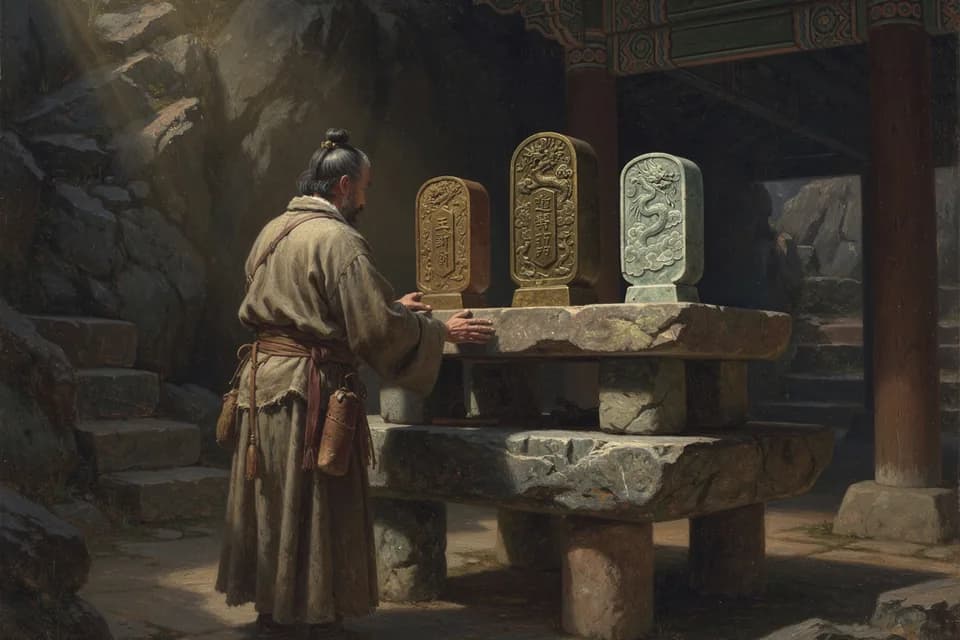
- Conferring heaven's authority to rule
- Marking the legitimacy of the heavenly descent
The three heavenly seals or tokens that Hwanin gave his son Hwanung as signs of heaven's authority when he sent him down to rule the world at Mount Taebaek.
About Cheonbuin (Three Heavenly Seals)
Heaven's tokens
The Samguk Yusa says only that Hwanin gave Hwanung 'three heavenly seals' (cheonbuin samgae) and sent him down to rule. The text does not say what they were. The word bu means a tally or token of authority and in a seal, and the three objects mark Hwanung's rule as delegated by heaven.
Interpretations
Scholars have proposed that the three seals reflect the ritual regalia of early Korean or northeast Asian rulers and shamans, commonly identified as a bronze mirror, a bronze sword, and a bronze bell or rattle, objects found together in Bronze Age burials of the Korean peninsula and Manchuria. The comparison with the three imperial regalia of Japan (mirror, sword, and jewel) is also often made. These identifications are modern hypotheses; the myth itself names no objects.
In modern tradition
Daejonggyo and other Dangun-centered movements treat the three seals as symbols of the heavenly mandate, and they appear in modern art depicting Hwanung's descent.
Origin
Given by Hwanin to Hwanung before his descent (Samguk Yusa, Book 1, 'Gojoseon').
Sources and further reading
Source notes
These references are recorded in the catalog. Their passage wording and translation have not been checked, so quotations are not displayed here.
- Iryeon, Samguk Yusa, Book 1, 'Gojoseon (Wanggeom Joseon)' (paraphrase)
About this entry
By Elizabeth Stein for Mythos Atlas. About the author. Editorial notes are grounded in the site's cited sources and can be challenged through the contact page.