Korean Traditionelixir
Water of Life and Flowers of Revival
- Restoring the dead to life
- Healing mortal illness
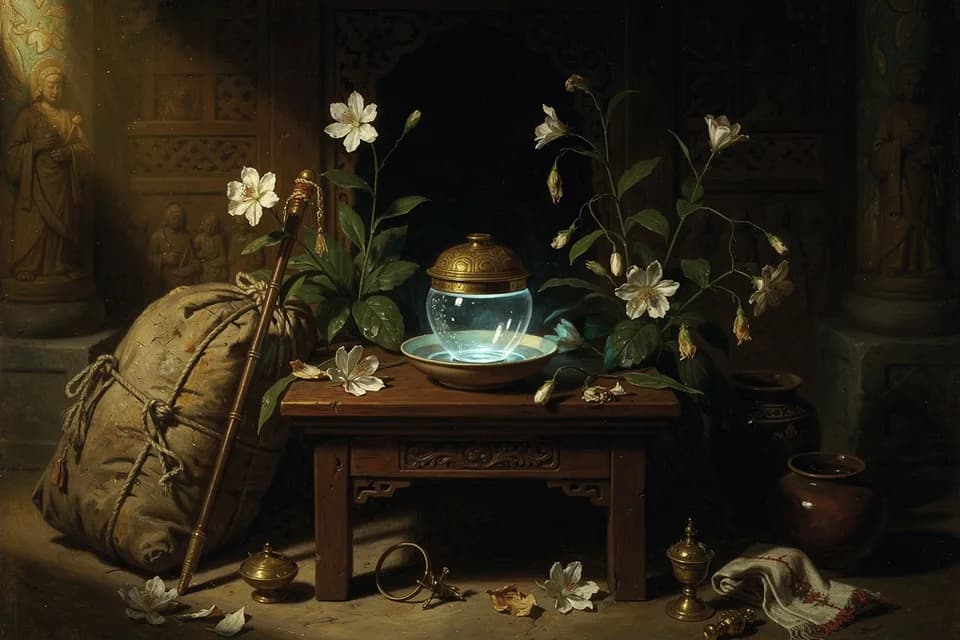
The medicinal water of the Western Heaven and the flowers that restore bone, flesh, and breath, which Princess Bari brings back from the end of the world to revive her dead parents.
About Water of Life and Flowers of Revival
The medicine water
In the Bari Gongju songs, King Ogu and Queen Gildae fall mortally ill and learn that only the medicinal water (yaksu) of the Western Heaven can save them. Bari earns it by years of labor for its guardian, drawing water, cutting firewood, and tending fire, and brings it home in a vessel.
The flowers
Along with the water she gathers flowers that restore the parts of a body: in many versions a flower that revives bone, one that restores flesh, and one that restores breath. When she meets her parents' funeral procession, she lays the flowers on their bodies and pours the water into their mouths, and they return to life.
Flowers of life in Korean shamanism
Flowers that restore life appear in several Korean shamanic narratives, especially in Jeju, where the Seocheon flower field in the other world is tended by a flower-guardian god, and flowers of life and death decide human fates. Paper flowers are prominent in Korean shamanic rites for the dead.
Origin
Guarded at the source in the Western Heaven, and earned by Bari through years of labor (Bari Gongju muga).
Sources and further reading
Source notes
These references are recorded in the catalog. Their passage wording and translation have not been checked, so quotations are not displayed here.
- Bari Gongju muga (paraphrase of the revival scene common to many versions)
About this entry
By Elizabeth Stein for Mythos Atlas. About the author. Editorial notes are grounded in the site's cited sources and can be challenged through the contact page.