Korean TraditionGuide of the Dead
Bari Gongju
바리공주(Bari Gongju)
Also known as Princess Bari, Baridegi, Bari-degi
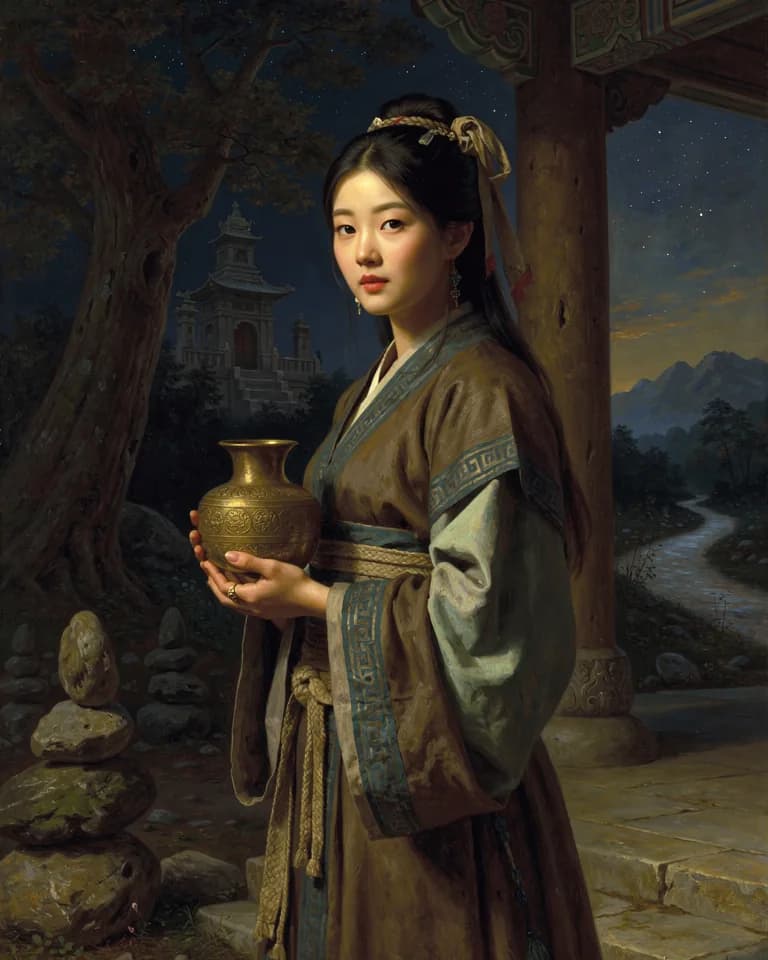
- the dead and their passage
- healing
- the patron of shamans
The seventh daughter of a king, thrown away at birth, who alone agrees to journey to the Western Heaven for the water of life when her parents are dying; she returns in time to revive them and becomes the goddess who guides the dead to the other world.
About Bari Gongju
A song for the dead
The story of Princess Bari is a muga, a shamanic narrative song, sung by Korean shamans in rites for the dead such as the Seoul jinogwi-gut and the east-coast ogu-gut, where the shaman guides the soul of the dead to the other world as Bari did. It exists in many dozens of recorded versions; one of the first to be written down was recorded from a Seoul shaman and published by Akiba Takashi and Akamatsu Chijō in 1937, and the folklorist Kim Tae-gon later recorded many more.
The story
In a common version, King Ogu marries Queen Gildae in an inauspicious year, as a fortune-teller had warned, and they have only daughters. When the seventh daughter is born, the king in anger has her cast away in a jade box into the water. She is rescued and raised by an old couple, or in some versions protected by the Buddha or by animals. Years later the king and queen fall mortally ill, and learn that only medicinal water from the Western Heaven can save them. The six elder daughters refuse. Bari, found and summoned, agrees to go, repaying the debt of her birth if not of her upbringing.
The journey and the return
Dressed as a man, she crosses mountains, rivers, and hells, sometimes helped by the Buddha. At the source of the water, its guardian demands years of labor: drawing water, cutting firewood, and tending fire, and in many versions he marries her and she bears him seven sons. At last she returns with the water and the flowers that restore bone, flesh, and breath, and meets her parents' funeral procession. She revives them. Offered wealth and half the kingdom, she asks instead to become the one who guides the dead, and she is honored as the ancestor of shamans.
Meaning
The story reverses the Confucian preference for sons: the rejected daughter alone fulfills filial duty. It is one of the best-known Korean myths and has been retold in modern novels, plays, and music.
Origin story
The seventh daughter of King Ogu and Queen Gildae, abandoned at birth (versions differ in names and details).
Across traditions
Parallel figures
Figures who play a role like Bari Gongju's in other traditions.
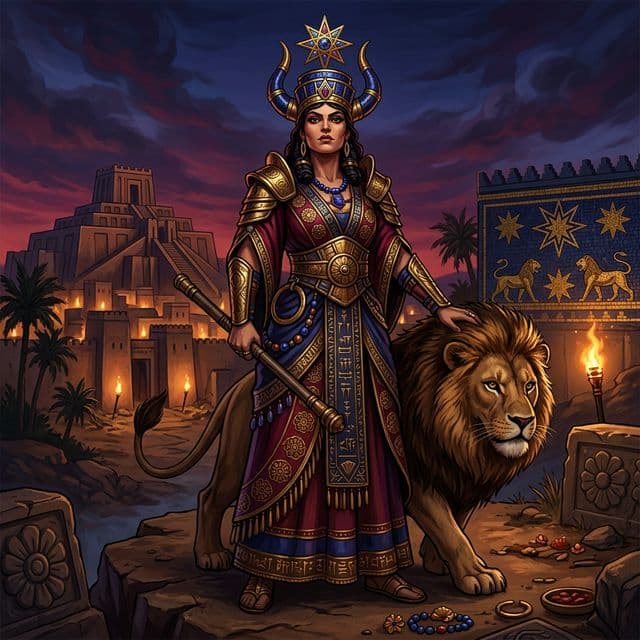 MesopotamianInanna
Both descend through the realm of the dead and return, with the power of life at stake; Bari goes willingly to fetch the water of life for her parents, while Inanna descends to claim the underworld and must be rescued. The comparison is typological.
Compare Bari Gongju and Inanna side by side
Worship and cult
Temples, festivals, and practices recorded for Bari Gongju
Her song is performed by shamans in rites for the dead (jinogwi-gut in Seoul, ogu-gut on the east coast), in which the shaman, in Bari's role, leads the soul of the deceased to the other world.
In the atlas
Where Bari Gongju appears
Stories
Sources and further reading
Source notes
These references are recorded in the catalog. Their passage wording and translation have not been checked, so quotations are not displayed here.
- Bari Gongju muga, Seoul versions, as collected in Hanguk Muga Jip (paraphrase)
- Bari Gongju muga (paraphrase of the revival scene common to many versions)
About this entry
By Elizabeth Stein for Mythos Atlas. About the author. Editorial notes are grounded in the site's cited sources and can be challenged through the contact page.
Parallels are editorial comparisons across traditions: a shared role does not, by itself, establish a shared origin.