Korean Traditioninstrument
Manpasikjeok
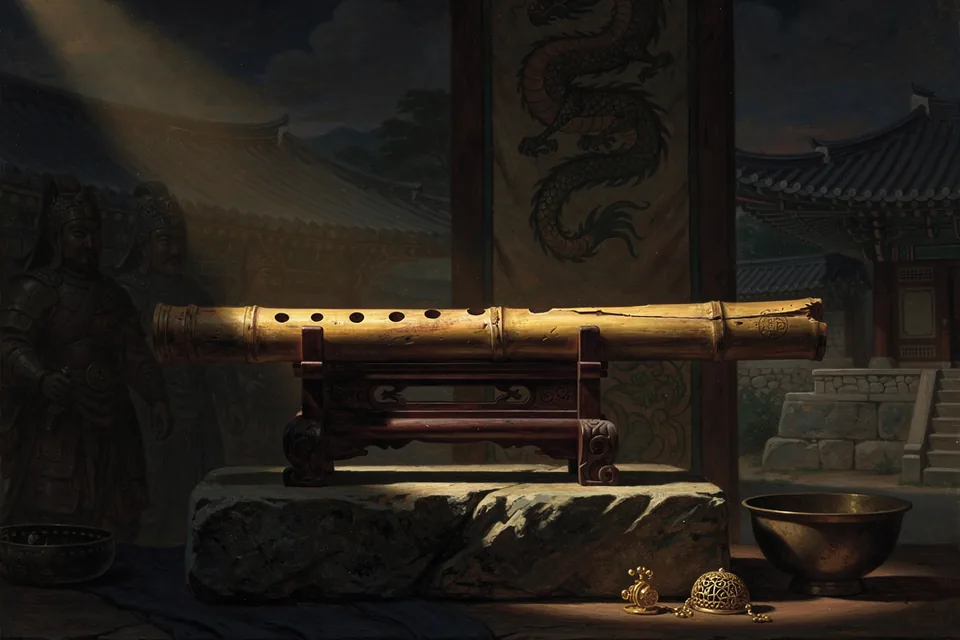
- Driving off enemy armies
- Curing disease
- Bringing or stopping rain
- Calming wind and waves
The bamboo flute made from a stalk that was two by day and one by night, given to Silla by the sea dragon of King Munmu; when played it drove off enemies, cured sickness, brought rain in drought, and calmed the wind and waves.
About Manpasikjeok
The bamboo of the floating mountain
In the Samguk Yusa, a small turtle-shaped mountain floats toward the temple of Gameunsa in 682, and on it grows a bamboo that is two stalks by day and one by night. A dragon tells King Sinmun that the bamboo, like two hands clapping, makes sound only when joined, and that a flute made from it will bring peace to the world, a gift from his father, King Munmu, now a sea dragon, and the general Kim Yu-sin, now a heavenly god.
The flute's powers
When the flute was played, the text says, enemy soldiers retreated, disease was healed, drought ended in rain and floods cleared, and wind and waves grew still, so it was called 'the flute that calms ten thousand waves'. It was kept in the royal treasury, and the Samguk Yusa tells how in a later reign it was lost and recovered and given a longer title.
Legacy
Manpasikjeok has become a symbol of harmony and national peace in Korea. Traditional Korean transverse bamboo flutes (daegeum) are sometimes linked with it in popular tradition, though the historical instrument's form is unknown.
Origin
Cut from the bamboo on a floating mountain in the East Sea in 682 and made into a flute by King Sinmun (Samguk Yusa, Book 2).
Sources and further reading
Source notes
These references are recorded in the catalog. Their passage wording and translation have not been checked, so quotations are not displayed here.
- Iryeon, Samguk Yusa, Book 2, 'Manpasikjeok' (paraphrase)
About this entry
By Elizabeth Stein for Mythos Atlas. About the author. Editorial notes are grounded in the site's cited sources and can be challenged through the contact page.