Korean Traditionlegend
Manpasikjeok: The Flute That Calms Ten Thousand Waves
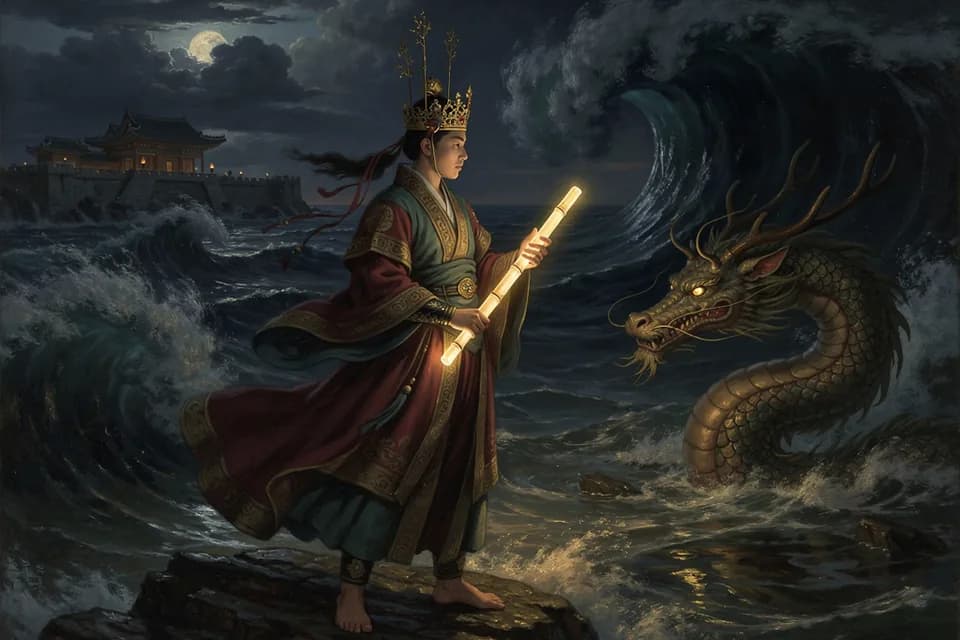
King Munmu of Silla asks to be buried in the East Sea so he can become a dragon and guard the kingdom; his son receives from a sea dragon a bamboo that is two by day and one by night, and makes from it a flute that drives off enemies, heals the sick, brings rain, and stills the waves.
An editorial retelling
The story
A king who became a dragon
King Munmu of Silla (r. 661-681) completed the unification of most of the Korean peninsula under Silla. The Samguk Sagi records his deathbed instructions: he was to be cremated in the Buddhist manner and his remains buried in the East Sea. The Samguk Yusa adds that he wished to become a great dragon after death, to protect the kingdom from invaders and uphold the Buddhist law. His son, King Sinmun, completed the temple of Gameunsa on the coast, 'the temple of gratitude', in his father's honor.
The floating mountain
In the fifth month of 682, the Samguk Yusa says, an official reported that a small mountain was floating toward Gameunsa on the East Sea, drifting back and forth with the waves. The king's diviner said that the late king, now a sea dragon, and the great general Kim Yu-sin, now a god in heaven, wished to send a treasure to guard the state, and that the king should go to the shore. The mountain was shaped like the head of a turtle, and on its top grew a bamboo that was two stalks by day and joined into one by night.
The dragon's gift
The king went to the pavilion called Iyeondae to watch. When the bamboo became one, heaven and earth shook, and a storm and darkness lasted seven days. When they cleared, the king sailed to the mountain, and a dragon came to him bearing a belt of black jade. The king asked why the bamboo parted and joined. The dragon answered: just as one hand cannot make a sound but two hands clapping can, this bamboo makes sound only when joined. It is a sign that the king will rule the world by sound. Cut it and make a flute, and the whole world will be at peace. Your father has become a great dragon of the sea, and Kim Yu-sin a god of heaven; the two sages of one mind have sent this treasure.
The flute
The king had the bamboo cut, and the mountain and the dragon vanished. He made a flute from it and kept it in the royal treasury. When it was played, enemy armies withdrew, sickness was healed, drought brought rain and floods cleared, and the wind died and the waves grew calm. It was called Manpasikjeok, 'the flute that calms ten thousand waves', and honored as a national treasure. Later kings, the Samguk Yusa says, gave it further titles when it was lost and found again.
The sea and the shore
Off the coast near Gameunsa stands Daewangam, 'the rock of the great king', traditionally identified as King Munmu's underwater tomb, and the ruins of Gameunsa still show its twin stone pagodas. The story joins the Silla state's Buddhist piety with older ideas of sea dragons as guardians.
Listen or change reading mode
Highlights
King Munmu asks to be buried at sea to become a guardian dragon; a floating turtle-shaped mountain brings a bamboo that is two by day and one by night; a dragon explains that it makes sound only when joined, and the flute made from it stills enemies, sickness, drought, and waves.
Why it matters
A Silla legend of state protection that links the kingdom's unification with Buddhist and dragon beliefs, and gives meaning to Daewangam and the Gameunsa temple site on the Gyeongju coast.
Sources and further reading
By Elizabeth Stein for Mythos Atlas. About the author. Editorial notes are grounded in the site's cited sources and can be challenged through the contact page.
Works cited
Samguk Yusa, Book 2, 'Manpasikjeok'
Iryeon; trans. Ha Tae-hung and Grafton K. Mintz
Samguk Sagi, Annals of Silla, King Munmu, year 21
Kim Busik