Korean TraditionAncestral Mother
Yuhwa
柳花 (유화)(Yuhwa)
Also known as Lady Yuhwa, Buyeo-sin (the Buyeo goddess)
- rivers
- motherhood
- agriculture
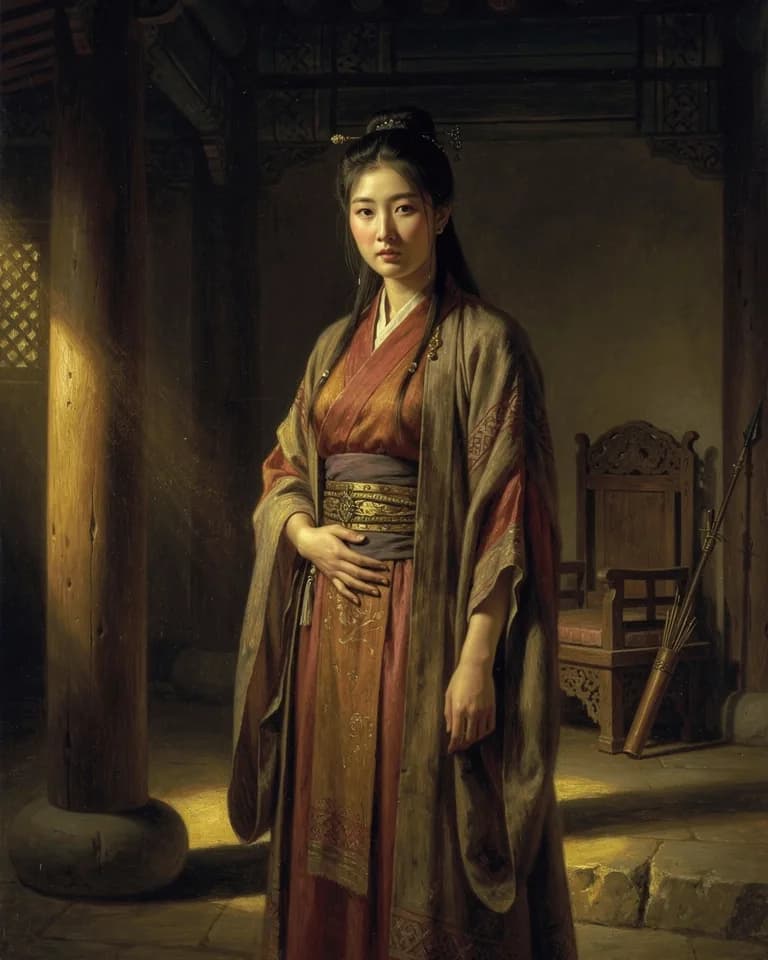
The daughter of Habaek, the River Earl, who is seduced and abandoned by Haemosu, banished by her parents, sheltered by King Geumwa of East Buyeo, and there lays the egg from which Jumong hatches; later worshipped by Goguryeo as a mother goddess.
About Yuhwa
The River Earl's daughter
In the Samguk Sagi, King Geumwa of East Buyeo finds Yuhwa south of Mount Taebaek at Ubalsu, where her parents have banished her after her union with Haemosu. He shuts her in a room, where sunlight follows her even when she moves away from it, and she conceives. She lays an egg as large as five measures of grain. Geumwa has it thrown to dogs and pigs, which will not eat it; left on the road, where horses and cattle step around it; and in the fields, where birds cover it with their wings. He cannot break it and returns it to her, and a boy breaks out: Jumong.
Helping her son
When Jumong must flee Geumwa's jealous sons, Yuhwa advises him on choosing the best horse. Yi Gyu-bo's poem adds that when Jumong forgets the grain seeds she has prepared, she sends them after him with a pair of doves, which he shoots down to recover the seeds, then revives.
A worshipped mother
The Samguk Sagi records that Yuhwa died in East Buyeo in the fourteenth year of Jumong's reign and that Geumwa buried her with the rites of a queen dowager and built her a shrine. Chinese histories of the sixth and seventh centuries report that Goguryeo kept two shrines, one to the 'Buyeo goddess', carved in wood in the form of a woman, and one to the 'Gaodeng god', said to be their ancestor and her son; scholars identify these as Yuhwa and Jumong.
Origin story
Eldest daughter of Habaek, the River Earl (Samguk Sagi; Dongmyeongwang-pyeon).
Worship and cult
Temples, festivals, and practices recorded for Yuhwa
Honored by the Goguryeo court as the mother of the dynasty's founder, with a wooden image, according to seventh-century Chinese sources.
Sacred sites
- A shrine built for her in East Buyeo by King Geumwa, according to the Samguk Sagi; the Goguryeo shrine of the 'Buyeo goddess' described in Chinese histories.
Family
Yuhwa's family at a glance
- Who are Yuhwa's parents?
- The atlas's kinship records name one parent of Yuhwa: Habaek. Ancient accounts do not always agree on divine parentage.
- Who are Yuhwa's children?
- Children of Yuhwa recorded in the atlas: Jumong.
- Who were Yuhwa's spouses and consorts?
- Spouses and consorts of Yuhwa recorded in the atlas: Haemosu.
In the atlas
Where Yuhwa appears
Sources and further reading
Source notes
These references are recorded in the catalog. Their passage wording and translation have not been checked, so quotations are not displayed here.
- Kim Busik, Samguk Sagi, Annals of Goguryeo, King Dongmyeong (paraphrase)
- Zhou shu, account of Goguryeo (paraphrase)
About this entry
By Elizabeth Stein for Mythos Atlas. About the author. Editorial notes are grounded in the site's cited sources and can be challenged through the contact page.
Parallels are editorial comparisons across traditions: a shared role does not, by itself, establish a shared origin.
Family relationships come from the atlas's kinship records. Ancient sources often disagree on divine genealogy.
Genealogy
Family tree
Yuhwa's parents, consorts, children and rivals, as recorded in the atlas.