Korean TraditionFounding King
Jumong
朱蒙 (주몽)(Jumong; Chumo on the Gwanggaeto Stele)
Also known as King Dongmyeong, Chumo, Go Jumong
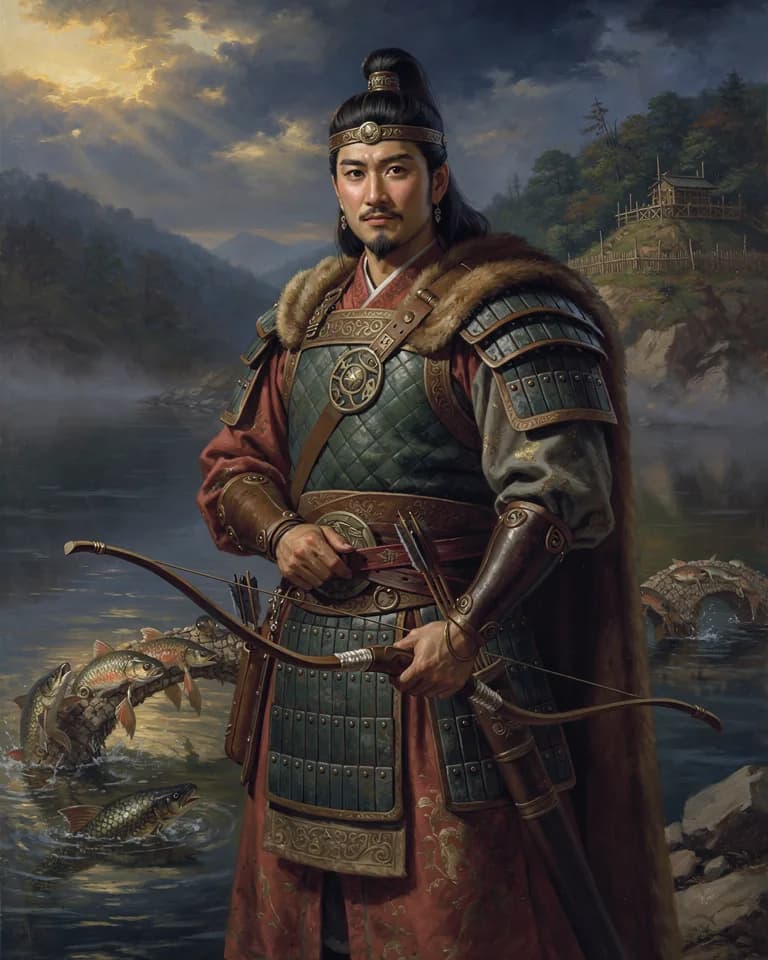
- archery
- the founding of Goguryeo
- kingship
The egg-born son of Heaven and of the River Earl's daughter, a peerless archer who flees East Buyeo when fish and turtles rise to bridge a river for him, founds Goguryeo at Jolbon, and in the earliest account ascends to heaven on a yellow dragon.
About Jumong
The earliest account
The Gwanggaeto Stele of 414 CE, the oldest written source for any Korean foundation myth, says that King Chumo, son of the Heavenly Emperor and the daughter of Habaek, broke from an egg; traveling south, he reached a great river and declared himself son of heaven and grandson of Habaek, and reeds joined and turtles surfaced to let him cross. He founded his capital on the mountain west of Holbon. Tired of the world, he was fetched by a yellow dragon sent from heaven and rose to heaven from a hill east of Holbon, standing on the dragon's head.
The Samguk Sagi
Kim Busik's history (1145) gives the fuller version. Born from Yuhwa's egg in the palace of King Geumwa of East Buyeo, the boy made his own bow and arrows at seven and never missed, and 'Jumong', the Buyeo word for a good archer, became his name. Geumwa's sons plotted to kill him. Set to tend the king's horses, he starved the best horse and fattened the poor ones; the king took the fat horses and left him the fine thin one. Warned by his mother, he fled with three companions. At the Eomsa River, with pursuers behind him and no bridge, he declared himself son of Heaven and grandson of Habaek, and fish and turtles rose to make a bridge, sinking again after he crossed. He founded Goguryeo at Jolbon in 37 BCE, at the age of twenty-two, and took the surname Go.
Worship
Goguryeo worshipped its founder at a royal shrine, and Chinese histories name a Goguryeo god 'Gaodeng', the son of the Buyeo goddess, generally identified with Jumong. The traditional date of 37 BCE is not independently confirmed.
Origin story
Hatched from an egg laid by Yuhwa, daughter of Habaek, after she was touched by the sunlight of Heaven; son of Haemosu in Samguk Yusa and Yi Gyu-bo.
Worship and cult
Temples, festivals, and practices recorded for Jumong
Royal ancestor worship at the founder's shrine; the Goguryeo harvest festival of heaven (Dongmaeng) recorded in Chinese histories.
Sacred sites
- The shrine of the founder in the Goguryeo capitals, to which later kings made offerings, according to the Samguk Sagi; the 'Gaodeng god' shrine described in Chinese histories.
Family
In the atlas
Where Jumong appears
Sources and further reading
Source notes
These references are recorded in the catalog. Their passage wording and translation have not been checked, so quotations are not displayed here.
- Gwanggaeto Stele (paraphrase)
- Kim Busik, Samguk Sagi, Annals of Goguryeo, King Dongmyeong (paraphrase)
About this entry
By Elizabeth Stein for Mythos Atlas. About the author. Editorial notes are grounded in the site's cited sources and can be challenged through the contact page.
Parallels are editorial comparisons across traditions: a shared role does not, by itself, establish a shared origin.
Family relationships come from the atlas's kinship records. Ancient sources often disagree on divine genealogy.
Genealogy
Family tree
Jumong's parents, consorts, children and rivals, as recorded in the atlas.