Korean TraditionMountain
Wunü Mountain (Jolbon)
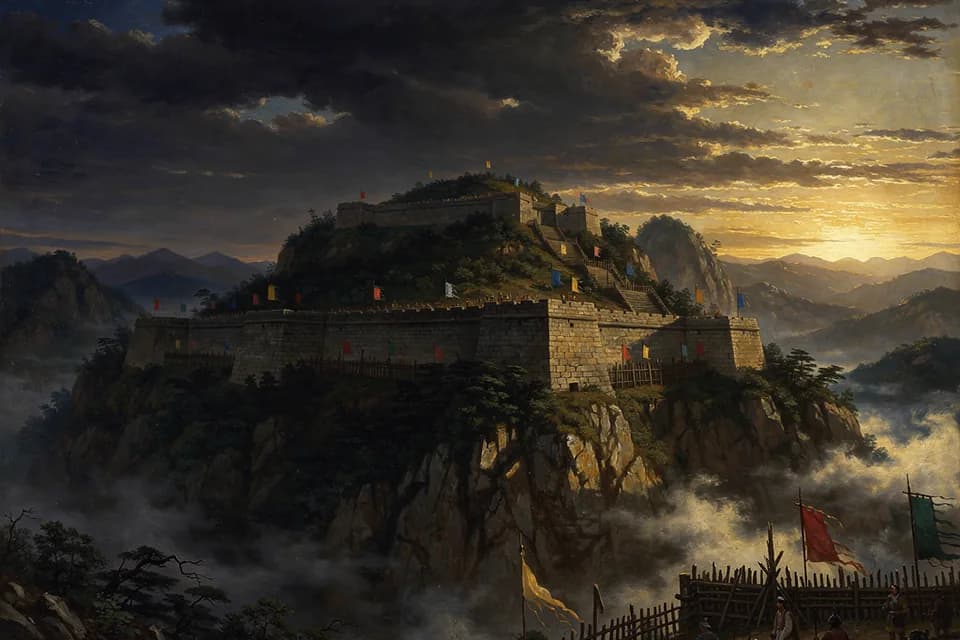
The flat-topped mountain fortress near Huanren, Liaoning, China, widely identified as Holbon or Jolbon, where the Gwanggaeto Stele and the Samguk Sagi say Jumong founded Goguryeo's first capital.
About Wunü Mountain (Jolbon)
The first capital
The Gwanggaeto Stele (414 CE) says that Chumo built his capital 'on the mountain west of Holbon', and the Samguk Sagi says Jumong founded Goguryeo at Jolbon. Most scholars identify this first capital with the mountain fortress on Wunü Mountain ('Five Women Mountain'), a sheer-sided, flat-topped mountain rising above the Hun River valley near the city of Huanren in Liaoning Province, China. Excavations have found walls, building foundations, and Goguryeo artifacts on its summit plateau.
World Heritage
Wunü Mountain City is part of the UNESCO World Heritage Site 'Capital Cities and Tombs of the Ancient Koguryo Kingdom' (inscribed 2004), with the later capital at Ji'an, where the Gwanggaeto Stele stands.
A contested heritage
Goguryeo's history is claimed by both Korean and Chinese historiography, and the site's interpretation has been part of that debate; this entry follows the Korean foundation myth's own geography and the archaeological identification.
On the map
Wunü Mountain (Jolbon) among other places of the Korean Tradition.
Sources and further reading
Source notes
These references are recorded in the catalog. Their passage wording and translation have not been checked, so quotations are not displayed here.
- Gwanggaeto Stele, opening lines (paraphrase)
About this entry
By Elizabeth Stein for Mythos Atlas. About the author. Editorial notes are grounded in the site's cited sources and can be challenged through the contact page.
Coordinates mark where the myths place a site, or where the tradition locates it today. Mythic realms are left off the map or marked as symbolic placements.