Korean TraditionSacred Site
Chamseongdan
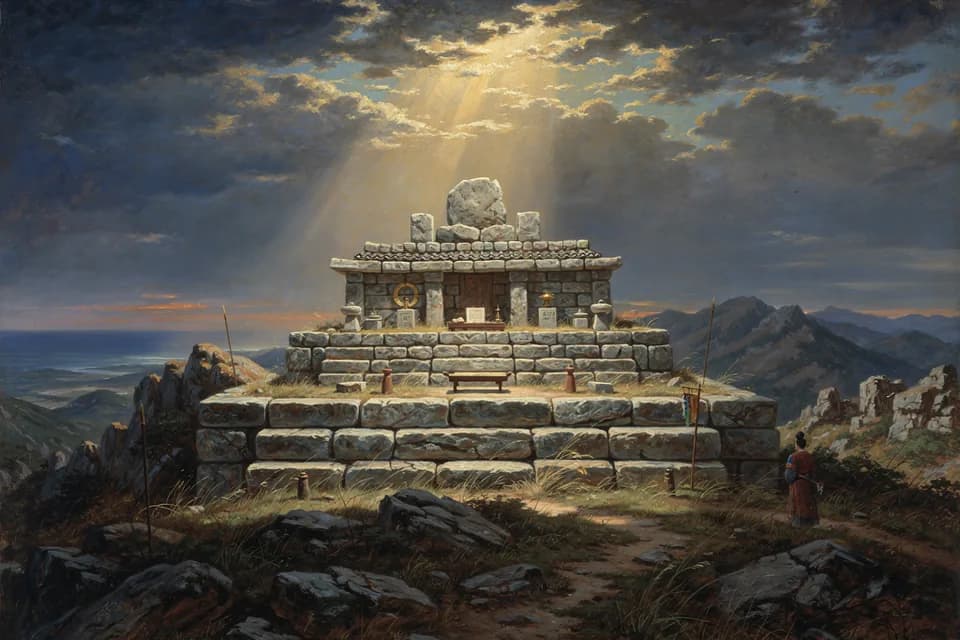
The stone altar on the summit of Mount Mani on Ganghwa Island, traditionally said to have been built by Dangun for sacrifices to heaven, where rites are held on National Foundation Day and the National Sports Festival torch is lit.
About Chamseongdan
Dangun's altar
Chamseongdan stands near the summit of Manisan, the highest peak of Ganghwa Island at the mouth of the Han River, west of Seoul. Tradition, recorded in Goryeo and Joseon geographies, holds that Dangun built an altar here to offer sacrifices to heaven. The present stone structure, a round lower terrace and a square upper platform symbolizing heaven and earth, has been rebuilt and repaired many times, and its age cannot be traced to antiquity.
Royal and national rites
Goryeo and Joseon kings sent officials to perform rites at the altar. Today, on National Foundation Day (3 October), a ceremony to heaven is held at Chamseongdan, and since the mid-twentieth century the flame for Korea's National Sports Festival has been kindled here by women dressed as priestesses.
Protected site
Chamseongdan is designated a Historic Site of South Korea and draws many hikers and visitors, especially at the new year and on Foundation Day.
On the map
Chamseongdan among other places of the Korean Tradition.
Sources and further reading
Source notes
These references are recorded in the catalog. Their passage wording and translation have not been checked, so quotations are not displayed here.
- Joseon-era geographies of Ganghwa (e.g., Sinjeung Dongguk Yeoji Seungnam, 1530) (paraphrase)
About this entry
By Elizabeth Stein for Mythos Atlas. About the author. Editorial notes are grounded in the site's cited sources and can be challenged through the contact page.
Coordinates mark where the myths place a site, or where the tradition locates it today. Mythic realms are left off the map or marked as symbolic placements.