Chinese Pantheon
Guanyin
Also known as Avalokiteshvara, Kannon (Japanese), Quan Am (Vietnamese), Goddess of Mercy
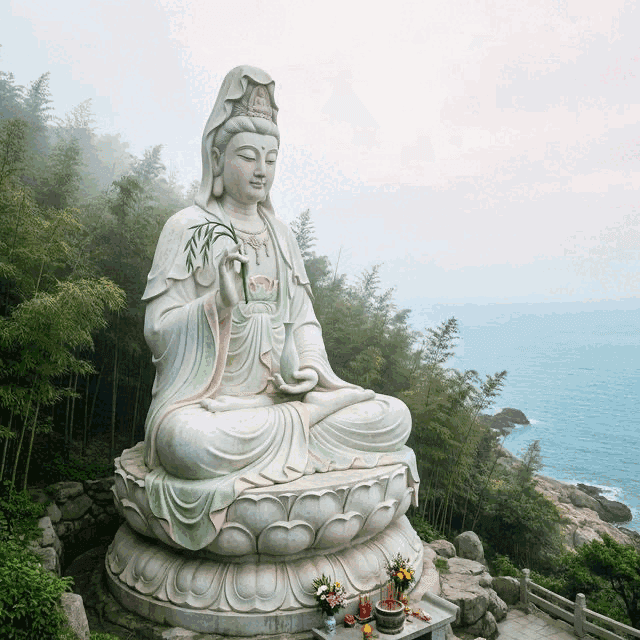
- mercy
- compassion
- healing
- children
- sailors
- protection
The Bodhisattva of Compassion who hears the cries of all beings in the world. She is one of the most beloved deities in East Asian Buddhism, embodying unconditional mercy and the motherly aspect of divine love.
About Guanyin
She Who Hears the Cries of the World
Guanyin is the most widely venerated bodhisattva in East Asian Buddhism, worshipped by millions across China, Japan, Korea, and Vietnam. Her name means 'One Who Perceives the Sounds [Cries] of the World,' reflecting her boundless compassion for all suffering beings.
From Male to Female
Originally the male bodhisattva Avalokiteshvara in Indian Buddhism, Guanyin transformed into a female figure in China by the Song dynasty (960-1279 CE). This transformation allowed her to embody maternal compassion and made her more accessible to women, who prayed to her for children, protection, and mercy. Her gender fluidity reflects the Buddhist teaching that enlightened beings transcend worldly distinctions.
The Vow of Compassion
According to legend, Guanyin was about to enter Nirvana when she heard the cries of suffering beings. She vowed to remain in the world until all beings are liberated, postponing her own final enlightenment out of compassion. This selfless vow makes her the model of Mahayana Buddhist compassion.
The Thousand Arms
One popular form shows Guanyin with a thousand arms, each with an eye in the palm, representing her ability to see and reach out to all beings in distress. She is also depicted riding a dragon, standing on a lotus, or holding a child for women praying for offspring.
Journey to the West
In the classic novel, Guanyin orchestrates the entire pilgrimage, selecting Tang Sanzang for the mission and providing Sun Wukong with the golden fillet that keeps him obedient. She appears repeatedly to rescue the pilgrims, demonstrating the Buddhist principle of compassionate intervention.
Popular Worship
Guanyin is worshipped both in Buddhist temples and home shrines. Pregnant women, fishermen, and those in danger especially seek her protection. The 19th day of the second, sixth, and ninth lunar months are sacred to her. Putuo Mountain in Zhejiang Province is her primary pilgrimage site.
Origin story
The bodhisattva Avalokiteshvara attained enlightenment but postponed entering Nirvana upon hearing the suffering cries of the world. Vowing to save all beings before accepting final liberation, she took the form of Guanyin and remains accessible to all who call upon her name.
Across traditions
Parallel figures
Figures who play a role like Guanyin's in other traditions.
 GreekHestiaIllustration
Both are gentle, compassionate deities who offer protection and are associated with the domestic sphere
Compare Guanyin and Hestia side by side
Worship and cult
Temples, festivals, and practices recorded for Guanyin
Hearer of cries. Vegetarian offerings, white robes, and a thousand arms in some images. She is Avalokiteshvara in China, then also a mother. Pilgrimage to Putuo is the sea-road form of the same mercy.
Sacred sites
- Putuo Shan, her island
- Guanyin halls in almost every Chinese Buddhist monastery
Festivals
- Guanyin's birthday(s) in the lunar calendar
- Ullambana adjacent compassion rites
In the museums
Guanyin in art
Real objects in public collections, released into the public domain by the museums that hold them. Dates refer to when each object was made. Objects made within the tradition come first, later depictions after.
 (opens the museum record)
Ancient object
Bodhisattva Avalokiteshvara (Guanyin) (opens the museum record)
A Yuan-dynasty wood sculpture the museum titles Bodhisattva Avalokiteshvara (Guanyin), dated by inscription to 1282. Guanyin, the East Asian form of the bodhisattva of compassion, became one of the most widely venerated figures in Chinese Buddhism.
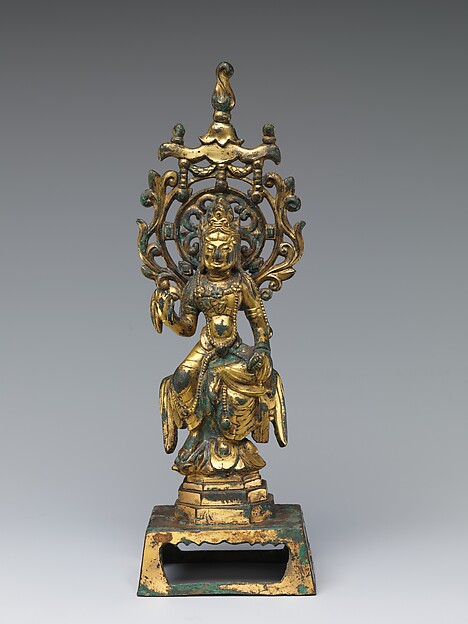 (opens the museum record)
Ancient object
Bodhisattva Avalokiteshvara (Guanyin) (opens the museum record)
A gilt bronze figure from the Five Dynasties period the museum titles Bodhisattva Avalokiteshvara (Guanyin), an early example of the type before the fully Sinicized feminine form became standard.
Sources and further reading
Source notes
These references are recorded in the catalog. Their passage wording and translation have not been checked, so quotations are not displayed here.
- Lotus Sutra, Chapter 25
About this entry
By Elizabeth Stein for Mythos Atlas. About the author. Editorial notes are grounded in the site's cited sources and can be challenged through the contact page.
Parallels are editorial comparisons across traditions: a shared role does not, by itself, establish a shared origin.
Keep exploring
One myth a week, with its sources in a short email. The sign-up form is just below.
Genealogy
Family tree
Guanyin's parents, consorts, children and rivals, as recorded in the atlas.