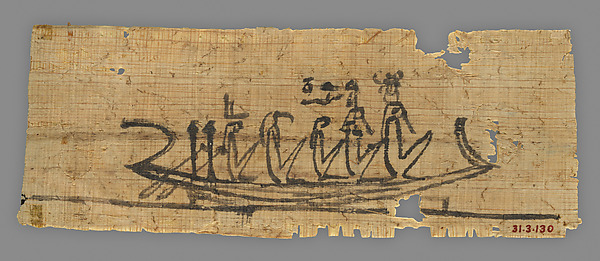
Papyrus fragment with a painting of Khepri, Shu, Tefnut, Thoth, and Isis in a solar boat, The Metropolitan Museum of Art
Egyptian pantheon
Shu
Šw(Shu)
air
the space between sky and earth
sunlight
dryness
God of the air and dry space, a member of the Ennead. Shu was produced by Atum and, with his twin sister and consort Tefnut, fathered Geb (Earth) and Nut (Sky), whom he is famously depicted physically separating and holding apart.
Shu is the personification of air and the dry, light-filled space that separates sky from earth. In the Heliopolitan cosmogony recorded in the Pyramid Texts, he was produced by the creator god Atum, who is said to have sneezed or spat him out along with his twin sister Tefnut, goddess of moisture, at the very beginning of creation.
Father of Geb and Nut
Shu and Tefnut, in turn, gave rise to the next generation of the Ennead: Geb, god of the earth, and Nut, goddess of the sky. One of the most iconic images in Egyptian religious art shows Shu standing between his two children, his arms raised to physically hold Nut's star-covered body aloft above the reclining figure of Geb, keeping heaven and earth eternally separated after they had once been locked together in embrace. This scene appears repeatedly on papyri, coffins, and tomb ceilings throughout Egyptian history.
Light and Order
As the personification of sunlight-filled air, Shu was closely tied to concepts of order and stability within the created world, sometimes described as bearing up the sky in an act that maintained the very structure of the cosmos against collapse back into primeval chaos. In the succession of divine kingship recorded in Egyptian theology, Shu was said to have ruled the earth after his father Atum, later passing kingship down through Geb to Osiris.
Later Turmoil
In some New Kingdom mythological texts, Shu's reign as king of the gods is troubled by conspiracies and attacks from the followers of the serpent Apep (Apophis), reflecting the broader Egyptian theme of order under constant threat from chaos, which every king, divine or human, was required to hold at bay.
Origin Story
Shu was produced by the creator god Atum at the very beginning of creation, spat out or sneezed into being along with his twin sister Tefnut. Together they fathered Geb and Nut, and Shu is remembered above all for physically separating his two children, sky and earth, holding them apart to allow the ordered world to exist between them.
Both are primordial figures whose role centers on maintaining the separation between sky and earth, though the Egyptian pairing has Shu as the separator rather than the sky itself
Source Notes
These records lack edition and translator details. Their wording has not been verified as a direct quotation.
Atum-Khoprer... you spat out as Shu, you spat out as Tefnut.
Ancient Texts
Pyramid Texts by Anonymous Egyptian priests
c. 2400-2300 BCE·Ancient Egyptian (Hieroglyphic)
The earliest source for Shu's origin from Atum and his place in the Ennead
Gods and Pharaohs from Egyptian Mythology by Geraldine Harris
1982·English
Covers the Shu-Geb-Nut separation myth and its iconography
References & further reading
Editorial notes for deeper study (not a full bibliography).
Faulkner, Raymond O. (trans.). *The Ancient Egyptian Pyramid Texts* (Oxford University Press, 1969).
Wilkinson, Richard H. *The Complete Gods and Goddesses of Ancient Egypt* (Thames & Hudson, 2003).
Browse representative texts and policies on the Sources page.
Worship & Cult
How Shu was venerated in ancient times
Sacred Temples
•Cult center at Leontopolis, where he was worshipped alongside Tefnut in lion form
Worship Practices
Shu and Tefnut were worshipped in leonine form at Leontopolis in the Nile Delta. Elsewhere, Shu's presence was felt chiefly through his role in the cosmological iconography of sky and earth rather than through a widespread independent cult.
Domains
air
the space between sky and earth
sunlight
dryness
Symbols
ostrich feather
raised arms (holding up the sky)
In the museums
Shu in art
Real objects in public collections, released into the public domain by the museums that hold them. Dates refer to when each object was made. Objects made within the tradition come first, later depictions after.
Papyrus fragment with a painting of Khepri, Shu, Tefnut, Thoth, and Isis in a solar boat
Egyptian, Late Period or later · 664 BCE or later · Papyrus, ink
A fragment from a funerary papyrus painted with a scene of deities in a solar boat; the museum's own title lists Shu among the figures depicted, alongside Khepri, Tefnut, Thoth, and Isis.
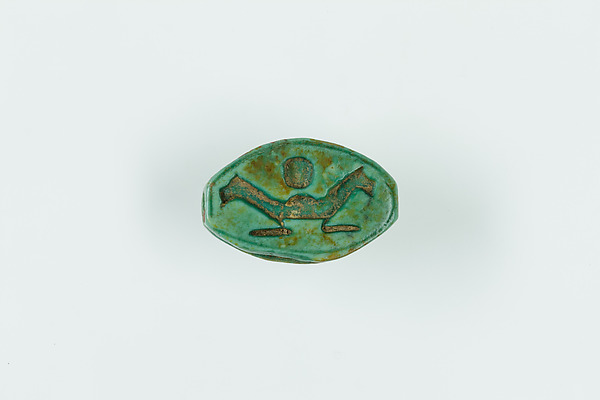
Cowroid with Outward-facing Merged Lions and Sun Disk
Egyptian, New Kingdom–Third Intermediate Period · ca. 1550–664 BCE · Glazed steatite
A glazed steatite cowroid seal whose inscription and design the museum catalogs as invoking Re, Shu, and Tefnut alongside a sun disk and lions. It served as an amuletic seal rather than a temple image.