Side by sideParallel across traditions

The Dagda vs Odin

The Dagda
The DagdaCeltic
Odin
OdinNorse

The Dagda's epithet 'Ollathair' (All-Father) parallels Odin's 'Allfather'; both wield a great magical implement and are linked to wisdom and magic.

At a glance

The Dagda and Odin compared
The DagdaOdin
TraditionCeltic PantheonNorse Pantheon
Domainsfertility, agriculture, manliness, strength, magic, druidry, wisdomwisdom, war, death, poetry, magic, knowledge
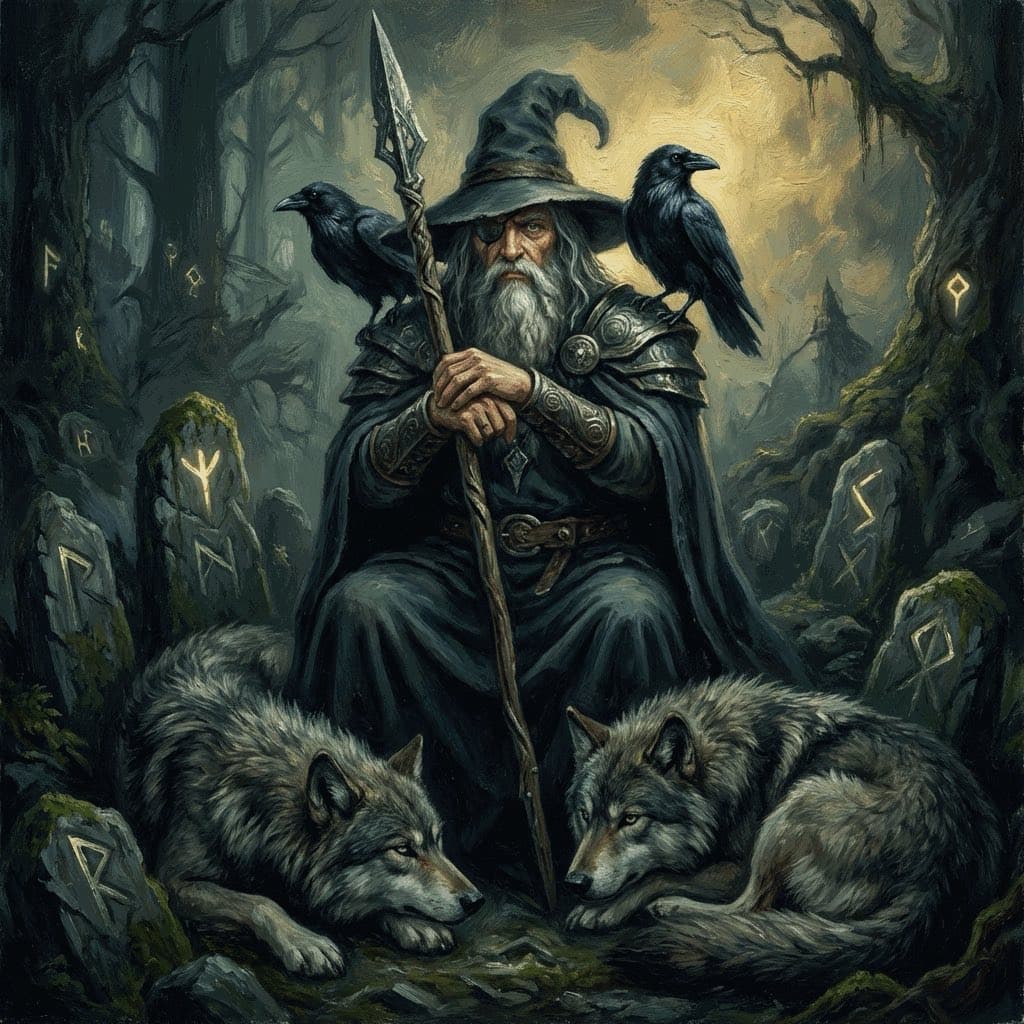
Symbolscauldron, club, harpspear Gungnir, ravens Huginn and Muninn, eight-legged horse Sleipnir, wolves Geri and Freki, one eye
Also calledEochaid Ollathair, Ruad RohezAllfather, Woden, Wotan, The Wanderer

Where they meet

Both are associated with magic and wisdom.

Where they part

Only The Dagda

Associated with fertility, agriculture, manliness, strength, and druidry.

Only Odin

Associated with war, death, poetry, and knowledge.

How each was worshipped

The Dagda

Cult sites
No standing temple; Brú na Bóinne is later associated, not a proven Dagda fane
Festivals
Samhain in later seasonal reading

Club, cauldron, and harp. Evidence is medieval Irish literature, not excavation of a Dagda temple. Treat Newgrange slogans with caution. The cult, if reconstructed, is hospitality, weather, and the chieftain's hall.

Odin

Cult sites
Temple at Uppsala (Adam of Bremen), with Thor and Freyr; No surviving named stave-church equivalent; mounds, trees, and halls
Festivals
Yule; Sacrifices for victory (sigurblót)

Hanged god, poetry, and the war-dead. Wednesday keeps his name. Uppsala tradition put him with Thor and Freyr. Spear, ravens, and the high seat are the cult signs; evidence is later and Christian-filtered, and should be read that way.

The two figures

Celtic Pantheon

The Dagda

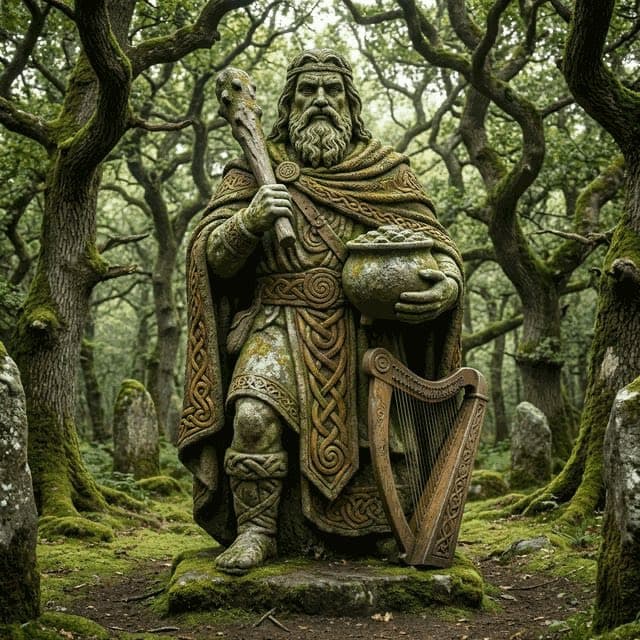
The father figure and king of the Tuatha Dé Danann. A giant, bearded powerhouse with a magic club that can kill with one end and heal with the other, and a cauldron that never runs empty.

The Dagda is one of the principal leaders of the **Tuatha Dé Danann**, the divine tribe who arrived in Ireland shrouded in magical mist or in cloud-ships from the northern islands of the world. His parents are sometimes given as Elatha of the Fomorians and Eithne, making him half-Fomorian himself, though other traditions name Danu as the mother of all the Tuatha Dé Danann. He is the father of many important deities, including Brigid, Aengus, Midir, and Bodb Derg. His primary consort is the Morrígan, the great goddess of war and sovereignty.

The Dagda, whose name means **"the Good God"** (not morally good, but good at everything), is the father figure and High King of the **Tuatha Dé Danann**, the divine race of Irish mythology. He embodies abundance, fertility, and the life-giving power of the earth. Despite his immense power, he is often depicted with a comically short tunic and enormous appetite, lending him a more approachable, earthy quality than many other chief deities.

Read the full The Dagda entry

Norse Pantheon

Odin

King of the Aesir and god of wisdom, war, and death. Odin sacrificed his eye at Mimir's well for wisdom and hung himself on Yggdrasil for nine days to learn the runes.

Odin is the son of the primordial beings Borr and Bestla. Along with his brothers Vili and Ve, he slew the giant Ymir and created the world from his body.

Odin is the chief of the Aesir, a relentless seeker of wisdom. He sacrificed his eye to Mimir's Well for knowledge and hung himself from Yggdrasil for nine nights to discover the runes.

Read the full Odin entry
About this comparison

Comparisons pair figures that play a similar role across traditions, or that the myths connect within one. A shared role does not, by itself, establish a shared origin.