Side by sideSiblings

The Dagda vs Ogma

The Dagda
The DagdaCeltic
Ogma
OgmaCeltic

The Dagda and Ogma are recorded as siblings in the Celtic Pantheon.

At a glance

The Dagda and Ogma compared
The DagdaOgma
TraditionCeltic PantheonCeltic Pantheon
Domainsfertility, agriculture, manliness, strength, magic, druidry, wisdomeloquence, language, learning, strength
Symbolscauldron, club, harpogham script, chain, club
Also calledEochaid Ollathair, Ruad RohezOgmios, Oghma, Ogma Grianainech

Where they meet

Both are associated with strength.

They share a symbol: club.

  • club

Where they part

Only The Dagda

Associated with fertility, agriculture, manliness, magic, druidry, and wisdom.

Only Ogma

Associated with eloquence, language, and learning.

How each was worshipped

The Dagda

Cult sites
No standing temple; Brú na Bóinne is later associated, not a proven Dagda fane
Festivals
Samhain in later seasonal reading

Club, cauldron, and harp. Evidence is medieval Irish literature, not excavation of a Dagda temple. Treat Newgrange slogans with caution. The cult, if reconstructed, is hospitality, weather, and the chieftain's hall.

Ogma

Cult sites
No attested temple in the surviving record

Ogham and the strong-man of the Tuatha. Irish saga, not a recovered temple list. Treat him as a literary champion unless a site turns up.

The two figures

Celtic Pantheon

The Dagda

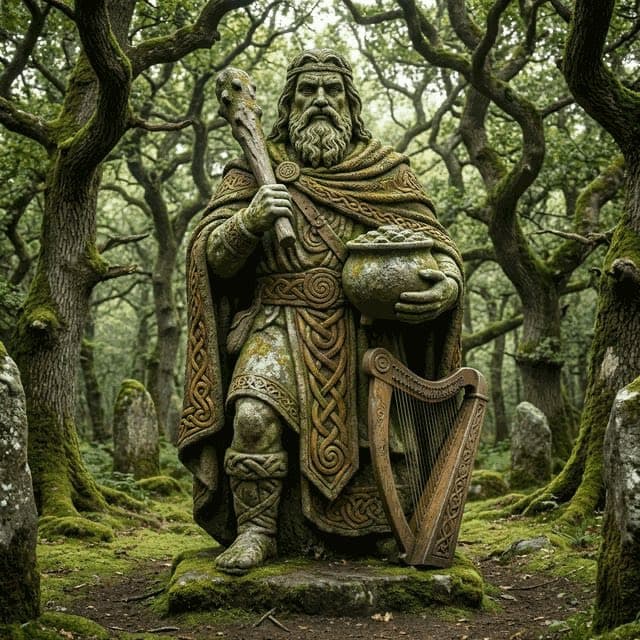
The father figure and king of the Tuatha Dé Danann. A giant, bearded powerhouse with a magic club that can kill with one end and heal with the other, and a cauldron that never runs empty.

The Dagda is one of the principal leaders of the **Tuatha Dé Danann**, the divine tribe who arrived in Ireland shrouded in magical mist or in cloud-ships from the northern islands of the world. His parents are sometimes given as Elatha of the Fomorians and Eithne, making him half-Fomorian himself, though other traditions name Danu as the mother of all the Tuatha Dé Danann. He is the father of many important deities, including Brigid, Aengus, Midir, and Bodb Derg. His primary consort is the Morrígan, the great goddess of war and sovereignty.

The Dagda, whose name means **"the Good God"** (not morally good, but good at everything), is the father figure and High King of the **Tuatha Dé Danann**, the divine race of Irish mythology. He embodies abundance, fertility, and the life-giving power of the earth. Despite his immense power, he is often depicted with a comically short tunic and enormous appetite, lending him a more approachable, earthy quality than many other chief deities.

Read the full The Dagda entry

Celtic Pantheon

Ogma

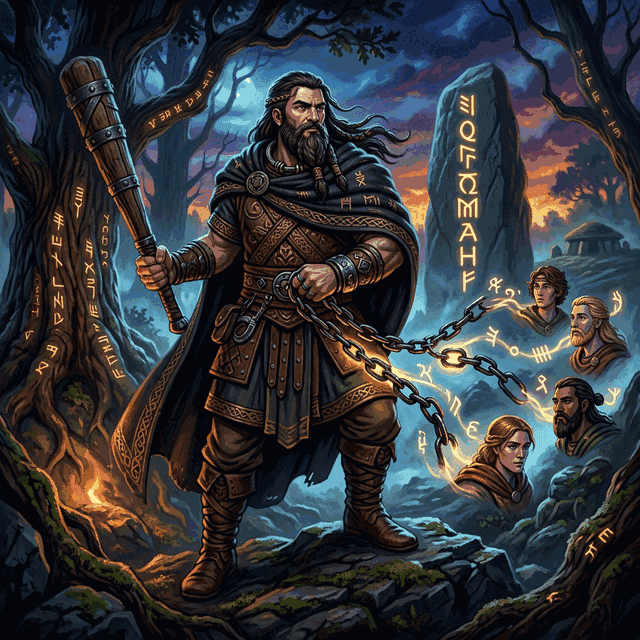
Inventor of the Ogham alphabet and champion of the Tuatha Dé Danann. His eloquence binds listeners with chains of gold that flow from his tongue.

Ogma is the son of **Elatha**, a Fomorian king, and therefore half-brother to the Dagda, Lugh, and Bres. Despite his mixed heritage, he fought for the Tuatha Dé Danann as their champion. In the Second Battle of Mag Tuired, he slew **Indech**, king of the Fomorians, and retrieved the sword **Orna**, which could recount the deeds it had performed when drawn. Ogma is credited with inventing **Ogham**, the earliest Irish writing system, whose letters are named after trees. The Greek writer Lucian described **Ogmios**, the Gaulish equivalent, as an old man leading willing captives by gold chains attached to his tongue, a vivid image of persuasive speech.

Ogma embodies the paradox of eloquence: words that are stronger than force, speech that binds more surely than chains. He is both warrior and poet, champion and scholar, reflecting the Celtic reverence for the power of language and the status of the filí (poet-seer) in early Irish society.

Read the full Ogma entry
About this comparison

Comparisons pair figures that play a similar role across traditions, or that the myths connect within one. A shared role does not, by itself, establish a shared origin.