Side by sideSiblings

Dian Cécht vs Goibniu

Dian Cécht
Dian CéchtCeltic
Goibniu
GoibniuCeltic

Dian Cécht and Goibniu are recorded as siblings in the Celtic Pantheon.

At a glance

Dian Cécht and Goibniu compared
Dian CéchtGoibniu
TraditionCeltic PantheonCeltic Pantheon
Domainshealing, medicine, healthsmithing, weapons, brewing, immortality
Symbolssilver hand, healing herbs, wellanvil, hammer, ale
Also calledDian Cecht, CainteGoibhniu, Govannon

Where they meet

The atlas records no domain or symbol that Dian Cécht and Goibniu share.

They are compared because of how the myths connect them, not because of what they rule.

Where they part

Only Dian Cécht

Associated with healing, medicine, and health.

Only Goibniu

Associated with smithing, weapons, brewing, and immortality.

How each was worshipped

Dian Cécht

Cult sites
No attested temple in the surviving record

Physician of the Tuatha; the well of healing is in the tales. No surviving Irish temple of Dian Cecht. Healing cults went to wells and saints later.

Goibniu

Cult sites
No attested temple in the surviving record

The smith who hosts the feast of immortality in the literature. Smith-gods leave tools and stories, not parish rolls. Honest absence of a festival list.

The two figures

Celtic Pantheon

Dian Cécht

The physician of the Tuatha Dé Danann, whose healing well could restore the dead to life. His jealousy over his son's greater skill led to tragedy.

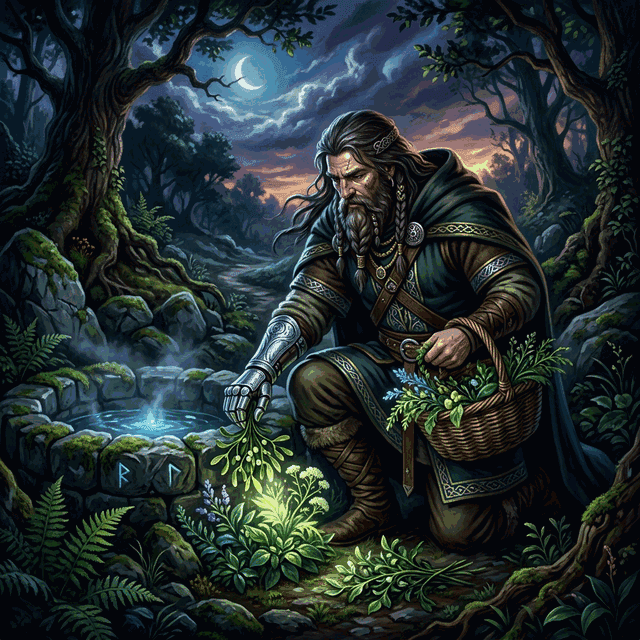
Dian Cécht served as chief physician to the **Tuatha Dé Danann**. When **Nuada** lost his arm in the First Battle of Mag Tuired, Dian Cécht fashioned him a fully functional arm of silver, a feat of divine surgery that restored the king's eligibility to rule. However, Dian Cécht's son **Miach** later replaced the silver arm with one of true flesh and bone, surpassing his father's craft. Consumed by jealousy, Dian Cécht struck Miach three times on the head with his sword: Miach healed the first two wounds, but the third cut his brain, killing him. From Miach's grave grew 365 healing herbs, one for every joint and sinew. Dian Cécht's daughter **Airmed** gathered and organized these herbs, but her father scattered them, and their secrets were lost.

Dian Cécht is the divine healer of Irish mythology, whose skills preserved the Tuatha Dé Danann through their wars against the Fir Bolg and the Fomorians. His name may mean "swift power" or "god of power," and his craft represents the ancient Irish respect for medical knowledge and its keepers.

Read the full Dian Cécht entry

Celtic Pantheon

Goibniu

The divine smith who forges weapons that never miss and brews the ale of immortality. His hammer falls three times, and the weapon is complete.

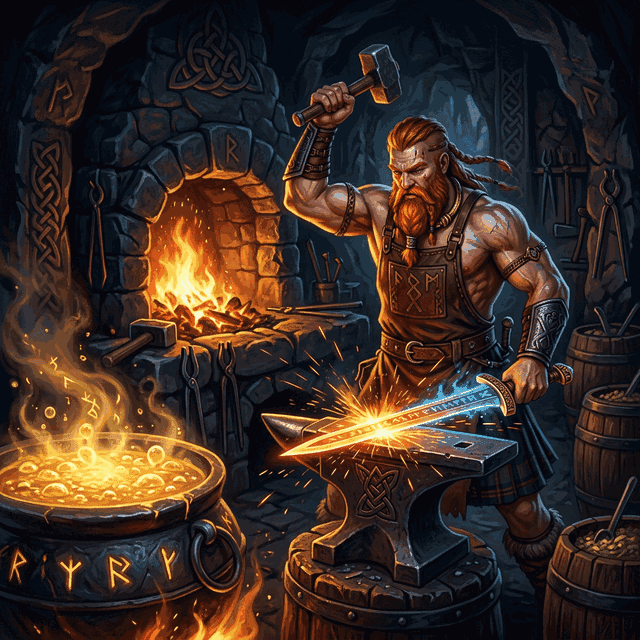
Goibniu is one of the **Trí Dé Dána**, the three gods of skill, alongside his brothers **Creidhne** (the brazier) and **Luchta** (the carpenter). Together they crafted the weapons of the Tuatha Dé Danann for the Second Battle of Mag Tuired. Goibniu worked at legendary speed: three blows of his hammer completed any weapon, and every spear he forged struck true. He also brewed the **Fled Goibnenn** (Feast of Goibniu), an ale that granted those who drank it immunity to age and disease. In the Welsh tradition, he appears as **Gofannon**, brother of the goddess Arianrhod.

Goibniu stands at the forge of the gods, hammer in hand, crafting the weapons that defend the Tuatha Dé Danann against their enemies. He represents the sacred status of the smith in Celtic society, a figure who transforms raw earth into gleaming metal, who shapes the tools of war and agriculture alike.

Read the full Goibniu entry
About this comparison

Comparisons pair figures that play a similar role across traditions, or that the myths connect within one. A shared role does not, by itself, establish a shared origin.