Mythos Atlas

Side by sideParallel across traditions

Goibniu vs Ilmarinen

Goibniu
GoibniuCeltic
Ilmarinen
IlmarinenFinnish Tradition (Kalevala)

Both are smiths of the gods whose craft carries supernatural power.

At a glance

Goibniu and Ilmarinen compared
GoibniuIlmarinen
TraditionCeltic PantheonFinnish Tradition (Kalevala)
Domainssmithing, weapons, brewing, immortalitysmithcraft, the weather, the forging of the sky
Symbolsanvil, hammer, alethe hammer and forge, the Sampo, the vault of heaven
Also calledGoibhniu, GovannonSeppo Ilmarinen (Ilmarinen the Smith)

Where they meet

The atlas records no domain or symbol that Goibniu and Ilmarinen share.

They are compared for the part each plays in their own tradition rather than for any attribute in common.

Where they part

Only Goibniu

Associated with smithing, weapons, brewing, and immortality.

Only Ilmarinen

Associated with smithcraft, the weather, and the forging of the sky.

How each was worshipped

Goibniu

Cult sites
No attested temple in the surviving record

The smith who hosts the feast of immortality in the literature. Smith-gods leave tools and stories, not parish rolls. Honest absence of a festival list.

Ilmarinen

Invoked in smiths' charms, especially the 'origin of iron'; Agricola records him as a weather god who helped travelers.

The two figures

Celtic Pantheon

Goibniu

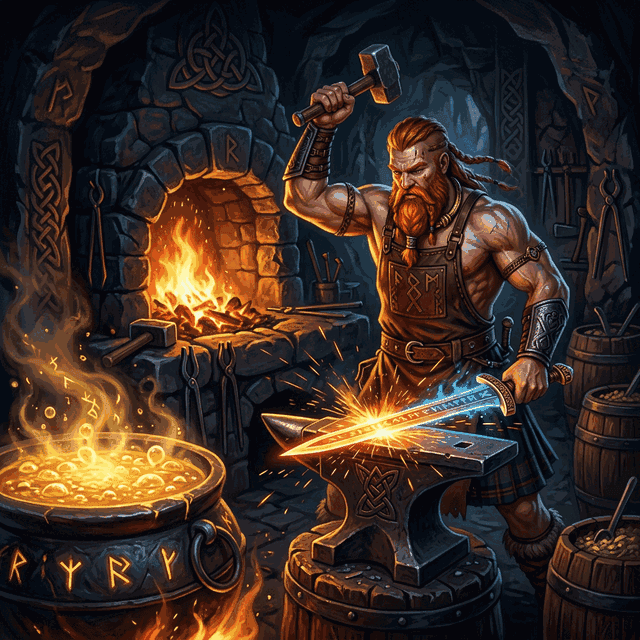
The divine smith who forges weapons that never miss and brews the ale of immortality. His hammer falls three times, and the weapon is complete.

Goibniu is one of the **Trí Dé Dána**—the three gods of skill—alongside his brothers **Creidhne** (the brazier) and **Luchta** (the carpenter). Together they crafted the weapons of the Tuatha Dé Danann for the Second Battle of Mag Tuired. Goibniu worked at legendary speed: three blows of his hammer completed any weapon, and every spear he forged struck true. He also brewed the **Fled Goibnenn** (Feast of Goibniu), an ale that granted those who drank it immunity to age and disease. In the Welsh tradition, he appears as **Gofannon**, brother of the goddess Arianrhod.

Goibniu stands at the forge of the gods, hammer in hand, crafting the weapons that defend the Tuatha Dé Danann against their enemies. He represents the sacred status of the smith in Celtic society—a figure who transforms raw earth into gleaming metal, who shapes the tools of war and agriculture alike.

Read the full Goibniu entry

Finnish Tradition (Kalevala)

Ilmarinen

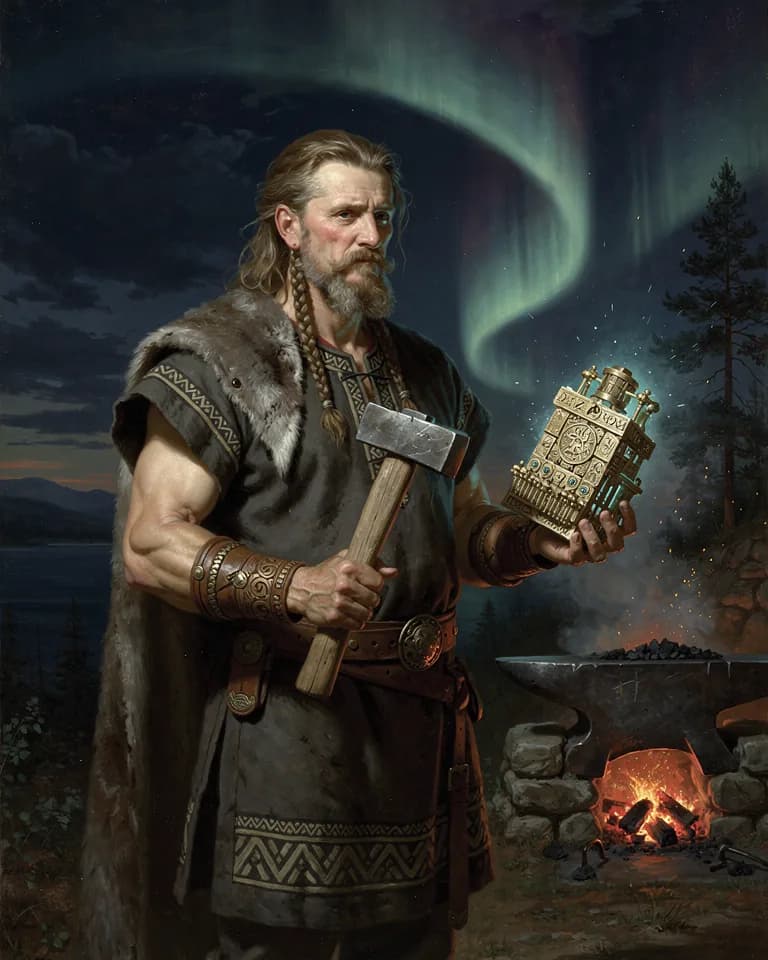
The eternal smith of Finnish tradition, who forged the vault of the sky and, in the Kalevala, the Sampo for Louhi of Pohjola; named by Agricola in 1551 as the maker of calm and storm who carried travelers on their way.

In folk poetry, and in the Kalevala's charm of the origin of iron, he is born on a hill of charcoal with a copper hammer in his hand.

Agricola's list of 1551 says Ilmarinen 'made peace and weather and carried travelers forward', a role as a god of the air and winds that matches his name, from *ilma*, 'air, weather'. In the runo-songs he is above all the smith (*seppo*), the one 'who forged the sky, who hammered out the lid of the air', so skilled that no trace of hammer or tongs can be seen on his work.

Read the full Ilmarinen entry
About this comparison

Comparisons pair figures that play a similar role across traditions, or that the myths connect within one. A shared role does not, by itself, establish a shared origin.