Finnish Tradition (Kalevala)
Ilmarinen
Ilmarinen
Also known as Seppo Ilmarinen (Ilmarinen the Smith)
- smithcraft
- the weather
- the forging of the sky
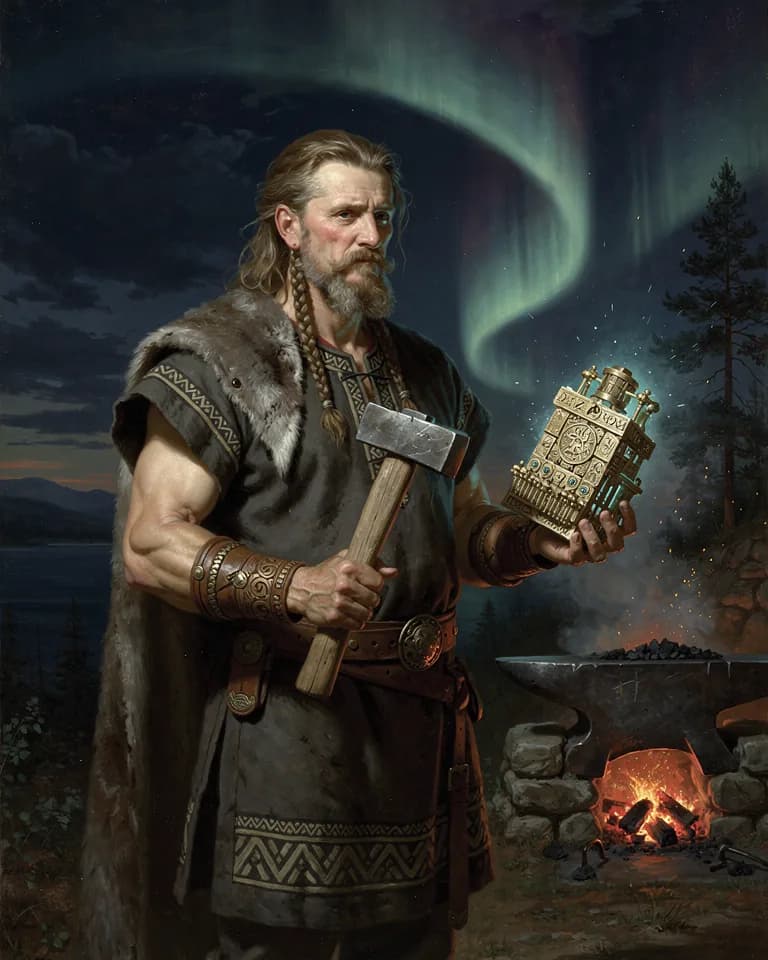
The eternal smith of Finnish tradition, who forged the vault of the sky and, in the Kalevala, the Sampo for Louhi of Pohjola; named by Agricola in 1551 as the maker of calm and storm who carried travelers on their way.
About Ilmarinen
A weather god become smith
Agricola's list of 1551 says Ilmarinen 'made peace and weather and carried travelers forward', a role as a god of the air and winds that matches his name, from ilma, 'air, weather'. In the runo-songs he is above all the smith (seppo), the one 'who forged the sky, who hammered out the lid of the air', so skilled that no trace of hammer or tongs can be seen on his work.
In the Kalevala
Väinämöinen tricks him into going to Pohjola, where he forges the Sampo, after failed attempts that produce a crossbow, a boat, a cow, and a plough, each of which he throws back into the fire. Louhi does not give him her daughter until later, after he has ploughed a field of serpents, bridled the bear of Tuoni and the wolf of Manala, and caught the great pike of Tuonela. His wife is killed through Kullervo's revenge; grief-stricken, he forges a bride of gold and silver who stays cold in his bed, and Väinämöinen warns the young men against making such idols. He joins the raid on the Sampo and later forges a false sun and moon when Louhi hides the real ones.
Craft and power
The smith's knowledge in Finnish tradition is also magical: the charm of the origin of iron, sung in Rune 9, tells how iron was born and how the smith first tempered it, knowledge that gives power to heal wounds made by iron.
Origin story
In folk poetry, and in the Kalevala's charm of the origin of iron, he is born on a hill of charcoal with a copper hammer in his hand.
Across traditions
Parallel figures
Figures who play a role like Ilmarinen's in other traditions.
 GreekHephaestus
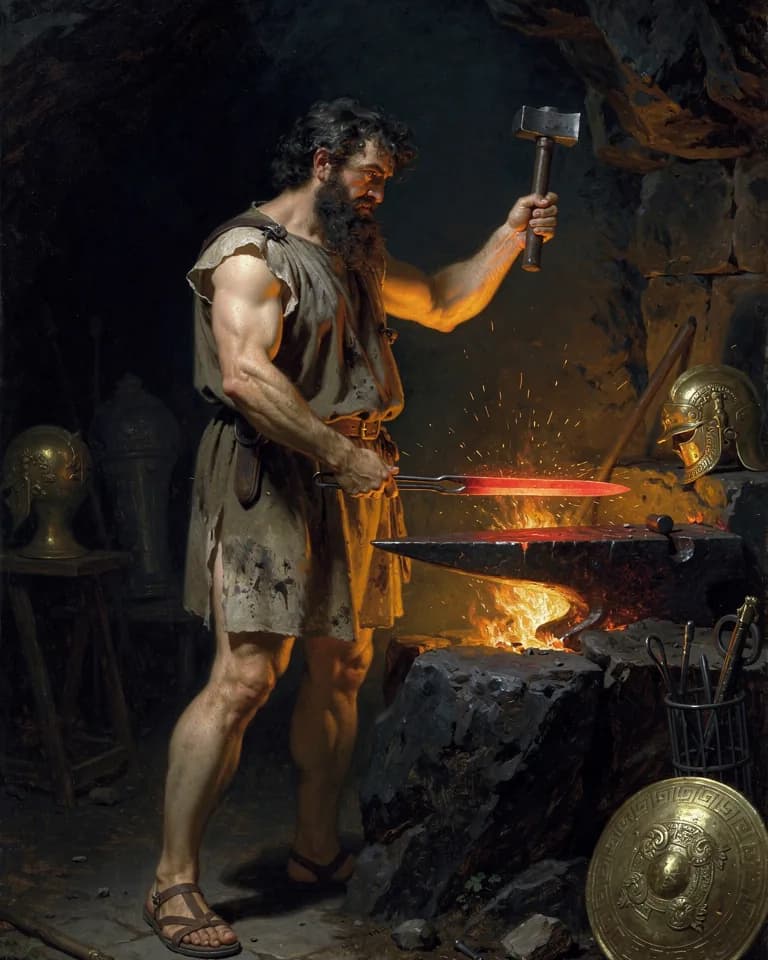
Both are divine master smiths who forge marvels for others, including a manufactured woman (Hephaestus's Pandora, Ilmarinen's golden bride) that brings no good.
Compare Ilmarinen and Hephaestus side by side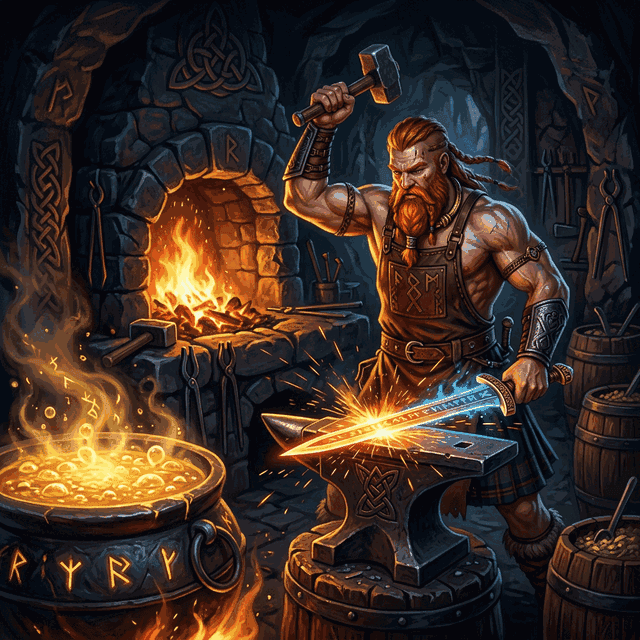 CelticGoibniu
Both are smiths of the gods whose craft carries supernatural power.
Compare Ilmarinen and Goibniu side by side
Worship and cult
Temples, festivals, and practices recorded for Ilmarinen
Invoked in smiths' charms, especially the 'origin of iron'; Agricola records him as a weather god who helped travelers.
In the atlas
Where Ilmarinen appears
Sources and further reading
Source notes
These references are recorded in the catalog. Their passage wording and translation have not been checked, so quotations are not displayed here.
- Kalevala (trans. John Martin Crawford, 1888), Rune XV
- Kalevala (trans. John Martin Crawford, 1888), Rune X
- Mikael Agricola, preface to Dauidin Psaltari (paraphrase)
Appears in
Ancient and classical works featuring this figure.
the smith who forges the Sampo (Runes 7-10, 18-25, 37-49)
About this entry
By Elizabeth Stein for Mythos Atlas. About the author. Editorial notes are grounded in the site's cited sources and can be challenged through the contact page.
Parallels are editorial comparisons across traditions: a shared role does not, by itself, establish a shared origin.
Genealogy
Family tree
Ilmarinen's parents, consorts, children and rivals, as recorded in the atlas.