Finnish Tradition (Kalevala)
Louhi
Louhi
Also known as Pohjan akka, Pohjolan emäntä (Mistress of Pohjola), Louhiatar
- the North (Pohjola)
- sorcery
- the Sampo
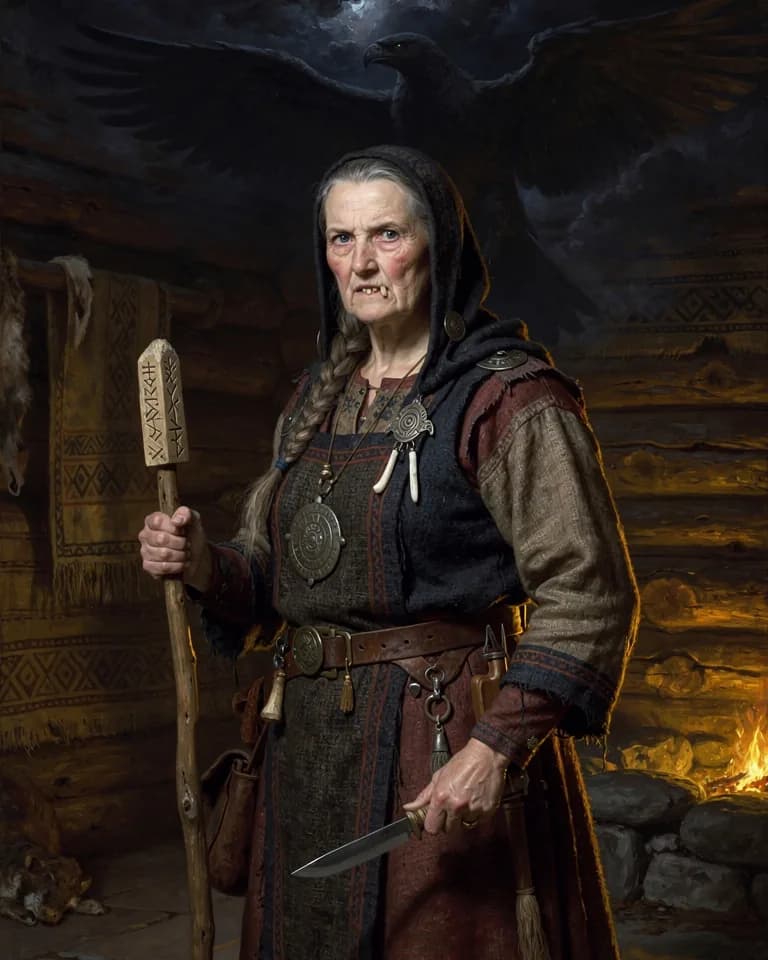
The powerful, gap-toothed mistress of Pohjola, the dark North, who demands the forging of the Sampo in exchange for her daughter, pursues the heroes as a giant eagle when they steal it, and hides the sun and moon in a mountain.
About Louhi
Mistress of the North
In Finnish folk poetry the Old Woman of the North, Pohjan akka, rules Pohjola, a cold, dark, hostile land somewhere to the north, and is a formidable sorceress; in charms the related Louhiatar or Loviatar is the mother of diseases. The Kalevala makes Louhi the chief antagonist of the Kalevala heroes, though an ambivalent one: she rescues the shipwrecked Väinämöinen and bargains fairly for her daughter's marriage.
The Sampo
Louhi promises her daughter to the man who can forge the Sampo, a wonder-mill that grinds grain, salt, and money. Ilmarinen succeeds, and she locks it in the rock-mountain of Pohjola behind nine locks, where it roots itself deep in the earth. When the heroes steal it, she sends fog, wind, and the sea-monster Iku-Turso after them, then transforms herself into a giant eagle carrying a hundred warriors under her wings. Väinämöinen smashes her talons with his rudder, and in the struggle the Sampo falls into the sea and breaks; Louhi carries home only its lid, which is why, the epic says, the North is poor.
Revenge
Louhi then sends plagues and a bear against Kalevala and steals the sun and moon, hiding them in a mountain until Ilmarinen's forging frightens her into releasing them. Her daughter becomes Ilmarinen's wife and is killed by Kullervo's wolves and bears.
Origin story
No origin is told; she is simply the mistress of Pohjola.
Worship and cult
Temples, festivals, and practices recorded for Louhi
Not worshipped; in folk charms the related figure of the Old Woman of the North, mother of diseases, is named in order to banish illness back to Pohjola.
In the atlas
Where Louhi appears
Sources and further reading
Source notes
These references are recorded in the catalog. Their passage wording and translation have not been checked, so quotations are not displayed here.
- Kalevala, Rune 10 (paraphrase)
- Kalevala, Rune 43 (paraphrase)
Appears in
Ancient and classical works featuring this figure.
the mistress of Pohjola, keeper of the Sampo (Runes 7-10, 42-49)
About this entry
By Elizabeth Stein for Mythos Atlas. About the author. Editorial notes are grounded in the site's cited sources and can be challenged through the contact page.
Parallels are editorial comparisons across traditions: a shared role does not, by itself, establish a shared origin.
Genealogy
Family tree
Louhi's parents, consorts, children and rivals, as recorded in the atlas.