Finnish Tradition (Kalevala)relic
Sampo
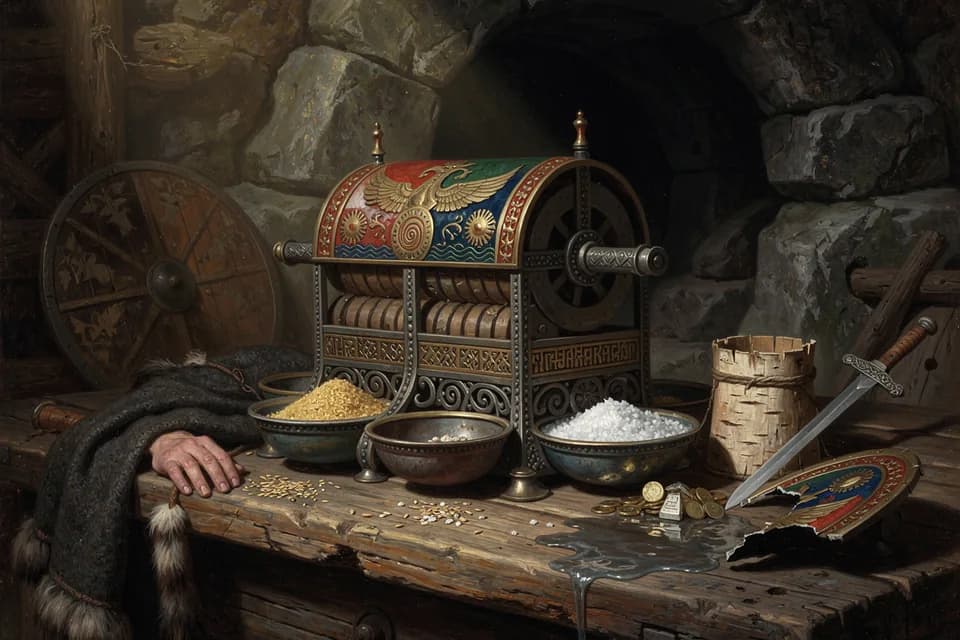
- Grinding grain, salt, and money without end
- Bringing prosperity to its land
- Enriching the sea and shore when shattered
The wonder-mill forged by Ilmarinen, with a many-colored lid, that grinds grain, salt, and money; locked in Pohjola's mountain, stolen by the Kalevala heroes, and shattered in the sea during Louhi's pursuit.
About Sampo
Forged in the North
In the Kalevala, Louhi of Pohjola promises her daughter to whoever can forge the Sampo, and Ilmarinen does so after destroying four lesser creations. It has a many-colored lid (kirjokansi) and grinds on three sides: flour, salt, and money. Louhi locks it in the rock-mountain of Pohjola, where it takes root, and her land prospers.
Stolen and shattered
When Väinämöinen, Ilmarinen, and Lemminkäinen steal it, Louhi pursues them as a giant eagle and drags it overboard. It breaks in the sea: the large pieces make the sea rich, smaller pieces washed ashore bring prosperity to Kalevala, and Louhi carries home only the lid.
A famous riddle
The folk songs never say clearly what the Sampo is, and scholars have proposed more than thirty interpretations: a mill, a treasure chest, a decorated shield, a talisman, a world pillar, the starry sky turning on its axis, and others. The Finnish folklorist Uno Harva connected it with the world pillar of northern Eurasian cosmology; others read it as a symbol of prosperity or of the heavens. No interpretation is certain, and Lönnrot's mill is his own resolution of the ambiguity.
Origin
Forged by Ilmarinen from a swan's feather tip, the milk of a barren cow, a grain of barley, and a summer lamb's wool (Kalevala, Rune 10).
Sources and further reading
Source notes
These references are recorded in the catalog. Their passage wording and translation have not been checked, so quotations are not displayed here.
- Kalevala (trans. John Martin Crawford, 1888), Rune X
About this entry
By Elizabeth Stein for Mythos Atlas. About the author. Editorial notes are grounded in the site's cited sources and can be challenged through the contact page.