Finnish Tradition (Kalevala)instrument
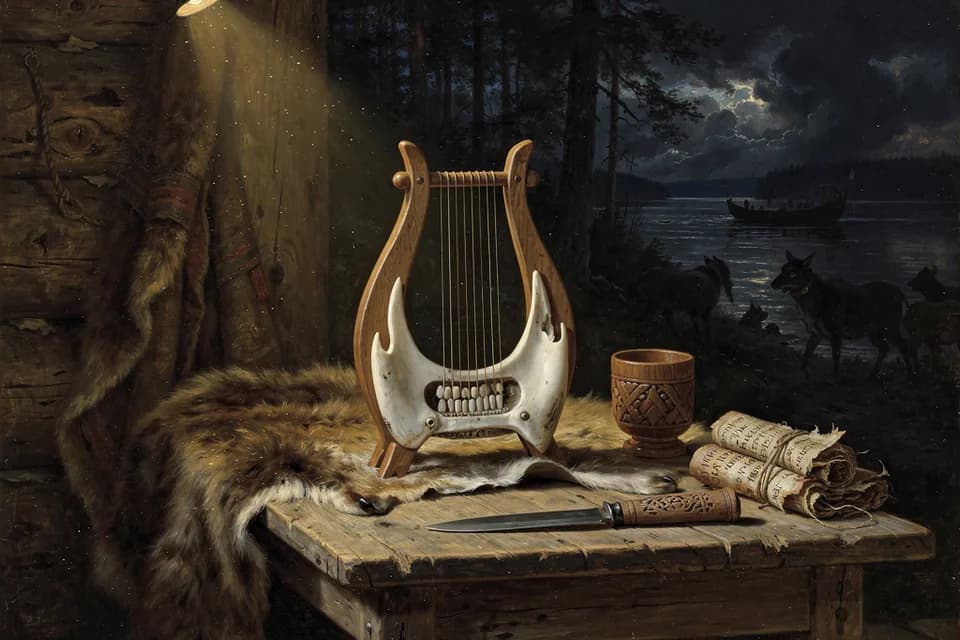
Kantele of Väinämöinen
- Enchanting all living things
- Bringing sleep
- Moving listeners to tears
The first kantele, made by Väinämöinen from the jawbone of a giant pike, whose music draws every creature to listen and puts Pohjola to sleep; lost overboard in Louhi's storm and replaced with one of birch.
About Kantele of Väinämöinen
The first kantele
In Rune 40, after the heroes kill the giant pike, Väinämöinen makes a kantele from its jawbone, using its teeth as pegs and hair from Hiisi's gelding as strings. Neither Ilmarinen nor Lemminkäinen nor anyone else can play it. In Rune 41 Väinämöinen sits on the rock of joy and plays, and all creatures of forest, air, and water, and the people too, come to listen, weeping; the old singer weeps too, and his tears roll into the sea and become pearls.
Lost and remade
In Rune 42 the music puts the people of Pohjola to sleep so the heroes can take the Sampo, but in Louhi's storm the kantele falls into the sea. In Rune 44 Väinämöinen makes a new one from a weeping birch, with pegs from an oak and strings from a maiden's hair. When he sails away at the end of the epic, he leaves the kantele and his songs to the Finnish people.
The instrument
The kantele, a plucked box-zither traditionally with five strings, is Finland's national instrument, and the Kalevala's account of its invention helped make it a symbol of Finnish identity in the nineteenth century.
Origin
Made by Väinämöinen from the jawbone and teeth of the pike killed in the rapids, with strings of hair from Hiisi's gelding (Kalevala, Rune 40).
Sources and further reading
Source notes
These references are recorded in the catalog. Their passage wording and translation have not been checked, so quotations are not displayed here.
- Kalevala (trans. John Martin Crawford, 1888), Rune XL
About this entry
By Elizabeth Stein for Mythos Atlas. About the author. Editorial notes are grounded in the site's cited sources and can be challenged through the contact page.