Finnish Tradition (Kalevala)epic
The Theft of the Sampo
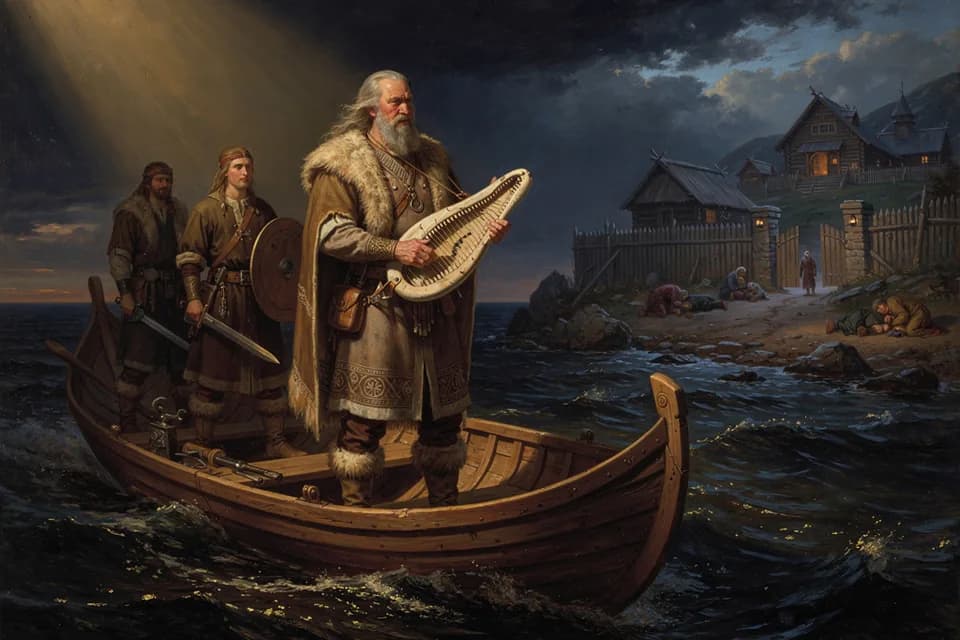
Väinämöinen, Ilmarinen, and Lemminkäinen sail north to take the Sampo; on the way Väinämöinen makes the first kantele from a giant pike's jawbone, and with its music puts Pohjola to sleep; Louhi pursues them as a giant eagle, and in the battle the Sampo shatters in the sea.
An editorial retelling
The story
The pike
When Pohjola grows rich from the Sampo, Väinämöinen proposes to take it, and Ilmarinen forges him a sword; Lemminkäinen joins them. As their ship passes through rapids, it runs onto the shoulders of an enormous pike and sticks fast. Väinämöinen kills the fish with his sword and they eat it. From its jawbone, with pegs from its teeth and strings of hair from Hiisi's gelding, he makes the first kantele. No one else can play it.
The music
Väinämöinen sits on the rock of joy and plays. Every living thing comes to listen: the animals of the forest, the birds, the fish of the waters, the people, and the powers of forest and water, Ahto, king of the waves, among them. The music is so beautiful that everyone who hears it weeps, and Väinämöinen weeps too; his tears roll down into the sea and become pearls.
Into Pohjola
At Pohjola Väinämöinen offers to share the Sampo; Louhi refuses. So he plays the kantele until all of Pohjola falls asleep. The heroes go to the rock-mountain; Ilmarinen greases the hinges of the nine locks with butter so they open without a sound, and an ox ploughs up the Sampo's roots. They carry it to the ship and sail away. Lemminkäinen, exultant, wants to sing; Väinämöinen forbids it, but he sings anyway, and a crane, startled by his harsh voice, flies screaming over Pohjola and wakes Louhi.
Louhi's pursuit
Louhi sends fog, which Väinämöinen cuts with his sword, and then the sea-monster Iku-Turso. In Crawford's translation: 'Wainamoinen, brave and mighty, / Seizes quick the water-monster, / Lifts him by his ears and questions: / "Iku-Turso, son of Old-age, / Why art rising from the blue-sea?"' Iku-Turso promises never to rise before men again and is thrown back. Then Louhi sends a storm, and the kantele falls overboard and is lost.
The eagle
Last Louhi turns herself into a giant eagle, with a hundred men under her wings and a thousand on her tail, and flies after the ship. Väinämöinen strikes her talons with his rudder; her claws break, and her men fall into the sea, but with her little finger she seizes the Sampo and drags it overboard. It falls into the sea and breaks. The large pieces sink to the bottom, and so the sea is rich; smaller pieces drift ashore at Kalevala, bringing good fortune to the land; Louhi carries home only the many-colored lid, and so the North is poor.
Afterward
Väinämöinen gathers the fragments and plants them. Later, missing his lost kantele, he makes a new one of birch. Louhi, in revenge, sends plagues and a bear against Kalevala and hides the sun and moon in a mountain, and the struggle continues through the final runes.
Listen or change reading mode
Highlights
The heroes' ship sticks on a giant pike, from whose jaw Väinämöinen makes the first kantele; his playing lulls Pohjola to sleep; a crane wakes Louhi; Iku-Turso is lifted from the sea by the ears; Louhi as a giant eagle seizes the Sampo, which breaks in the sea, leaving riches to the sea and the Kalevala shore and only the lid to the North.
Why it matters
The climax of the Kalevala, explaining the sea's wealth and Finland's prosperity through the shattered Sampo; the scene of Väinämöinen defending the Sampo against the eagle was painted by Akseli Gallen-Kallela (1896).
Sources and further reading
By Elizabeth Stein for Mythos Atlas. About the author. Editorial notes are grounded in the site's cited sources and can be challenged through the contact page.
Works cited
Kalevala, Runes 39-43
Elias Lönnrot; trans. John Martin Crawford