Finnish Tradition (Kalevala)tragedy
Kullervo
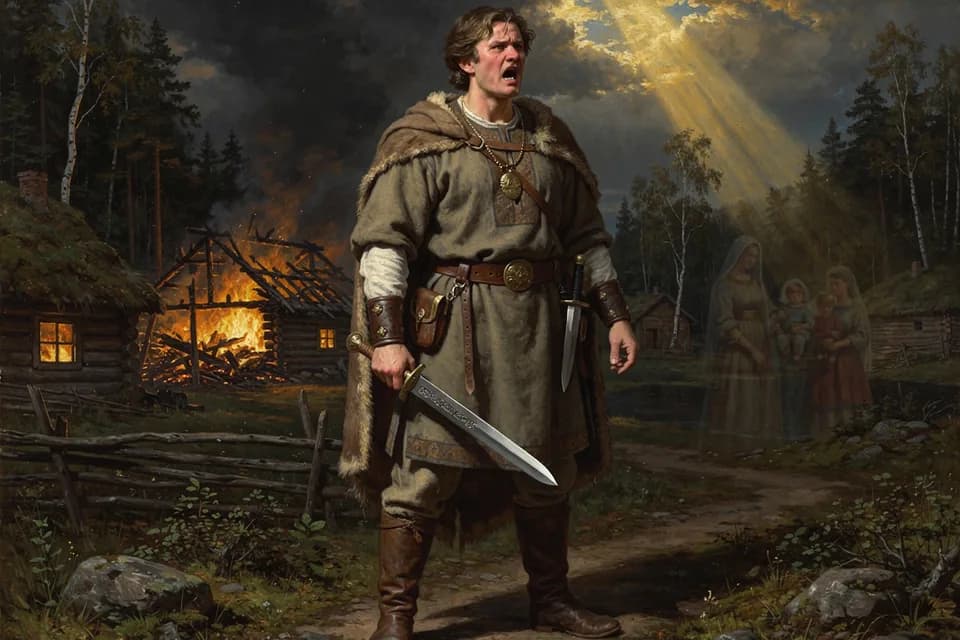
Born into slavery after his family is massacred, Kullervo is mistreated from childhood; he takes revenge on Ilmarinen's wife, unknowingly seduces his own sister, destroys the clan that wronged his family, and dies on his own sword at the place of his sin.
An editorial retelling
The story
Born to vengeance
Two brothers, Kalervo and Untamo, quarrel, and Untamo's men slaughter Kalervo's household, leaving only a pregnant woman, who is carried off as a slave. Her son, Kullervo, is born in Untamo's house, and in the cradle already vows revenge. Untamo tries to kill the child three times, by drowning, by burning, and by hanging, and each time the boy survives, sitting on the water, playing in the ashes, or carving pictures on the gallows tree. Every task given him he ruins: set to rock a baby, he kills it; to clear a forest, he sings it into a wasteland; to build a fence, he makes it reach the sky with no gate. Untamo sells him as a slave to the smith Ilmarinen.
The stone in the bread
Ilmarinen's wife, the Maiden of Pohjola, sends Kullervo out to herd the cattle and, out of spite, bakes a stone into his bread. When he cuts the loaf, his knife, the only thing he has from his father, breaks on the stone. In his rage he drives the cattle into a swamp to be eaten by wolves and bears, and drives wolves and bears home in their place. When the mistress goes out to milk them, they tear her apart.
His family, and his sister
Fleeing, Kullervo learns that his father, mother, brother, and sister are alive in a distant place, and goes to them. His mother tells him that his sister was lost long ago, gone berry-picking in the forest. Sent to pay the family's taxes, he meets a young woman on the road and, by force and bribes, takes her into his sledge. Afterward they learn from each other's stories that she is his lost sister. In horror she throws herself into a rapids and drowns.
Revenge and death
Kullervo goes to war against Untamo, although his family, one by one, tell him they will not weep if he dies. Only his mother says she will. With his sword he destroys Untamo's clan and burns their homes. Returning, he finds his family dead and the house empty; only the old black dog is left. He walks with the dog to the forest glade where he had wronged his sister. There he asks his sword whether it will drink guilty blood; the sword answers that it has drunk innocent blood and will not refuse his. He sets the hilt in the ground and falls upon the point.
Why Kullervo endures
Väinämöinen, hearing of his death, warns that children must not be raised in foolishness under a stranger's hand. The cycle, assembled by Lönnrot from songs of an orphaned slave-boy's revenge and of incest between brother and sister, is the darkest part of the Kalevala. It inspired Sibelius's choral symphony Kullervo (1892) and J. R. R. Tolkien's unfinished The Story of Kullervo, a forerunner of his tale of Túrin Turambar.
Listen or change reading mode
Highlights
Untamo destroys Kalervo's house and enslaves the pregnant survivor; her son Kullervo survives three attempts on his life, is sold to Ilmarinen, and avenges the stone in his bread with wolves and bears; he unknowingly seduces his sister, destroys Untamo's clan, and dies on his sword.
Why it matters
The Kalevala's great tragedy, the basis of Sibelius's Kullervo (1892) and a major influence on J. R. R. Tolkien, who retold it and drew on it for the story of Túrin.
Sources and further reading
By Elizabeth Stein for Mythos Atlas. About the author. Editorial notes are grounded in the site's cited sources and can be challenged through the contact page.
Works cited
Kalevala, Runes 31-36
Elias Lönnrot; trans. John Martin Crawford