Finnish Tradition (Kalevala)Creature
Iku-Turso
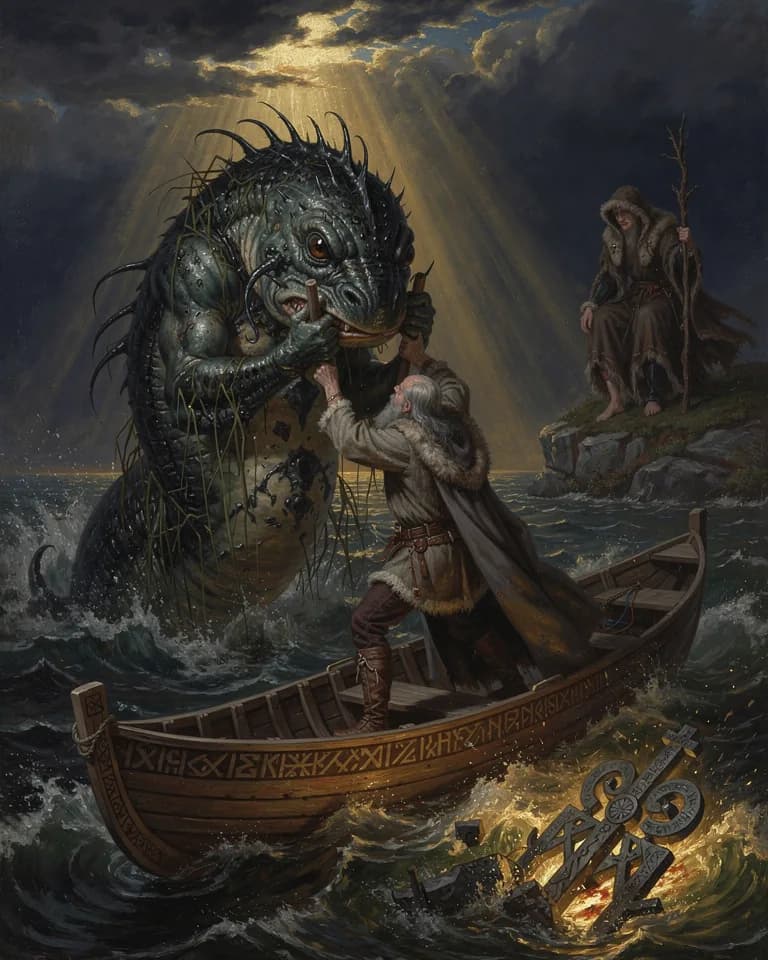
- rising from the deep to overturn ships
- commanded by sorcery
The sea-monster of Finnish tradition whom Louhi raises from the depths to stop the heroes carrying off the Sampo; Väinämöinen lifts him out of the water by the ears and makes him swear never to rise before men again.
About Iku-Turso
In the Kalevala
In Rune 42, when Väinämöinen, Ilmarinen, and Lemminkäinen are fleeing Pohjola with the Sampo, Louhi calls up Iku-Turso, 'son of Old-age', from the sea to seize the heroes and drown them. He rises beside the ship, but Väinämöinen grabs him by the ears, lifts him out of the water, and demands to know why he has come. Iku-Turso admits he was sent to capture them, and promises never again to rise before the eyes of men; Väinämöinen throws him back.
In folk tradition
In folk poetry and charms Iku-Turso (or Turso) is a monstrous being of the sea, sometimes connected with the origin of diseases and with the great oak of creation songs. The name is linked by many scholars with Turisas, whom Agricola lists in 1551 as a god who gave victory in war, though whether the two are the same figure is uncertain. Descriptions of Turso's form vary; he is often imagined with many arms, like a giant squid or octopus, but this image is largely modern.
Legacy
Iku-Turso has become a familiar figure in Finnish popular culture, and a Finnish Navy submarine of the 1930s was named after him.
Sources and further reading
Source notes
These references are recorded in the catalog. Their passage wording and translation have not been checked, so quotations are not displayed here.
- Kalevala (trans. John Martin Crawford, 1888), Rune XLII
About this entry
By Elizabeth Stein for Mythos Atlas. About the author. Editorial notes are grounded in the site's cited sources and can be challenged through the contact page.
The danger rating is an editorial shorthand for how the myths portray the creature, not a claim made by the sources.